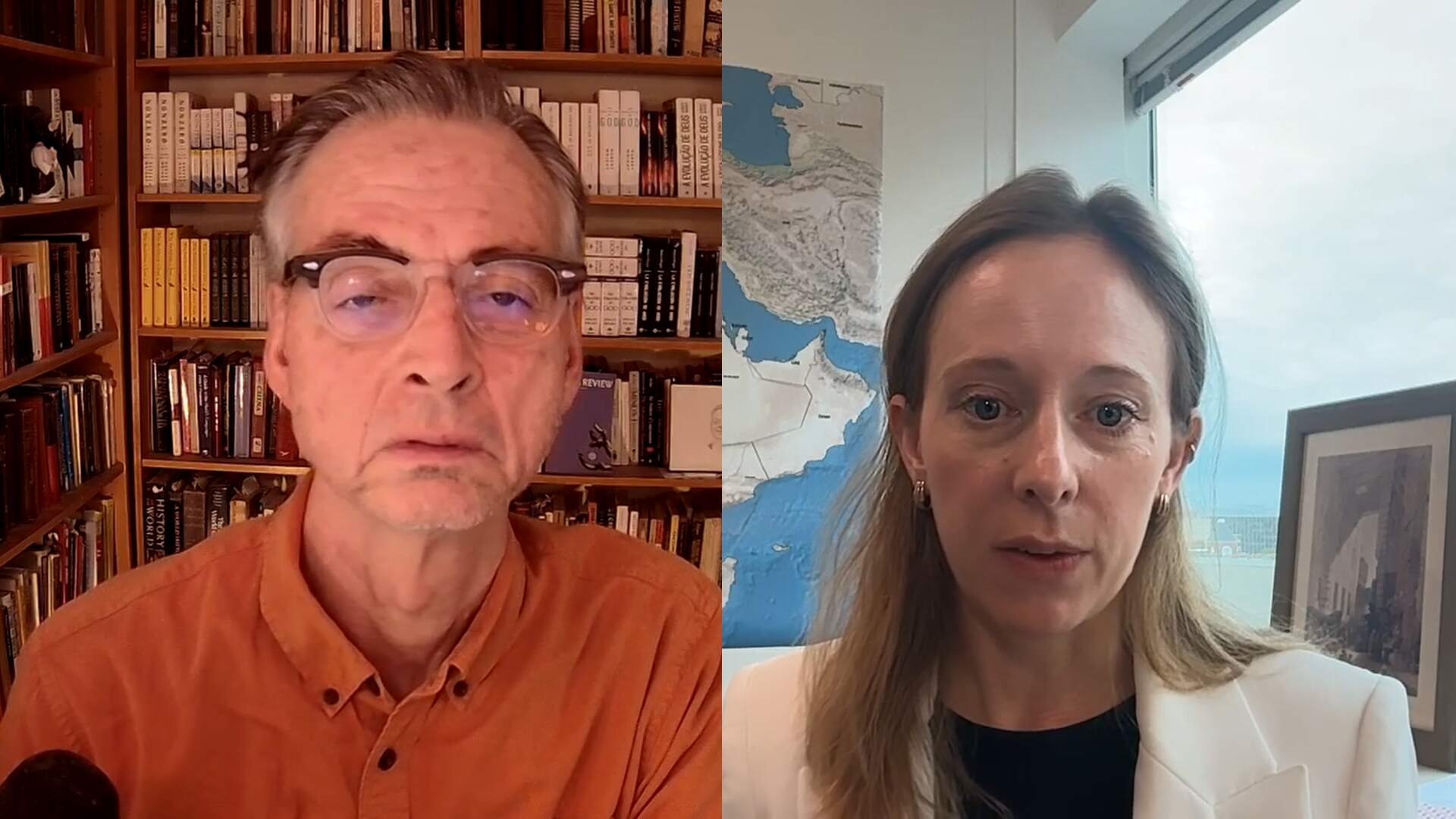
Worldwise: The Asian Century
Recorded: September 2  Posted: September 7

kidneystones wrote on 09/07/2009 at 10:58 AM
Japan Just Elected a Pro-China Party
I've cleaned up this comment. Here's Ali Wyne's bio. Parag Khanna is a working on his Ph.D.
Parag and Ali are scholars in the making and I wish them well; and even hope to see them back, maybe in about ten years. The observations that the 'future is up for grabs' and that 'state' and 'non-state' actors will be involved can't possibly be considered as insights, can they? 'States will compete and co-operate on different issues'. This is news?
Thanks to both for coming on and best of luck in all their future endeavors.
harkin wrote on 09/07/2009 at 06:09 PM
Re: Worldwise: The Asian Century (Parag Khanna & Ali Wyne)
How about this insight, from Khanna's Visions Of Europe In 2030:
"Islam will remain a fractured faith, widely practiced, but also subdued by the impetus of economic development. Just as Europe bought off communism, it will purchase the reform of Islamism toward constructive, prosperous social democracy."
Would love to hear a BhTV discussion between Khanna and Douglas Murray.
Michael wrote on 09/07/2009 at 10:25 PM
Re: Worldwise: The Asian Century (Parag Khanna & Ali Wyne)
Interesting diavlog. I just wonder how much Chinese power elites will identify with Chinese hegemony as they internationalize. It seems to me they would benefit more by submerging themselves into the multinationals. After all, corruption as a function of limited access to power will only get worse if China does not liberalize its political system. I wish this had discussed in depth, because I suspect it will be pivotal. Either way, we may be headed for, not an Asian Century, but a very subtle Zen Century.
consider wrote on 09/08/2009 at 08:40 AM
Re: Worldwise: The Asian Century (Parag Khanna & Ali Wyne)
This dialogue was mostly bad. Neither one knows the first thing about economics, but both prattled on, pretending that they do.
One of several examples: A. Whyn says Russia's economics is no longer considered impressive, yet in 2008 it grew 6% in a world wide recession, for the 10th year in a row.
This is what is so bad about political science experts discussing economics. They don't have the basics down and think smooth talk makes up for it. But it doesn't.
Lyle wrote on 09/08/2009 at 11:52 AM
Re: Worldwise: The Asian Century (Parag Khanna & Ali Wyne)
Actually I think they know a little economics. Enough to understand that Russia is not growing as fast as China and other Asian countries. Developing countries like Russia also grow despite a world wide economic downturn, because their economy lags far behind the developed world. Their annual growth is just an economic phenomena, and not a sign that their economy is robust or strong, or as robust or strong as some Asian country.
Lyle wrote on 09/08/2009 at 11:58 AM
I Agree With Your Conclusion
I liked this diavlog. The conversation flowed well between the two of you. I also agree with you that the idea of an Asian Century is a bit of hyperbole and that America's decline is nowhere on the horizon.
China has a century of social change it will have to go through, like becoming democratic, properly looking at itself in the mirror (the general populace still think Mao was a great guy), building a proper criminal justice system, so on and so forth. Domestic problems in China are immense and will keep it from taking the lead in Asia for some time, I think.
Namazu wrote on 09/08/2009 at 07:52 PM
Re: Worldwise: The Asian Century (Parag Khanna & Ali Wyne)
Something to consider before the think tanks talk us into wasting as much money worrying about China as we did about the Soviet Union:
bjkeefe wrote on 09/08/2009 at 08:05 PM
Re: Worldwise: The Asian Century (Parag Khanna & Ali Wyne)
Quoting harkin: Would love to hear a BhTV discussion between Khanna and Douglas Murray. Haven't listened to this one yet, but thanks for that link.
Lyle wrote on 09/08/2009 at 09:49 PM
Re: Worldwise: The Asian Century (Parag Khanna & Ali Wyne)
Is this supposed to detail where the part of China that is inhabitable (as in fully inhabitable, unlike Xinjiang, Tibet, and elsewhere out West)? Or is this a climate change deal? Curious.
Namazu wrote on 09/09/2009 at 10:42 AM
Re: Worldwise: The Asian Century (Parag Khanna & Ali Wyne)
Quoting Lyle: Is this supposed to detail where the part of China that is inhabitable (as in fully inhabitable, unlike Xinjiang, Tibet, and elsewhere out West)? Or is this a climate change deal? Curious. http://web.stratfor.com/images/GEOPO...a%20080615.pdf
Lyle wrote on 09/09/2009 at 11:40 AM
Re: Worldwise: The Asian Century (Parag Khanna & Ali Wyne)
Ah, that's what I thought. People forget that China has the big time challenge of having the bulk of its 1 billion people only able to live on 1/5 of the land.
Often not brought up is the fact that they can no longer feed their populace by themselves anymore, and they most import grain and foodstuffs from the United States and elsewhere.
bjkeefe wrote on 09/09/2009 at 12:39 PM
Re: Worldwise: The Asian Century (Parag Khanna & Ali Wyne)
Quoting Lyle: Often not brought up is the fact that they can no longer feed their populace by themselves anymore, and they most import grain and foostuffs from the United States and elsewhere. Can you document that claim? I'm not seeing anything that supports it with my own Googling. (It's kind of a pain, because the search results are swamped with stories like "Chinese imports to the US." (Does no one know what "export" means anymore?))
FWIW, one article I did come across, on the World Bank's site, dated April 2008, says this:
China is largely self-sufficient in food, which accounts for just above 1 per cent of imports.
Lyle wrote on 09/09/2009 at 02:44 PM
Re: Worldwise: The Asian Century (Parag Khanna & Ali Wyne)
No longer true from what I've read. Will find you some reports shortly if I can. From my understanding agriculture land in the 1/5 of China that can grow wheat and rice is as productive as it will ever get with peasant labor. Farmers in Europe and the US use gps and other tech intensive ways to maximize crop yields. The millions of Chinese farms can't afford to farm their small plots this way, and so can't get any more out of the land. Demand for food is going up and will likely continue to go up. So to meet the growth in demand, the grains and food will have to come from somewhere other than China.
I found a decent article online. Can't link it from the computer I'm on. Will link later. It looks like I got my idea from an argument made and passed on in the mid 90s that has been proved incorrect so far. Although China is importing some food from abroad and looks to be importing more in the future as its consumer choices change and demand increases.
Here's the article... which tries to
look wrote on 09/10/2009 at 02:13 PM
Re: Worldwise: The Asian Century (Parag Khanna & Ali Wyne)
Quoting Namazu: http://web.stratfor.com/images/GEOPO...a%20080615.pdf What an insightful article. I have a vision of SecState Clinton giving a lesson in geopolitics in front of a large map, smartly smacking Tibet with a pointer.

|