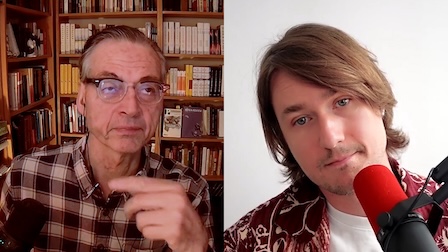
Snork Edition
Recorded: December 23  Posted: December 28
graz wrote on 12/28/2009 at 02:52 PM
Re: Snork Edition (Will Wilkinson & James Poulos)
Charmed, I'm sure.
James... that sounds awfully close to Koran. And it ought to be avoided in these threatened times.
By the way, had you been a baseball fan, you would have heard the word pronounced as |ˈkarəm| nearly every single game since the beginning of baseball time. But baseball is boring too.
Wait... It's the snork edition... not snark?... Nevermind. Happy New Year and such.
Simon Willard wrote on 12/28/2009 at 03:13 PM
Snork in 3D
I can't improve on the social/political analysis of Avatar given by these guys. It's pretty shallow stuff if you are looking for real meaning. But it's wrong to say that Cameron "missed a chance" to say something profound; he is very intentionally targeting the moral sense of 16-year-old girls (who went to see Titanic repeatedly) along with a boy's desire for action (boys of all ages). He needs large audiences to make the money to pay for this high-tech tour de force.
I didn't think I would like the blue cat people, but it was more enjoyable than I predicted.
The one great insight I came away with had to do with the future of 3D.
Avatar does 3D right. Not as a gimmick, but as a tool to present the action. The movie has lots of 3D content, in the form of complicated motion of the actors, props, and camera movement. There's a large part of the human brain devoted to decoding stereo vision and constructing 3D mental models (though more acutely in men than women). This apparatus goes completely unused in traditional movies. A well-done 3D movie like Avatar can put this apparatus to work to clarify
claymisher wrote on 12/28/2009 at 03:58 PM
Re: Snork in 3D
Quoting Simon Willard: I can't improve on the social/political analysis of Avatar given by these guys. It's pretty shallow stuff if you are looking for real meaning. But it's wrong to say that Cameron "missed a chance" to say something profound; he is very intentionally targeting the moral sense of 16-year-old girls (who went to see Titanic repeatedly) along with a boy's desire for action (boys of all ages). He needs large audiences to make the money to pay for this high-tech tour de force.
I didn't think I would like the blue cat people, but it was more enjoyable than I predicted.
The one great insight I came away with had to do with the future of 3D.
Avatar does 3D right. Not as a gimmick, but as a tool to present the action. The movie has lots of 3D content, in the form of complicated motion of the actors, props, and camera movement. There's a large part of the human brain devoted to decoding stereo vision and constructing 3D mental models (though more acutely in men than women). This apparatus goes completely unused in traditional movies. A well-done 3D movie like Avatar can put this apparatus to work to clarify
bjkeefe wrote on 12/28/2009 at 04:18 PM
Re: Snork Edition (Will Wilkinson & James Poulos)
As far as Will and James's discussion of health care legislation goes ... I found their review of a movie they didn't see and comments on a golfer they don't know quite helpful.
Simon Willard wrote on 12/28/2009 at 04:48 PM
Re: Snork Edition (Will Wilkinson & James Poulos)
Quoting bjkeefe: As far as Will and James's discussion of health care legislation goes ... I found their review of a movie they didn't see and comments on a golfer they don't know quite helpful. You forgot to mention health care legislation they haven't read.
Simon Willard wrote on 12/28/2009 at 04:57 PM
Re: Snork in 3D
[Each] layer looks flat, stacked in front of or behind some other layer. So, people for example look like cardboard cutouts rather than rounded figures. I did not see layers. I had a good 3D sensation with rounded figures.
What's worse, if the camera's depth of field holds something out of focus in the foreground or background, you can't do anything about it. If you look at something that's closer or farther away, your eyes have a natural tendency to bring it into focus. 3D camerawork frustrates that instinct. Regular old 2D imagery, on the other hand, does not trick your eyes into trying to focus on something they can't, because both eyes are always looking at the same plane. All around, fewer headaches. This is a good point. The film-maker has to try to keep everything in focus simultaneously so you get a clear image of whatever you look at. You can do that with computer graphics. But if your mind is telling your eyes to refocus at a new distance, this could cause confusion. The parallax correction works but the usual change of focal length of the eyes' lenses is not needed, leading -- perhaps -- to a headache. It didn't bother
bjkeefe wrote on 12/28/2009 at 05:14 PM
Re: Snork Edition (Will Wilkinson & James Poulos)
Quoting Simon Willard: You forgot to mention health care legislation they haven't read. Nice.
Jyminee wrote on 12/28/2009 at 05:56 PM
Is there a right to health care?
Yes. Despite James's philosophical blather, we already (partially) acknowledge a fundamental right to health care.
If a pedestrian keels over in the street with a heart attack, he will be treated regardless of his ability to pay. In an emergency, treatment comes first, payment later. If he doesn't have health insurance and can't pay, the cost is transferred to everyone else via higher prices for their medical services.
Look at what happened to the terrorist who tried to blow up the flight in Detroit--he was given medical treatment for his self-inflicted burns. American health care will treat, for free (I'm assuming he doesn't have Aetna), a foreigner who tried to murder hundreds of civilians! And the health consumers of Michigan will foot the bill.
Why do we treat an acute emergency like a heart attack or a car accident different from a chronic disease like cancer? I see no real difference between the two types of ailments. Once you accept that someone dying in the street deserves medical treatment, irrespective of whether he can pay for it, the fundamental right is established.
Wonderment wrote on 12/28/2009 at 08:44 PM
Re: Is there a right to health care?
Why do we treat an acute emergency like a heart attack or a car accident different from a chronic disease like cancer? I see no real difference between the two types of ailments. Once you accept that someone dying in the street deserves medical treatment, irrespective of whether he can pay for it, the fundamental right is established. Agreed. I would add, however, that we've already taken it farther. No one argues that a cancer patient should receive no treatment because she is poor or that a child should have no relief for a headache because he can't pay for the aspirin.
In other words, we have already extended the fundamental right to healthcare far beyond emergencies and chronic disease. We all agree that the indigent (including prisoners, foreigners, etc.) have a right to healthcare.
The problem is that we also hold the view that health care is a commodity that can be bought and sold.
So the question is not whether it's a right; that's settled. The only question is who pays for healthcare and how dearly.
cognitive madisonian wrote on 12/28/2009 at 09:54 PM
Re: Is there a right to health care?
A few things to consider:
First, it is simply impossible to verify health insurance before giving treatment to someone having a heart attack, stroke, etc. where literally every second counts. It is not an admission of some intrinsic right to health care, it is rather an admission of the impossibility of verification of insurance in emergency circumstances.
Second, since the vast majority of Americans have health care insurance, it's a pretty safe bet that the person you're treating will be able to pay for it.
I do not see any basis for the belief in a 'right' to health care. All of the rights laid out in the Bill of Rights are based on what you, as an individual can do--you can speak, you can assemble with others, you can practice your religion, etc. None of them are based on access to institutions, industries, etc.
Rather, believing in a 'right' to health care as an assertion that you have the right to another human's labor. It's philosophically little different than Feudalism and is a fundamental sea change in the way that we look at labor--in place of the market place, we instead wish to interpret labor as
T.G.G.P wrote on 12/28/2009 at 10:14 PM
Re: Snork Edition (Will Wilkinson & James Poulos)
Rousseau didn't believe in the noble savage.
I haven't seen Avatar, nor do I plan to. But I'd question Poulos' critique of its lack of hotness. I should preface this by saying I'm a prude, so perhaps more of a pre-modern than post-modern conservative like him. The old horror film Possession had demonic interspecies sex. It was not hot, it was strange and repulsive. It was supposed to be, because we are to identify with the creeped out estranged husband played by Sam Neill. The director supposedly thought of the movie based on his own divorce. Shifting from somewhat highbrow (it's at least foreign!) to lowbrow internet culture, have any of you seen that GIF of the two dogs where one vomits and then begins eating his own vomit while the other runs off? Now to us, that's certainly alien behavior but to that other species I presume somewhat normal. And they're from the same planet and highly adapted to be pleasing to human beings! There's no reason for the mating of one species to be appealing to a completely different species. The very genitalia of ducks (news to Radley Balko's readers, but not mine) is evidence
Wonderment wrote on 12/29/2009 at 12:52 AM
Re: Snork Edition (Will Wilkinson & James Poulos)
I haven't seen Avatar, nor do I plan to. But I'd question Poulos' critique of its lack of hotness. "Avatar" is a PG-13 movie, which of course means any number of people can be blown up, mutilated and sadistically tortured; but the lovemaking has to be understated, tame and without orgasm or genitalia.
JonIrenicus wrote on 12/29/2009 at 01:14 AM
I second the horrible California weather
Living in Los Angeles is hard.
Month after endless month of clear skies and golden sunshine. Sickening. I wish we got to have multi week long blanketing of rain and cloudy skies like so many of you get to experience.
Jyminee wrote on 12/29/2009 at 02:51 AM
Re: Is there a right to health care?
Quoting cognitive madisonian: First, it is simply impossible to verify health insurance before giving treatment to someone having a heart attack, stroke, etc. where literally every second counts. It is not an admission of some intrinsic right to health care, it is rather an admission of the impossibility of verification of insurance in emergency circumstances. But you just proved my point. We value saving a person's life more than making sure that he can pay for the life-saving treatment. If you're brought to a hospital after getting hit by a bus, and you can't pay, "you have the right to another human's labor" [your words].
I do not see any basis for the belief in a 'right' to health care. All of the rights laid out in the Bill of Rights are based on what you, as an individual can do--you can speak, you can assemble with others, you can practice your religion, etc. None of them are based on access to institutions, industries, etc. Not true. The right to a trial compel judges, attorneys, juries, etc., to act on your behalf.
If one is not able to market one's labor when the government determines it is a right, then the home builder, the plumber, the electrician, etc. had
benjy wrote on 12/29/2009 at 11:28 AM
Re: Snork Edition (Will Wilkinson & James Poulos)
The constitution doesn't guarantee a right too food yet we have food stamps. Why? Because we decide that we're willing to use some resources taken from people who have more of them to help people who have less of them eat. I like this system and I vote for it even though I don't use them, because I think its right and I don't want people to die because they can't afford food. Ditto for public schools--I'd like the gov't, i.e. us and our collective resources, to better fund poor ones so people who have less money get an equal education. And I don't feel my rights are threatened by this--collective responsibilities are one side of the equation, freedom is another. If we paid no taxes, we'd have no roads, police, etc., etc. Its all just a question of where we draw the line, and there doesn't seem to be any good reason that dying due to inability to afford medical care is fundamentally different from dying due to inability to afford food. So if you argue against the government helping people afford health care, be honest and argue against it providing food stamps and
Unit wrote on 12/29/2009 at 11:49 AM
Re: Snork Edition (Will Wilkinson & James Poulos)
Quoting benjy: The constitution doesn't guarantee a right too food yet we have food stamps. Why? Because we decide that we're willing to use some resources taken from people who have more of them to help people who have less of them eat. I like this system and I vote for it even though I don't use them, because I think its right and I don't want people to die because they can't afford food. Ditto for public schools--I'd like the gov't, i.e. us and our collective resources, to better fund poor ones so people who have less money get an equal education. And I don't feel my rights are threatened by this--collective responsibilities are one side of the equation, freedom is another. If we paid no taxes, we'd have no roads, police, etc., etc. Its all just a question of where we draw the line, and there doesn't seem to be any good reason that dying due to inability to afford medical care is fundamentally different from dying due to inability to afford food. So if you argue against the government helping people afford health care, be honest and argue against it providing food stamps and
benjy wrote on 12/29/2009 at 12:19 PM
Re: Snork Edition (Will Wilkinson & James Poulos)
OK, so we're on the same page about the goals to pursue, but differ on whether there's only one way to enhance welfare... Of course innovation and productivity gains are tremendously important--no serious person argues against that. But even with them some people don't have the skills or for other reasons can't find work, i.e. gain enough resources to support themselves. Do you care, and if so what would your approach be? And of course I mentioned its all about where we draw the line, did you skip that part. No forced organ transfers in my platform.
Unit wrote on 12/29/2009 at 12:35 PM
Re: Snork Edition (Will Wilkinson & James Poulos)
Quoting benjy: OK, so we're on the same page about the goals to pursue, but differ on whether there's only one way to enhance welfare... Of course innovation and productivity gains are tremendously important--no serious person argues against that. But even with them some people don't have the skills or for other reasons can't find work, i.e. gain enough resources to support themselves. Do you care, and if so what would your approach be? And of course I mentioned its all about where we draw the line, did you skip that part. No forced organ transfers in my platform. I would try not to throw out the baby with the proverbial bath-water, so cultivate a price-system for medical procedures, let people who can afford them pay for them so prices come down due to competition among providers, and help poor people with vouchers and health-stamps. That would be a start in the right direction. Instead it seems we are taking health-care from a group of people that was prudent and saved for it and will give it to another group of people that was profligate and didn't save. The incentives are misaligned: we
Ray wrote on 12/29/2009 at 01:32 PM
Re: Snork Edition (Will Wilkinson & James Poulos)
Quoting Unit: it seems we are taking health-care from a group of people that was prudent and saved for it and will give it to another group of people that was profligate and didn't save. Nobody saves for catastrophic health care.
Quoting Unit: less personal responsibility. Not true, but, even if it were, who cares?
Quoting Unit: I'm leaving out the cronyfication of the insurance industry. Because it has already happened.
Quoting Unit: this bill will be costly hence will hurt people in all dimensions One dimension.
Quoting Unit: it doesn't have any market friendly provisions It can't. Medicine itself is market-unfriendly.
Quoting Unit: it will also stump innovation and productivity gains, which are the only true welfare-enhancing changes. I don't know how one stumps a gain, but there have been no significant innovations in health care in the private market.
Wonderment wrote on 12/29/2009 at 01:48 PM
Re: Snork Edition (Will Wilkinson & James Poulos)
The constitution doesn't guarantee a right too food yet we have food stamps. Why? Wait. Aren't we founded on the right to LIFE, liberty and the pursuit of happiness?
The right to life means we are protected from life-threatening situations, like invasions by Canadians, street crime by gun-wielding thugs, and a right to treatment for life-threatening injuries and illnesses.
Nicotine addiction would be one example of a life-threatening illness. Another would be breaking your back in a motorcycle accident. A third would be contracting HIV.
Unit wrote on 12/29/2009 at 02:04 PM
Re: Snork Edition (Will Wilkinson & James Poulos)
Quoting Ray: Nobody saves for catastrophic health care. Health Savings Accounts. The law discourage such savings.
It can't. Medicine itself is market-unfriendly. The law makes it so.
I don't know how one stumps a gain, but there have been no significant innovations in health care in the private market. No? It was all centrally-planned by politicians?
Ehkzu wrote on 12/29/2009 at 02:42 PM
Re: Snork Edition (Will Wilkinson & James Poulos)
There's no reason to think their sexual anatomy would be different from ours, in fact. Most sci-fi fans suffer from the Star Wars Cantina syndrome--funny looking aliens for the sake of funny lookingness.
But if you study evolutionary biology you'll see how powerfully convergent evolutionary forces are.
I'm a scuba diver and I've seen a lot of seriously alien stuff down there. Some of the sex isn't appealing, to be sure. Shark sex is basically rape, for example. And hermaphroditic nudibranchs that don't even have faces as we'd perceive them...well, that's a stretch too. But some fish mate for life, and make love very affectionately. That you should be able to relate to.
As for Avatar's aliens...why blue skin? What's the evolutionary model for that? Why tails? No erect bipedal hominid would have a tail. Why 10 ft. tall? I doubt our design scales up like that.
But our sexual design is strongly determined by our intelligence, the fact that we must nurture our young longer than any other species, the fact that human females can't bear children easily because of the constraints of bipedal locomotion...we have to have strong pair bonding. This requires having sex
uncle ebeneezer wrote on 12/29/2009 at 02:55 PM
Re: I second the horrible California weather
Well, last week was pretty harsh by LA standards. 50's, rain, wind...catastrophe!!
Blackadder wrote on 12/29/2009 at 03:09 PM
A Question and a Confession
Before we can answer the question of whether there is a fundamental right to health care, we first have to know what a fundamental right to health care is. A lot of people, for example, seem to assume that if there's a fundamental right to health care, then health care should be provided directly or indirectly by the government. It's not clear, however, whether they conclude this because they think it follows simply from the fact that health care is a fundamental right, or if they just think that provided health care via government is more practical than through some other means (I confess that I didn't listen to the whole health care discussion because I find Mr. Poulos hard to listen to, so I don't know if they addressed this point).
AemJeff wrote on 12/29/2009 at 03:12 PM
Re: Snork Edition (Will Wilkinson & James Poulos)
Quoting Ehkzu: There's no reason to think their sexual anatomy would be different from ours, in fact. Most sci-fi fans suffer from the Star Wars Cantina syndrome--funny looking aliens for the sake of funny lookingness.
But if you study evolutionary biology you'll see how powerfully convergent evolutionary forces are.
I'm a scuba diver and I've seen a lot of seriously alien stuff down there. Some of the sex isn't appealing, to be sure. Shark sex is basically rape, for example. And hermaphroditic nudibranchs that don't even have faces as we'd perceive them...well, that's a stretch too. But some fish mate for life, and make love very affectionately. That you should be able to relate to.
As for Avatar's aliens...why blue skin? What's the evolutionary model for that? Why tails? No erect bipedal hominid would have a tail. Why 10 ft. tall? I doubt our design scales up like that.
But our sexual design is strongly determined by our intelligence, the fact that we must nurture our young longer than any other species, the fact that human females can't bear children easily because of the constraints of bipedal locomotion...we have to have strong pair bonding. This requires having sex
T.G.G.P wrote on 12/29/2009 at 03:27 PM
Re: Is there a right to health care?
Quoting Jyminee: Not true. The right to a trial compel judges, attorneys, juries, etc., to act on your behalf. No, the right to a trial means the government CANNOT take away your life, liberty or property without it. The judge, prosecutor and jury are not there to act on YOUR BEHALF (unlike your own defense attorney) but to carry out the law. Ever since Gideon v Wainright it has been the case that the government is obligated to provide public defenders for the indigent, but that was not the case for most of our history. Christopher Green's paper on Constitutional indexicals (excellent in its own right) uses that change as an example for his fifth possible conception of the Constitution (text expressing meaning by today's linguistic conventions).[/quote]
Quoting benjy: Ditto for public schools--I'd like the gov't, i.e. us and our collective resources, to better fund poor ones so people who have less money get an equal education. If it were merely about funding for the poor, they wouldn't have to also be operated by the government. See School is Propaganda and John Hasnas on the remedial state. Universal public education is the result of kulturkampf. Its historical roots are in Protestant
cognitive madisonian wrote on 12/29/2009 at 07:55 PM
Re: Is there a right to health care?
Quoting Jyminee: But you just proved my point. We value saving a person's life more than making sure that he can pay for the life-saving treatment. If you're brought to a hospital after getting hit by a bus, and you can't pay, "you have the right to another human's labor" [your words]. For a while I wondered if this would be a hangup on my (derived) theory. But consider that every doctor who works in an ER chose to be an emergency room doctor; they could have been a podiatrist or a neurosurgeon etc. in private practice, but they have chosen to be ER doctors. As such, they have agreed to treat whoever comes to their workplace. This was not hoisted on them by the government. So, there is a fundamental difference there.
It's more of a presumption of ability to pay than a recognition of some right. Again, when most Americans have health care insurance (close to 90%), it is a safe bet that the person walking in will have a means of paying for it. We don't ignore the market, we just ignore the impossibility of maintaining a market system for that precise event, due to the
Wonderment wrote on 12/29/2009 at 08:01 PM
Re: Snork Edition (Will Wilkinson & James Poulos)
I would try not to throw out the baby with the proverbial bath-water, so cultivate a price-system for medical procedures, let people who can afford them pay for them so prices come down due to competition among providers, and help poor people with vouchers and health-stamps. That would be a start in the right direction. Instead it seems we are taking health-care from a group of people that was prudent and saved for it and will give it to another group of people that was profligate and didn't save. The incentives are misaligned: we will get less prudent behavior, less personal responsibility. It's a simple transfer of health-care and I'm leaving out the cronyfication of the insurance industry. So you'd be against Medicare and Social Security too? Those are also systems that reward those who don't save. If we required wealthier people to forgo Medicare and SS, then we'd just compound the reward-for-bad-behavior. Also, by this logic, why help the poor at all? Doesn't the help provide a disincentive to work? Of course, the poor who are sick won't go away (and may be costlier down the road) which may be
Unit wrote on 12/29/2009 at 08:42 PM
Re: Snork Edition (Will Wilkinson & James Poulos)
Quoting Wonderment: So you'd be against Medicare and Social Security too? Those are also systems that reward those who don't save. If we required wealthier people to forgo Medicare and SS, then we'd just compound the reward-for-bad-behavior. Also, by this logic, why help the poor at all? Doesn't the help provide a disincentive to work? Of course, the poor who are sick won't go away (and may be costlier down the road) which may be a good argument for treating them. Also, you may just want to create a society that is more compassionate to the disadvantaged, which is a separate argument. But a strict incentive-analysis doesn't justify helping the poor or the elderly. Yes I'm against Medicare and Social Security. They're unfunded liabilities that will bring the country to its knees in the long run, unless they are gradually scaled back, which is what I'm advocating: e.g. raise the age for being eligible to Medicare.
Senior citizen are the richest segment of the population. They've had a life-time to accumulate savings, and yet more than half of all welfare goes to them. Welfare goes to rich people. If you really want to subsidize the poor go
Ehkzu wrote on 12/29/2009 at 09:14 PM
Re: Snork Edition (Will Wilkinson & James Poulos)
People tend to be lumpers or splitters. The former see commonalities and common forces; the latter see differences and unique historical occurrences.
I'm a lumper. You're most likely a splitter. Lumpers see a place for splitters, but splitters typically see lumpers just as defective splitters.
Evolutionary convergence doesn't require mammals. It requires situations, interplaying with the laws of physics.
That's why ichthysaurs, pelagic sharks, mahi mahi and dolphins all look so similar from the widest part of the body aft. The exigencies of being a large marine top predator mandate body shape. Ichthysaurs started out looking like lizards, kind of; the earliest sharks were probably more like present-day horn sharks. Dophin ancestors looked like otters. Yet all resemble each other now. The biggest difference in overall shape is the fact that cetaceans locomite with an up-down motion of their tail, rather than the side-to-side motion of the others. Yet apart from the 90 degree rotation, the motion itself is the same in the way the body propels itself through the water.
The situation in question is what must a terrestrial (remember, you can't smelt metals underwater), tool-using, cooperative, intelligent creature look like? The only one we know is an
AemJeff wrote on 12/29/2009 at 09:42 PM
Re: Snork Edition (Will Wilkinson & James Poulos)
Quoting Ehkzu: People tend to be lumpers or splitters. The former see commonalities and common forces; the latter see differences and unique historical occurrences.
I'm a lumper. You're most likely a splitter. Lumpers see a place for splitters, but splitters typically see lumpers just as defective splitters.
Evolutionary convergence doesn't require mammals. It requires situations, interplaying with the laws of physics.
That's why ichthysaurs, pelagic sharks, mahi mahi and dolphins all look so similar from the widest part of the body aft. The exigencies of being a large marine top predator mandate body shape. Ichthysaurs started out looking like lizards, kind of; the earliest sharks were probably more like present-day horn sharks. Dophin ancestors looked like otters. Yet all resemble each other now. The biggest difference in overall shape is the fact that cetaceans locomite with an up-down motion of their tail, rather than the side-to-side motion of the others. Yet apart from the 90 degree rotation, the motion itself is the same in the way the body propels itself through the water.
The situation in question is what must a terrestrial (remember, you can't smelt metals underwater), tool-using, cooperative, intelligent creature look like? The only one we know is an
Ray wrote on 12/29/2009 at 11:10 PM
Re: Snork Edition (Will Wilkinson & James Poulos)
Quoting Unit: Health Savings Accounts. Are meaningless. It's long-term and catastrophic care that accounts for big medical expenditures.
No one puts aside several million dollars for long-term care. Health savings accounts are typically several thousand dollars and cover shit like broken arms, stitches, and flu shots.
Quoting Unit: The law makes it so. No. There can be no rational or free market for medicine and health care because of the nature of medicine and health care.
No free market for health care has ever worked. None ever will.
Quoting Unit: No? It was all centrally-planned by politicians? No. There is no 'it'. Medical innovation of national significance ended with vaccines and lifestyle advice ('don't smoke'). All medical innovation since has been of marginal importance.
Ray wrote on 12/29/2009 at 11:23 PM
Re: Snork Edition (Will Wilkinson & James Poulos)
Quoting Ehkzu: People tend to be lumpers or splitters...I've noticed that splitters appear to have an emotional need for uniqueness Thanks, Malcolm Gladwell. You've solved psychology forever. Next?
Quoting Ehkzu: That's why ichthysaurs, pelagic sharks, mahi mahi and dolphins all look so similar They look just like trilobites and jellyfish.
Quoting Ehkzu: The situation in question is what must a terrestrial (remember, you can't smelt metals underwater), tool-using, cooperative, intelligent creature look like? That's not even remotely close to the question.
Here's the real question: what can the audience sympathize with? What will they accept a depiction of sex with? Of friendship?
The process of designing the Avatar aliens was not in any way an open thought experiment. It was at best a problem of poetics, at worst a marketing tactic.
Quoting Ehkzu: I've spent decades trying to come up with an evolutionary model for something substantially different. You couldn't just take a few hours to read Vernor Vinge?
Blackadder wrote on 12/29/2009 at 11:36 PM
Re: Snork Edition (Will Wilkinson & James Poulos)
Quoting Ray: [Health Savings Accounts] Are meaningless. It's long-term and catastrophic care that accounts for big medical expenditures. The health care system in Singapore is based on HSA-like accounts and tends to work pretty well (outcomes similar to the U.S. and Europe, less than 5% GDP on health care).
Quoting Ray: No one puts aside several million dollars for long-term care. Health savings accounts are typically several thousand dollars and cover shit like broken arms, stitches, and flu shots. Well sure. The whole point of an HSA is that you use it for less expensive ordinary care while maintaining a catastrophic policy for if you get really sick.
Quoting Ray: Medical innovation of national significance ended with vaccines and lifestyle advice ('don't smoke'). All medical innovation since has been of marginal importance. You think advances in pharma and surgery in the last couple of decades have been of marginal importance?
Blackadder wrote on 12/29/2009 at 11:38 PM
Re: Snork Edition (Will Wilkinson & James Poulos)
Quoting Unit: Senior citizen are the richest segment of the population. They've had a life-time to accumulate savings, and yet more than half of all welfare goes to them. Welfare goes to rich people. And it's funded through a regressive tax.
Unit wrote on 12/29/2009 at 11:50 PM
Re: Snork Edition (Will Wilkinson & James Poulos)
Quoting Ray: No one puts aside several million dollars for long-term care. Health savings accounts are typically several thousand dollars and cover shit like broken arms, stitches, and flu shots. First of all cost are over-inflated right now because of govt intervention, so you wouldn't have to save as much. Second, you're underestimating the amount of money that is now wasted and that could be truly put to work in a saving account. Third, poor people have a right to choose too: by saving or by giving them cash to spend (vouchers) they will have the same options to opt out, walk away, plan, leave to their children etc... as rich people do now and more to the point as *only* very rich people will be able to do once we're all straight-jacketed in the "public option".
No. There can be no rational or free market for medicine and health care because of the nature of medicine and health care.
No free market for health care has ever worked. None ever will. "No, no, no, it doesn't work because it doesn't work". Beautiful logic.
No. There is no 'it'. Medical innovation of national significance ended with vaccines and lifestyle advice
claymisher wrote on 12/30/2009 at 12:02 AM
Re: Snork Edition (Will Wilkinson & James Poulos)
Quoting Unit: First of all cost are over-inflated right now because of govt intervention, so you wouldn't have to save as much. Second, you're underestimating the amount of money that is now wasted and that could be truly put to work in a saving account. Third, poor people have a right to choose too: by saving or by giving them cash to spend (vouchers) they will have the same options to opt out, walk away, plan, leave to their children etc... as rich people do now and more to the point as *only* very rich people will be able to do once we're all straight-jacketed in the "public option". 30,000,000 Americans don't have health insurance right now. That's as many people as in Canada. That's plenty big free market in health care already.
Unit wrote on 12/30/2009 at 12:54 AM
Re: Snork Edition (Will Wilkinson & James Poulos)
Quoting claymisher: 30,000,000 Americans don't have health insurance right now. That's as many people as in Canada. That's plenty big free market in health care already. How is pushing up prices going to help them? It's like the myth of "affordable housing" that was supposedly going to help poor people. How is politicizing health-care going to help the 30M? They're not a powerful lobby. Everything that's ever been politicized has ended benefiting rich powerful lobbies. They take turns of course, when the GOP is in power it reroutes transfers to its lobbies, when the Dems are in power they reroute goodies to their constituencies. Do you think that health-care in nationalized systems is more uniform? Not one bit. Look at public education: is everyone guaranteed the same basic minimum? Nope. To the point where some people might be better off *without* the obligation of being schooled up to a certain age. Same with health-care: a portion of the 30M will rather not have all this money spent on something they might not actually want, more precisely the cost will hurt our ability to help them in other alternative ways. What I'm getting at is that if this
Unit wrote on 12/30/2009 at 12:58 AM
Re: Snork Edition (Will Wilkinson & James Poulos)
Quoting claymisher: 30,000,000 Americans don't have health insurance right now. That's as many people as in Canada. That's plenty big free market in health care already. But there's no voucher system.
claymisher wrote on 12/30/2009 at 01:25 AM
Re: Snork Edition (Will Wilkinson & James Poulos)
Quoting Unit: But there's no voucher system. Who needs vouchers? We don't have vouchers for bicycles and the free market does a pretty good job producing bicycles. Why hasn't the free market spontaneously ordered up low-cost competitive health care for the 30,000,000 uninsured? 30,000,000 is a lot of customers. Maybe we just need to keep waiting and it'll appear, like the Great Pumpkin.
Unit wrote on 12/30/2009 at 01:40 AM
Re: Snork Edition (Will Wilkinson & James Poulos)
Quoting claymisher: Who needs vouchers? We don't have vouchers for bicycles and the free market does a pretty good job producing bicycles. Why hasn't the free market spontaneously ordered up low-cost competitive health care for the 30,000,000 uninsured? 30,000,000 is a lot of customers. Maybe we just need to keep waiting and it'll appear, like the Great Pumpkin. Well, there are licensing issues. The doctors run a monopoly and they have enough rents as it is. I've advocated letting WalMart run clinics with cheaper nurse practitioners or what have you, but it's illegal at the moment.
Unit wrote on 12/30/2009 at 01:42 AM
Re: Snork Edition (Will Wilkinson & James Poulos)
Quoting claymisher: Who needs vouchers? We don't have vouchers for bicycles and the free market does a pretty good job producing bicycles. Why hasn't the free market spontaneously ordered up low-cost competitive health care for the 30,000,000 uninsured? 30,000,000 is a lot of customers. Maybe we just need to keep waiting and it'll appear, like the Great Pumpkin. We do have vouchers for food and pumpkins, great or small.
Don Zeko wrote on 12/30/2009 at 11:10 AM
Re: Snork Edition (Will Wilkinson & James Poulos)
Quoting Simon Willard: You forgot to mention health care legislation they haven't read. Nice, but not a perfect comparison. They've read about Avatar.
T.G.G.P wrote on 12/30/2009 at 05:10 PM
Re: Snork Edition (Will Wilkinson & James Poulos)
Quoting claymisher: 30,000,000 Americans don't have health insurance right now. That's as many people as in Canada. That's plenty big free market in health care already. "Free market" is not determined by the number of people without a product. Plenty more people do not use crack cocaine, but is there a "free market" in crack? Of course not, it's illegal! The government pays for the majority of all health costs in this country, so it is plenty distorted already (like education, which similarly has ever-increasing costs without much demonstrated improvement in quality). There's not a free market because health is one of the most heavily regulated & restricted sectors of the economy. As Roderick Long argued in the link I provided earlier, the AMA deliberately restricted the supply of doctors in the past, which of course leads to a shortage today. It's not just libertarians like Milton Friedman that make that argument about licensure restrictions, progressive economist Dean Baker says the same thing.
On second thought, it's hard to find a good short piece from Baker that sums it up. He's got a free online book titled The Conservative Nanny State that discusses it in more detail. He
AemJeff wrote on 12/30/2009 at 05:48 PM
Re: Snork Edition (Will Wilkinson & James Poulos)
Quoting Ray: ...
You couldn't just take a few hours to read Vernor Vinge? Heh.
Simon Willard wrote on 12/30/2009 at 07:04 PM
Re: Snork Edition (Will Wilkinson & James Poulos)
Quoting Wonderment: Wait. Aren't we founded on the right to LIFE, liberty and the pursuit of happiness?
The right to life means we are protected from life-threatening situations, like invasions by Canadians, street crime by gun-wielding thugs, and a right to treatment for life-threatening injuries and illnesses.
Nicotine addiction would be one example of a life-threatening illness. Another would be breaking your back in a motorcycle accident. A third would be contracting HIV. Nicotine addiction? Isn't that pushing a bit far? You can't protect against every life-threatening situation. You'd have to outlaw automobiles, just to take one obvious example.
It's useful to remember that everyone dies. Billions of people have tried, but no one ever lives past 120 years. Do you think that violates the right to life?
Unit wrote on 12/30/2009 at 07:28 PM
Re: Snork Edition (Will Wilkinson & James Poulos)
Quoting Ray: Medical innovation of national significance ended with vaccines and lifestyle advice ('don't smoke'). All medical innovation since has been of marginal importance. "They're not in any way motivated to recommend what might be the best thing for the patient," Matthews said. "They're there to sell their product."
Why wouldn't a rep not be interested in the patient? Does it occur to people that businesses want to cultivate a reputation? Ever heard of competition?
Wonderment wrote on 12/30/2009 at 07:29 PM
Re: Snork Edition (Will Wilkinson & James Poulos)
It's useful to remember that everyone dies. Billions of people have tried, but no one ever lives past 120 years. Do you think that violates the right to life? No one is talking about abolishing death. The point is to provide pre-natal to grave healthcare -- free for those in need, affordable for the rest.
Unit wrote on 12/30/2009 at 07:48 PM
Re: Snork Edition (Will Wilkinson & James Poulos)
Quoting Wonderment: Wait. Aren't we founded on the right to LIFE, liberty and the pursuit of happiness?
The right to life means we are protected from life-threatening situations, like invasions by Canadians, street crime by gun-wielding thugs, and a right to treatment for life-threatening injuries and illnesses.
Nicotine addiction would be one example of a life-threatening illness. Another would be breaking your back in a motorcycle accident. A third would be contracting HIV. Economists distinguish between national defense, where by the act of defending the border soldiers simultaneously provide protection for the entire nation, and services that can be contracted on an individual basis, like paying a doctor for diagnosing your illness. The jargon is public good vs. private good. I don't necessarily endorse this point of view but it might help clarify the difference between invasions and medicine.
kezboard wrote on 12/30/2009 at 09:05 PM
Bah.
This was disappointing. I like Wilkinson and I know he's all about the high-minded philosophical critiques of liberalism, but all of the talk about pushing the bill through and lack of bipartisan support and unpopularity in the polls obscures the political foundation of the whole health-care reform enchilada, which was obvious from the beginning: the Democrats need a bill and they're going to get it regardless of how kludgey it is, while the Republicans are going to oppose everything and call it the end of the world and the road to fascism regardless of what's actually in it, and Joe Lieberman is going to spend all his time trying to get attention. The complaining about how the Democrats are hell-bent on getting health care legislation by pumping up a fake crisis is sort of silly. Anyone who spent any amount of time reading the news during the past few years realizes that a huge part of the reason the Democrats were elected in both 2006 and 2008 was to do something about health care. The idea that Poulos suggests, that they should all just
Francoamerican wrote on 12/31/2009 at 03:19 AM
Re: Snork Edition (Will Wilkinson & James Poulos)
In 1948, the World Health Organisation, under the auspices of the United Nations, recognized a universal right to health and health care. The United States never ratified this document.
So the right to health care exists, whether Americans think it does or not. The question of whether there "really" is such a right is otiose and academic. Rights are invented, not discovered, unless you believe in an imaginary "state of nature."
And who still believes such nonsense?
Ocean wrote on 12/31/2009 at 07:37 AM
Re: Snork Edition (Will Wilkinson & James Poulos)
Quoting Francoamerican: In 1948, the World Health Organisation, under the auspices of the United Nations, recognized a universal right to health and health care. The United States never ratified this document.
So the right to health care exists, whether Americans think it does or not. The question of whether there "really" is such a right is otiose and academic. Rights are invented, not discovered, unless you believe in an imaginary "state of nature."
And who still believes such nonsense? Here is a paragraph from the International Covenant on Economic, Social and Cultural Rights:
The right to health
Main article: Right to health
Article 12 of the Covenant recognises the right of everyone to "the enjoyment of the highest attainable standard of physical and mental health."[39] "Health" is understood not just as a right to be healthy, but as a right to control ones own health and body (including reproduction), and be free from interference such as torture or medical experimentation.[40] States must protect this right by ensuring that everyone within their jurisdiction has access to the underlying determinants of health, such as clean water, sanitation, food, nutrition and housing, and through a comprehensive system of healthcare, which is available to everyone without
piscivorous wrote on 12/31/2009 at 08:39 AM
Re: Snork Edition (Will Wilkinson & James Poulos)
You are one of the last individuals that I would have expected to link "otiose and acedemic" to each other!
cognitive madisonian wrote on 12/31/2009 at 10:08 AM
Re: Snork Edition (Will Wilkinson & James Poulos)
Quoting Francoamerican: In 1948, the World Health Organisation, under the auspices of the United Nations, recognized a universal right to health and health care. The United States never ratified this document.
So the right to health care exists, whether Americans think it does or not. Only if you believe that America has no right to govern itself.
Jefferson, Madison and others recognized that the only rights that exist are entitlements to individual initiative. The right to speak (something that many European countries do not fully recognize), the right to assemble, the right to practice your religion.
Rights are not entitlements to state amenities or the labor of others.
Ray wrote on 12/31/2009 at 11:33 AM
Re: Snork Edition (Will Wilkinson & James Poulos)
Quoting Unit: Does it occur to people that businesses want to cultivate a reputation? Ever heard of competition? Ever heard of the guillotine?
That is where market competition in medicine will lead you.
You have a naive understanding of markets; your problems are fundamental. This means you will not understand anything I'm about to say, but...the hell with it. Here goes:
Jenny McCarthy has an autistic kid. Sarah Palin has a kid with Down's Syndrome. Reagan had Alzheimer's. Christopher Reeve was paralyzed. Several celebrities have had breast cancer. Just about all CEOs have prostate cancer (or will).
The instant it becomes the case that people like this-- and only people like this--find themselves relieved of their conditions, then, my friend, you will know class warfare.
You cannot distribute cures to serious conditions through markets. Once you cure cancer, everybody is getting the cure.
Only marginally effective treatments pay. There are many reasons why this is true, but I want you to work hard and try to grasp two of them: 1) health care and medicine are not like flat-screen TVs; 2) market forces don't govern big corporations that produce technologically sophisticated goods.
Unit wrote on 12/31/2009 at 12:18 PM
Re: Snork Edition (Will Wilkinson & James Poulos)
Quoting Ray: Ever heard of the guillotine?
That is where market competition in medicine will lead you.
You have a naive understanding of markets; your problems are fundamental. This means you will not understand anything I'm about to say, but...the hell with it. Here goes:
Jenny McCarthy has an autistic kid. Sarah Palin has a kid with Down's Syndrome. Reagan had Alzheimer's. Christopher Reeve was paralyzed. Several celebrities have had breast cancer. Just about all CEOs have prostate cancer (or will).
The instant it becomes the case that people like this--and only people like this--find themselves relieved of their conditions, then, my friend, you will know class warfare.
You cannot distribute cures to serious conditions through markets. Once you cure cancer, everybody is getting the cure.
Only marginally effective treatments pay. There are many reasons why this is true, but I want you to work hard and try to grasp two of them: 1) health care and medicine are not like flat-screen TVs; 2) market forces don't govern big corporations that produce technologically sophisticated goods. You're right: I have a hard time understanding what you are saying. What's your point? Can you make it clearer? Sorry for being slow.
My point is that Medicine is the
Francoamerican wrote on 12/31/2009 at 12:28 PM
Re: Snork Edition (Will Wilkinson & James Poulos)
Quoting cognitive madisonian: Only if you believe that America has no right to govern itself.
Jefferson, Madison and others recognized that the only rights that exist are entitlements to individual initiative. The right to speak (something that many European countries do not fully recognize), the right to assemble, the right to practice your religion.
Rights are not entitlements to state amenities or the labor of others. America certainly has the right to govern itself. Badly.
Francoamerican wrote on 12/31/2009 at 12:32 PM
Re: Snork Edition (Will Wilkinson & James Poulos)
Oceans says and quotes....
Thank you Ocean for filling in the details.
Francoamerican wrote on 12/31/2009 at 12:35 PM
Re: Snork Edition (Will Wilkinson & James Poulos)
Quoting piscivorous: You are one of the last individuals that I would have expected to link "otiose and acedemic" to each other! There are more things in heaven and earth than are dreamt of in thy philosophy, Piscivorous.
T.G.G.P wrote on 12/31/2009 at 01:10 PM
Re: Snork Edition (Will Wilkinson & James Poulos)
Quoting Ray: Ever heard of the guillotine? A paramount example of government innovation in healthcare delivery!
That is where market competition in medicine will lead you. No, it actually led to the AMA demanding restrictions, no guillotines necessary.
You have a naive understanding of markets; your problems are fundamental. That's very funny, because you have given no evidence of having a better understanding! You make many extreme assertions, completely unsupported! Contrast that with David Goldhill on medicine. Notice how he supplies statistics and logical arguments to back up his case rather than merely saying "Our healthcare system is broken, end of story".
You cannot distribute cures to serious conditions through markets. Once you cure cancer, everybody is getting the cure. I agree with your second sentence, but not your first. At one time only rich people had cell phones, now thousands of the African poor do. Once only rich people had tvs that were in color or on the big screen, those are now common in America. When a product is first developed it is usually very expensive and doesn't have all the bugs worked out. So expensive and less-tested medical treatments are going to reach the rich first. But the
debra.bradle wrote on 12/31/2009 at 03:02 PM
Re: Snork Edition (Will Wilkinson & James Poulos)
Really thoughtful topics and comments. Blogginheads is so much better than mass media. Hope the average American catches on.
Greater access to the healthcare system would be a positive change. Not single, government payer. The comments in this segment nailed it. We need the balance of several interests (private business, government, individuals, groups) iterating on how to get the best results and balancing power.
The problem with extreme left idealogs pushing this initiative is it's a recipe for the post office. A pyschiatrist friend of mine used to counsel postal workers. I asked her "why do those workers go postal?" (get a gun and go crazy). No mystery; straightforward human behavior. A system with high level of accountability and low level of authority, will cause a human to go crazy.
This left wing scheme will try to force government and healthcare workers to be accountable for: self inflicted health problems (type II diabetes, substance abuse), terminal cancer, etc. Healthcare workers have no control over many of these ailments. A doctor has no authority to make a patient stop eating McDonalds, doing crack or prevent death from incurable cancer.
AemJeff wrote on 12/31/2009 at 03:09 PM
Re: Snork Edition (Will Wilkinson & James Poulos)
Quoting debra.bradle: Really thoughtful topics and comments. Blogginheads is so much better than mass media. Hope the average American catches on.
Greater access to the healthcare system would be a positive change. Not single, government payer. The comments in this segment nailed it. We need the balance of several interests (private business, government, individuals, groups) iterating on how to get the best results and balancing power.
The problem with extreme left idealogs pushing this initiative is it's a recipe for the post office. A pyschiatrist friend of mine used to counsel postal workers. I asked her "why do those workers go postal?" (get a gun and go crazy). No mystery; straightforward human behavior. A system with high level of accountability and low level of authority, will cause a human to go crazy.
This left wing scheme will try to force government and healthcare workers to be accountable for: self inflicted health problems (type II diabetes, substance abuse), terminal cancer, etc. Healthcare workers have no control over many of these ailments. A doctor has no authority to make a patient stop eating McDonalds, doing crack or prevent death from incurable cancer. Wow, so I inflicted diabetes on myself. Thanks for clearing that up. Why not come back again when you've
debra.bradle wrote on 12/31/2009 at 03:26 PM
Re: Snork Edition (Will Wilkinson & James Poulos)
Type I is a disease. Type II is acquired and can be cured through lifestyle.
http://www.medicalnewstoday.com/articles/7504.php.
Hope this helps.
AemJeff wrote on 12/31/2009 at 04:21 PM
Re: Snork Edition (Will Wilkinson & James Poulos)
Quoting debra.bradle: Type I is a disease. Type II is acquired and can be cured through lifestyle.
http://www.medicalnewstoday.com/articles/7504.php.
Hope this helps. Managing to be both offensive and clueless, you've also mischaracterized what you don't understand. There's no cure, it occurs randomly with some correlation to some lifestyle issues but also runs in families. You can mitigate it to varying extents through a lifestyle approach, but that depends on the individual.
That ignores your specious use of misinformation to support a bad argument regarding universal healthcare. You also didn't bother to parse the thumbnail article you linked to for support.
Hope that helped.
cognitive madisonian wrote on 12/31/2009 at 06:15 PM
Re: Snork Edition (Will Wilkinson & James Poulos)
Quoting Francoamerican: America certainly has the right to govern itself. Badly. Well I'd say there's been plenty of that over the last year
cognitive madisonian wrote on 12/31/2009 at 06:21 PM
Re: Snork Edition (Will Wilkinson & James Poulos)
Quoting debra.bradle: Really thoughtful topics and comments. Blogginheads is so much better than mass media. Hope the average American catches on.
Greater access to the healthcare system would be a positive change. Not single, government payer. The comments in this segment nailed it. We need the balance of several interests (private business, government, individuals, groups) iterating on how to get the best results and balancing power.
The problem with extreme left idealogs pushing this initiative is it's a recipe for the post office. A pyschiatrist friend of mine used to counsel postal workers. I asked her "why do those workers go postal?" (get a gun and go crazy). No mystery; straightforward human behavior. A system with high level of accountability and low level of authority, will cause a human to go crazy.
This left wing scheme will try to force government and healthcare workers to be accountable for: self inflicted health problems (type II diabetes, substance abuse), terminal cancer, etc. Healthcare workers have no control over many of these ailments. A doctor has no authority to make a patient stop eating McDonalds, doing crack or prevent death from incurable cancer. If the government becomes the arbiter of our health, which is what the left wing of
rfrobison wrote on 12/31/2009 at 09:26 PM
Health care as a "right"
I found the discussion informative and interesting in laying out the objections to the health care bill on philosophical grounds and I think Messrs. Wilkinson and Poulos are on to something.
No reasonable, reasonably compassionate person would deny that decent health is a Good Thing, both for individuals and society. But there is a simple reason why the Bill of Rights in the Constitution is short and primarily negative--things that the government cannot take away (e.g., no abridgment of free speech, freedom of religion--or from it, if you prefer--and the rest).
The reason is those negative rights are relatively easy to define and enforce, and they are the same for everyone. There is no right to education specified in the Constitution, no right to electricity, no right to employment, and no right to health care.
Why not? Were the Founding Fathers all a bunch of stupid callous bastards (like today's Republican party) who hated their fellow human beings and didn't realize how important these things are? (OK, so electricity doesn't really fit the analogy since they didn't have it yet, but bear with me.) The answer is no; they understood that human wants and
Francoamerican wrote on 01/01/2010 at 06:47 AM
Re: Health care as a "right"
Quoting rfrobison: No reasonable, reasonably compassionate person would deny that decent health is a Good Thing, both for individuals and society. But there is a simple reason why the Bill of Rights in the Constitution is short and primarily negative--things that the government cannot take away (e.g., no abridgment of free speech, freedom of religion--or from it, if you prefer--and the rest).
The reason is those negative rights are relatively easy to define and enforce, and they are the same for everyone. There is no right to education specified in the Constitution, no right to electricity, no right to employment, and no right to health care.
Why not? Were the Founding Fathers all a bunch of stupid callous bastards (like today's Republican party) who hated their fellow human beings and didn't realize how important these things are? (OK, so electricity doesn't really fit the analogy since they didn't have it yet, but bear with me.) The answer is no; they understood that human wants and needs, however pressing, are endless and ever-changing. Moreover, they are as varied as the people who have them.
What is this "reasonable standard of health care for all," please, in 100 words or less that
stephanie wrote on 01/01/2010 at 12:09 PM
Re: Snork Edition (Will Wilkinson & James Poulos)
Quoting bjkeefe: As far as Will and James's discussion of health care legislation goes ... I found their review of a movie they didn't see and comments on a golfer they don't know quite helpful. Heh. I did enjoy this diavlog, though. I usually enjoy Will and James, so them together was a bonus. Plus, I have lots of opinions about Avatar without having seen it too.
stephanie wrote on 01/01/2010 at 12:16 PM
Re: Is there a right to health care?
Quoting Jyminee: Yes. Despite James's philosophical blather, we already (partially) acknowledge a fundamental right to health care. Agreed. Which is why our current model makes no sense and the obvious model is single payer, which likely will not have the costs savings in the US as in other countries. Basically, one's health issues are a function of how lucky one is, which is why it makes sense to share costs, especially given the obscene and unavoidable size of many of them. It's not like we have some competition-based model reducing costs now or that the opponents of the current reform are proposing such (as opposed to complaining about possible cuts to Medicare). I tend to think that firmly supporting this, rather than the half-hearted bill that we have, would have had more public support, although I guess this is a better comment for the Cohen-Loury diavlog.
stephanie wrote on 01/01/2010 at 12:27 PM
Re: Bah.
Good post.
Quoting kezboard: the Democrats need a bill and they're going to get it regardless of how kludgey it is, while the Republicans are going to oppose everything and call it the end of the world and the road to fascism regardless of what's actually in it, and Joe Lieberman is going to spend all his time trying to get attention.
Yep.
I get what Wilkinson was trying to say about the left seeing healthcare as a human right, or at least something that the government should just be doing more to secure for more citizens, while the right just fundamentally doesn't. But regardless of what the polls say about this particular bill, it seems like the American public agrees with the Democrats that the government should do something about the health care situation, because they voted them into office twice on this platform. I think this topic could be interesting, in part because I really don't get the contrary argument (yes, I could be more open-minded). But I agree that the opposition to the bill seems more based on fear of how it might affect you and general predisposition
rfrobison wrote on 01/01/2010 at 07:20 PM
Re: Health care as a "right"
Quoting Francoamerican: Hello rfrobinson.
There may be no constitutional right to education, but even in the US parents are under a legal obligation to provide an education for their children, whether it be private or public. Where there is an obligation there is a right, even if the right in question is nowhere explicitly stated (In the EU charter and French constitutional law it is stated explicitly as a right). Children have the right to an education, just as they have a right NOT to be exploited for their labor. Before the late 19th century, few people anywhere thought that education was a right. It was the privilege of the rich.
I am not sure why you think something so necessary to the enjoyment of life as health should be considered less important than education. But you will surely agree, won't you, that a certain minimum of healthcare is more important than the provision of electricity? Happy New Year, Franco. As usual, you raise some excellent points. First off, I didn't mean to come across like some Robert Bork on steroids, arguing that the only valid source of law in America is the Constitution (though all laws must
Furcifer wrote on 01/01/2010 at 11:55 PM
Re: Is there a right to health care?
Quoting cognitive madisonian: Second, since the vast majority of Americans have health care insurance, it's a pretty safe bet that the person you're treating will be able to pay for it. What if a hospital happened to do business in a community where the majority of potential patients lacked health insurance? Would it then be acceptable for the physicians to refuse urgent care until the afflicted person provided proof of sufficient coverage?
cognitive madisonian wrote on 01/02/2010 at 12:30 PM
Re: Is there a right to health care?
Quoting Furcifer: What if a hospital happened to do business in a community where the majority of potential patients lacked health insurance? Would it then be acceptable for the physicians to refuse urgent care until the afflicted person provided proof of sufficient coverage? Even then, it is not reasonably possible, in emergency situations, to expect this. I am, however, all for it for situations where people enter ERs with non-emergency symptoms.
Francoamerican wrote on 01/02/2010 at 02:32 PM
Re: Health care as a "right"
Quoting rfrobison: Happy New Year, Franco. As usual, you raise some excellent points. First off, I didn't mean to come across like some Robert Bork on steroids, arguing that the only valid source of law in America is the Constitution (though all laws must conform to its principles), and that the only legitimate role the U.S. government has is to provide those things, and only those things, specifically mentioned in the document itself. If that were true, we wouldn't need lawyers or judges or even legislators, maybe, and Barack Obama could sit on his throne in the Oval Office adjudicating disputes personally. Hmm, maybe that's not such a bad model of governance after all...
Also, I think it's important to distinguish between rights and public goods. I'm no constitutional scholar or expert on political theory, but my understanding of a legal right is that it is something to which all citizens are entitled in equal measure and without limitation. Only the state can act as the guarantor of a right, right? And if someone infringes a right to which I am entitled, then I have the further right to seek redress from the state.
A public good, as economists define it, on the other
T.G.G.P wrote on 01/02/2010 at 05:04 PM
Re: Health care as a "right"
Quoting Francoamerican: I agree that the US is probably too big a country to establish an economically efficient system of healthcare along European lines Why must healthcare be on a national basis? How about goverment-provided municipal medicine?
but if healthcare is a "public good," like education or security, doesn't the state have an obligation to ensure that everyone has access to it? I've heard a number of arguments regarding why security is a public good (and some anarchists arguing against that), but education and healthcare seem much more like private goods. The one exception I can think of is that vaccines protect people who aren't vaccinated, but most healthcare concerns other things.
Without measures to control costs (both on pharmaceutical companies and healthcare providers), American healthcare will continue to be the most expensive in the world without necessarily being the best in terms of outcomes. Ensuring coverage for everyone without seeking to hold down costs will, as you say, be the worst of both worlds.
Isn't that an argument for more comprehensive reform? I am sure that as an economist you can give me all kinds of good reasons for letting the
rfrobison wrote on 01/02/2010 at 07:06 PM
Re: Health care as a "right"
Quoting Francoamerican: Happy New Year to you too.
I agree that the US is probably too big a country to establish an economically efficient system of healthcare along European lines, but if healthcare is a "public good," like education or security, doesn't the state have an obligation to ensure that everyone has access to it? You admit this ("up to a certain point"), but claim that because healthcare is in limited supply, i.e. expensive, making it a right would impose unacceptable costs on others (presumably the healthy), unlike other civil rights, which leave others free in the exercise of their rights.
That may well be so, but that simply points to what seems to me, from afar and superficially, to be the major flaw in the recent legislation. Without measures to control costs (both on pharmaceutical companies and healthcare providers), American healthcare will continue to be the most expensive in the world without necessarily being the best in terms of outcomes. Ensuring coverage for everyone without seeking to hold down costs will, as you say, be the worst of both worlds.
Isn't that an argument for more comprehensive reform? I am sure that as an economist you
graz wrote on 01/02/2010 at 07:36 PM
Re: Health care as a "right"
Quoting rfrobison: I am happy to give you my preferred (very rough) blueprint for U.S. health care reform (as if anyone cared!)... I care, please do.
Unit wrote on 01/02/2010 at 09:19 PM
Re: Health care as a "right"
Quoting rfrobison: Franco:
I don't know whether to be flattered or insulted that you think of me as an economist. I had an econ professor who was particularly fond of this joke: What's the difference between a dead skunk in the road and a dead economist in the road? Answer: There are skid marks in front of the skunk.
I have an undergraduate degree in economics but aside from being far from top of my class in my chosen field of study, I had neither the aptitude for nor the interest in higher mathematics needed to plumb the depths of economic theory, the sine qua non of a "real" economist. It would be more accurate (and fairer to economists' wounded pride) to say I'm an amateur enthusiast for looking at questions of economic policy, and one who has been heavily influenced (for better or worse) by the ideas of neoclassical economics.
But as vain people often say: Enough about me. I would start by merely pointing out that the U.S. health care system, and the U.S. economy more generally is far, far from laissez-faire, whatever the rhetoric of some Republican politicians may say. Even in their current form, Medicare and Medicaid
rfrobison wrote on 01/02/2010 at 10:00 PM
Re: Health care as a "right"
OK, by popular demand of one (Thanks for making me feel important, graz!), here is my hodgey-podgey "plan" for health care reform:
There is near universal agreement that the two biggest problems with health care in the U.S. are its high and rapidly rising cost, and the fact that so many people can't or don't get adequate health insurance. From my very cursory look at the news about the current health care bill, the Democrats have made a stab at fixing (or at least ameliorating) the second problem, while barely bothering to genuflect in the direction of solving the first. [Sen. Ben Nelson's special dispensation for Medicaid in Nebraska has GOT to be unconstitutional on "equality under the law" grounds, but never mind.]
So here is what I propose:
1. Make health insurance mandatory. (This is something the Democrats' bill has right, in my opinion.) This is important because if we are going to require health insurance companies to cover everyone (See 2. below.), they can't be stuck with a sort of adverse selection problem where only the sickest and least able to pay for insurance want it, while the relatively young and healthy opt out. That's not a sustainable business model.
2. Prohibit insurance companies from refusing coverage for people with pre-existing conditions. (Right again, Dems.) But,
3. (and I'm not sure, but
rfrobison wrote on 01/02/2010 at 10:15 PM
Re: Health care as a "right"
Quoting Unit: rfrobinson,
it is indeed a reality as you say that current econ programs are heavy on the math. But not all (GMU comes to mind), and there are several famous economists that did not make extensive use of fancy math: Coase, Hayek, and recently Ostrom, to name a few. In fact the latter one, Lin Ostrom, would object to your statement that
Not in the least. Rules of the game arise and are enforced voluntarily all the time: neighborhood communities, kosher certification, Google, etc...
Also, regarding Franco's point on laissez-faire. It depends on the point of view. From my point of view, when govt intervenes it usually grants monopoly privileges to the highest bidder so that the protected cronies have free rein to do whatever they want. That's what I would call "laissez aller". Govt doesn't just close an eye and let people live, it usually grants one actor the privilege to do as they please. Unfortunately, there is this myth, especially in Econ textbooks, of the govt as the "impartial spectator", the third party, that comes in and only tweaks with the rules of the game, with the operating system, but leaves content alone. That at least was the spirit of the Constitution
Unit wrote on 01/02/2010 at 11:34 PM
Re: Health care as a "right"
Quoting rfrobison: OK, by popular demand of one (Thanks for making me feel important, graz!), here is my hodgey-podgey "plan" for health care reform:
There is near universal agreement that the two biggest problems with health care in the U.S. are its high and rapidly rising cost, and the fact that so many people can't or don't get adequate health insurance. From my very cursory look at the news about the current health care bill, the Democrats have made a stab at fixing (or at least ameliorating) the second problem, while barely bothering to genuflect in the direction of solving the first. [Sen. Ben Nelson's special dispensation for elderly Nebraskans has GOT to be unconstitutional on "equality under the law" grounds, but never mind.]
So here is what I propose:
1. Make health insurance mandatory. (This is something the Democrats' bill has right, in my opinion.) This is important because if we are going to require health insurance companies to cover everyone (See 2. below.), they can't be stuck with a sort of adverse selection problem where only the sickest and least able to pay for insurance want it, while the relatively young and healthy opt out. That's not a sustainable business model.
2. Prohibit insurance companies from refusing coverage for people with pre-existing conditions. (Right again, Dems.) But,
3. (and I'm not sure, but
dieter wrote on 01/03/2010 at 06:28 AM
Re: Health care as a "right"
Quoting rfrobison: 2. Prohibit insurance companies from refusing coverage for people with pre-existing conditions. (Right again, Dems.) But, The Germans did that as part of their neoliberal reforms in the 90ies. Private insurance companies managed to lure in the young and healthy and discourage the old and sickly effectively through targeted advertising. The costly patients were left to the public insurance companies, which are the equivalent of the public option. Old folks don't even buy new clothes. They aren't going to shop around for insurance policies.
Angela Merkel had to create some behind the scenes insurance redistribution fund that shuffles the money around. Thus you get at a single payer system anyway that looks like a market to the consumer, which at the end of the day just adds complexity and serves to guarantee some profits to "private" insurance companies.
Thank god Austria didn't go down that road. I am open to interesting solutions, but so far, the only thing that works effectively is to have single payer for those health services deemed essential. What that should entail and levels of cost sharing are a matter of debate. For everything beyond that, you can always have additional private insurance or pay out of pocket.
rfrobison wrote on 01/03/2010 at 07:08 AM
Re: Health care as a "right"
Quoting dieter: The Germans did that as part of their neoliberal reforms in the 90ies. Private insurance companies managed to lure in the young and healthy and discourage the old and sickly effectively through targeted advertising. The costly patients were left to the public insurance companies, which are the equivalent of the public option. Old folks don't even buy new clothes. They aren't going to shop around for insurance policies.
Angela Merkel had to create some behind the scenes insurance redistribution fund that shuffles the money around. Thus you get at a single payer system anyway that looks like a market to the consumer, which at the end of the day just adds complexity and serves to guarantee some profits to "private" insurance companies.
Thank god Austria didn't go down that road. I am open to interesting solutions, but so far, the only thing that works effectively is to have single payer for those health services deemed essential. What that should entail and levels of cost sharing are a matter of debate. For everything beyond that, you can always have additional private insurance or pay out of pocket. Interesting points, deiter, though
dieter wrote on 01/03/2010 at 07:59 AM
Re: Health care as a "right"
Quoting rfrobison: Interesting points, deiter, though I'm not sure how, at least in the American context, requiring private insurance companies to take all comers would constitute a "neoliberal reform." It would be an additional regulation, not a deregulation. I use "neoliberal" as a shorthand for corporate cronyism sold with free market rhetoric.
Quoting rfrobison: The thrust of my argument is that for historical and political reasons, a 100% publicly funded, government run health insurance program simply isn't feasible in the U.S., even if it were demonstrably superior in all respects to the private-led U.S. system. The reasons can't be technical however. You do have Medicare after all.
Quoting rfrobison: I would be curious to see an economic analysis of the share of profits generated in various large health care markets (e.g., the EU, U.S., Japan) and the extent to which Americans, with their aversion to price controls on drugs for example, may, in effect, in effect be subsidizing cheaper drugs in more regulated markets by allowing the pharmaceutical makers (many of them European!) to recoup a disproportionate share of their research and development costs from (relatively) free market America. Bargaining is not the same thing as price controls. Since when does lack of bargaining lead to more
rfrobison wrote on 01/03/2010 at 08:44 AM
Re: Health care as a "right"
Quoting dieter: I use "neoliberal" as a shorthand for corporate cronyism sold with free market rhetoric. An interesting "shorrthand" since the kind of cronyism that you refer to is basically the opposite of what a true liberal (in the European, not U.S. sense) reform involves, which aims to make competitive markets to operate more efficiently, not hand markets over to entrenched players for their own gain.
The reasons can't be technical however. You do have Medicare after all. Indeed we do. And it is rapidly headed toward insolvency--something the current "reform" on the table in the U.S. does absolutely nothing to address.
Bargaining is not the same thing as price controls. Since when does lack of bargaining lead to more innovation? I'm not sure what you mean by "bargaining." I may be misinformed, but if drug company want to do business in a country where the government is the sole buyer, it is hard to see what real "bargaining" can take place. Of course, if that company is the sole supplier of a drug for which there is no substitute, that alters the equation, but a "market" that pits a monopolist against a monopsonist seems unlikely to deliver the ideal
Francoamerican wrote on 01/03/2010 at 08:50 AM
Re: Health care as a "right"
Quoting T.G.G.P: Why must healthcare be on a national basis? How about goverment-provided municipal medicine?. Didn't I say that the US may be too big for healthcare on a national basis?
Quoting T.G.G.P: I've heard a number of arguments regarding why security is a public good (and some anarchists arguing against that), but education and healthcare seem much more like private goods. The one exception I can think of is that vaccines protect people who aren't vaccinated, but most healthcare concerns other things..
I disagree. I believe that healthcare is like education, the sine qua non of a decent life. In the EU both healthcare and education are considered rights. Rightly.
Quoting T.G.G.P: You admit that the current legislation is very flawed. The government has had the opportunity to hold down Medicare costs for decades but had declined to do so. What reason is there to think that more legislation will cut costs rather than increase them? Finally, whether a phrase dates from the 18th century has little to do with its accuracy. The replacement in the early 20th century of constitutional monarchies with fascism and communism was not some progressive improvement from the quaint misguided past. I have no idea, and
Francoamerican wrote on 01/03/2010 at 09:05 AM
Re: Health care as a "right"
rfrobison says...
I read your blueprint. Thorough and thoughtful. Maybe you should run for office in the US.
Re: laisser-faire. In its pure form the doctrine has never been followed anywhere. It was, as I am sure you know, elaborated by thinkers who were opposed to mercantilism and state monopolies which were both strong in 18th century France. That is why I called it "quaint."
rfrobison wrote on 01/03/2010 at 09:12 AM
Re: Health care as a "right"
Quoting Francoamerican: rfrobison says...
I read your blueprint. Thorough and thoughtful. Maybe you should run for office in the US. That's very nice of you to say, Franco, but as we all know, men less than 180 cm tall can never hope to win an election in America. My height: 170 cm.
Zannen! ("Too bad!" in Japanese.)
dieter wrote on 01/03/2010 at 09:52 AM
Re: Health care as a "right"
Quoting rfrobison: An interesting "shorrthand" since the kind of cronyism that you refer to is basically the opposite of what a true liberal (in the European, not U.S. sense) reform involves, which aims to make competitive markets to operate more efficiently, not hand markets over to entrenched players for their own gain. Those true liberals are hard to find. Most of those who proudly describe themselves as neoliberals and even shamelesly pledge allegiance to Milton Friedman and Hayek, the works of whom they can't possibly be familiar with, believe in a naive "business good, governement bad" philosophy. Their actions during the 90ies and early Oughts hurt market liberalism more than socialists could have ever dreamed of. Milton Friedman wanted to abolish medical licensing entirely. Our neoliberals must have skipped that chapter.
Quoting rfrobison: I'm not sure what you mean by "bargaining." I may be misinformed, but if drug company want to do business in a country where the government is the sole buyer, it is hard to see what real "bargaining" can take place. There are multiple countries and frequently multiple private and public health insurance companies (19 in the case of Austria) within said countries and not
cognitive madisonian wrote on 01/03/2010 at 10:02 AM
Re: Health care as a "right"
Not to impugn your effort, which is well-thought, but I don't much see the point of attempting a neo-liberal critique of opposition to socialized medicine to then advocate for something that Hayek and Friedman explicitly opposed.
dieter wrote on 01/03/2010 at 10:49 AM
Re: Health care as a "right"
Quoting cognitive madisonian: Not to impugn your effort, which is well-thought, but I don't much see the point of attempting a neo-liberal critique of opposition to socialized medicine to then advocate for something that Hayek and Friedman explicitly opposed. Friedman advocated some kind of universal health insurance for catastrophic care to my knowledge, which is an interesting thought.
I am not a disciple of Hayek or Friedman, but I like to make the libertarian case against governement programs and regulation and see where it leads me. I don't agree with abolishing all medical licensing, but I would like to see an extension of treatment rights for nurses, medics, pharmacists etc. Plus the other things, I mentioned, like deregulation of the drug market, pharmacies, insurance contracts for doctors, possibly prizes for drug innovation. And something needs to be done about the patent system.
Where the libertarian case fails for me is on the assumption that all patients are self-actualizing, informed profit-maximizers and the prisoner's dilemma issue in insurance. Hence some kind of mandates (for generics) and some kind of single payer.
The question about the inferiority or superiority of currently existing health care systems is a question of empirics, which of course trumps
bjkeefe wrote on 01/03/2010 at 10:55 AM
Re: Health care as a "right"
Quoting rfrobison: OK, by popular demand of one (Thanks for making me feel important, graz!), here is my hodgey-podgey "plan" for health care reform: I don't care about this issue enough to want to get into the wonkish weeds, but you are to be saluted for your effort in putting up a very substantive post.
cognitive madisonian wrote on 01/03/2010 at 11:01 AM
Re: Health care as a "right"
Quoting dieter: Friedman advocated some kind of universal health insurance for catastrophic care to my knowledge, which is an interesting thought. I also believe that we should have a catastrophic care fund. But that's quite different than socialized medicine. Some of the intellectual leaders of the GOP, most prominently Mitch Daniels, have advanced this model. Private savings accounts, with a catastrophic care security net, is defensible within neoliberal framework, imo.
I am not a disciple of Hayek or Friedman, but I like to make the libertarian case against governement programs and regulation and see where it leads me. I don't agree with abolishing all medical licensing, but I would like to see an extension of treatment rights for nurses, medics, pharmacists etc. Plus the other things, I mentioned, like deregulation of the drug market, pharmacies, insurance contracts for doctors, possibly prices for drug innovation. And something needs to be done about the patent system. Most of those are pretty neoliberal  I'm not so sure about patent laws. If you adjust patent laws and reduce the amount of time that a pharmaceutical researcher has to return profit on their investment, that will certainly alter their investment behavior.
Where the libertarian case fails for me is on
dieter wrote on 01/03/2010 at 11:52 AM
Re: Health care as a "right"
Quoting cognitive madisonian: Friedman advocated some kind of universal health insurance for catastrophic care to my knowledge, which is an interesting thought. I also believe that we should have a catastrophic care fund. But that's quite different than socialized medicine. Some of the intellectual leaders of the GOP, most prominently Mitch Daniels, have advanced this model. Private savings accounts, with a catastrophic care security net, is defensible within neoliberal framework, imo. I don't understand that. What is the private savings account for? Is it mandatory?
Btw. single payer is not the same as socialized medicine. Only the insurance company is necessarily governement run. And it is not a monopoly.
Quoting cognitive madisonian: If you adjust patent laws and reduce the amount of time that a pharmaceutical researcher has to return profit on their investment, that will certainly alter their investment behavior. About half of the drugs created are copy-cat drugs that provide no additional benefit over existing, patented drugs. Most of the money (and danger for humans) is caused by clinical trials. Seems like a waste.
Some kind of mandatory auctioning of licences after some years could solve the problem.
Quoting cognitive madisonian: Where the libertarian case fails for me is on the assumption that all patients
cognitive madisonian wrote on 01/03/2010 at 12:29 PM
Re: Health care as a "right"
Quoting dieter: I don't understand that. What is the private savings account for? Is it mandatory? Here's some basic info (tried to find a better site; a FL govt site would be better): http://www.myflorida.com/MyBenefits/..._HSA_Works.htm
The National Review recently did a small piece on it, too. It worked well in the counties where it was tried. Moving that into a national model might require some adjustments but the basic model would be there.
About half of the drugs created are copy-cat drugs that provide no additional benefit over existing, patented drugs. Most of the money (and danger for humans) is caused by clinical trials. Seems like a waste.
Some kind of mandatory auctioning of licences after some years could solve the problem. In regards to the clinical trials, I don't see a viable alternative. A problem with copy-cat drugs seems to be a flaw within the existing system rather than a total indictment of the basic philosophy behind it. In place of an auctioning, wouldn't it make more sense to simply have the license expire and the knowledge become public record?
That applies to over the counter prices for specific drugs or treatments, but not to which specific drugs
T.G.G.P wrote on 01/03/2010 at 01:52 PM
Re: Health care as a "right"
Quoting Francoamerican: Didn't I say that the US may be too big for healthcare on a national basis? Yes, do you think the municipal proposal is good?
I disagree. I believe that healthcare is like education, the sine qua non of a decent life. In the EU both healthcare and education are considered rights. Rightly. Earlier you used the term "public good". That's a pretty well defined term and it doesn't mean "things I think people are entitled to have", it must have certain properties (non-excludable, non-rivalrous). You haven't argued that it has such properties or explained why there is a market failure.
I have no idea, and no desire to find out, why the US government is unable to control costs. It would seem to be very relevant since they are supposed to be attempting to control costs right now!
Laisser-faire was an economic doctrine, usually called "liberalism" or "neo-liberalism" by Europeans. Europeans in general do not consider it the foundation of "liberal" constitutional democracy. Historically, the connection between economic liberalism and political liberalism is real, but in the 20th century Europeans gradually moved towards "social democracy," a doctrine that combines classical political liberalism with the welfare state. My point was that you can't establish the
Francoamerican wrote on 01/03/2010 at 02:35 PM
Re: Health care as a "right"
Quoting T.G.G.P: Yes, do you think the municipal proposal is good?!). I am too uninformed to comment.
Quoting T.G.G.P: Earlier you used the term "public good". That's a pretty well defined term and it doesn't mean "things I think people are entitled to have", it must have certain properties (non-excludable, non-rivalrous). You haven't argued that it has such properties or explained why there is a market failure.!). I was responding to frobison who used the term public good. The exchange began--you might want to go back to the beginning--with my statement that in Europe education and healthcare are considered to be rights. The EU charter defines them as rights, and so does French constitutional law. I don't see why I should have to argue anything. I accept the laws of the country in which I reside!
Quoting T.G.G.P: It would seem to be very relevant since they are supposed to be attempting to control costs right now!!). But it is no concern of mine.
Quoting T.G.G.P: My point was that you can't establish the inferiority of a doctrine by the fact that it is old/unpopular these days.!). True, but history, at least on this side of the Atlantic, has moved on.
stephanie wrote on 01/03/2010 at 02:45 PM
Re: Health care as a "right"
As a policy plan preferable to either the current system or the reform that is currently being enacted, I largely agree with your points. Unfortunately, I think something like that is probably going to be politically non-feasible, perhaps even more so than something like single payor is, and it's the fear that people have of losing their current insurance (primarily employer-based) without being able to get something as good, and probably the power of old people or soon to be old people who don't want their Medicare means tested. Again, those are political concerns, not policy ones.
dieter wrote on 01/03/2010 at 03:05 PM
Re: Health care as a "right"
Quoting cognitive madisonian: Here's some basic info (tried to find a better site; a FL govt site would be better): http://www.myflorida.com/MyBenefits/..._HSA_Works.htm
The National Review recently did a small piece on it, too. It worked well in the counties where it was tried. Moving that into a national model might require some adjustments but the basic model would be there. I still don't understand the argument behind such a system.
What is the deal with the libertarian love for subsidized savings accounts as opposed to pay as you go systems for all kinds of insurance, pensions, etc.? I fear these systems might flood the capital markets and cause another financial tsunami, which libertarians will no doubt blame on the governement. ;-)
Quoting cognitive madisonian: In regards to the clinical trials, I don't see a viable alternative. I'm not against clinical trials. I wanted to point out that most of drug development costs are in clinical trials, which have to be repeated for each copy-cat. So we have a pretty good picture about the costs and the waste.
Quoting cognitive madisonian: A problem with copy-cat drugs seems to be a flaw within the existing system rather than a total indictment of the basic philosophy behind it. In place
Unit wrote on 01/03/2010 at 03:11 PM
Re: Health care as a "right"
Quoting dieter: I still don't understand the argument behind such a system.
What is the deal with the libertarian love for subsidized savings accounts as opposed to pay as you go systems for all kinds of insurance, pensions, etc.? I fear these systems might flood the capital markets and cause another financial tsunami, which libertarians will no doubt blame on the governement. ;-) The point is "supply and demand". The only way to bring prices down, discover innovations, and avoid the huge wastes and inefficiencies currently plaguing the health-care system is to have people pay directly for the health-care they want to consume. The typical example of this phenomenon is Lazik surgery where provider compete for uninsured dollars.
dieter wrote on 01/03/2010 at 03:28 PM
Re: Health care as a "right"
Quoting Unit: I still don't understand the argument behind such a system.
What is the deal with the libertarian love for subsidized savings accounts as opposed to pay as you go systems for all kinds of insurance, pensions, etc.? I fear these systems might flood the capital markets and cause another financial tsunami, which libertarians will no doubt blame on the governement. ;-) The point is "supply and demand". The only way to bring prices down, discover innovations, and avoid the huge wastes and inefficiencies currently plaguing the health-care system is to have people pay directly for the health-care they want to consume. The typical example of this phenomenon is Lazik surgery where provider compete for uninsured dollars. Cost sharing has the same effect.
Unit wrote on 01/03/2010 at 03:34 PM
Re: Health care as a "right"
Quoting dieter: Cost sharing has the same effect. I'm not so sure. Providers don't have an incentive to meet consumer demand when they can easily draw form a large pool of "common" money. Imagine if everyone was insured on groceries, and most people coverage was comprehensive. You'd go to the store and load up your cart because your insurance is paying anyways. That's how we purchase health-care in the US.
cognitive madisonian wrote on 01/03/2010 at 03:39 PM
Re: Health care as a "right"
Quoting dieter: I still don't understand the argument behind such a system.
What is the deal with the libertarian love for subsidized savings accounts as opposed to pay as you go systems for all kinds of insurance, pensions, etc.? I fear these systems might flood the capital markets and cause another financial tsunami, which libertarians will no doubt blame on the governement. ;-) Unit addressed this one so I'll leave it go.
I'm not against clinical trials. I wanted to point out that most of drug development costs are in clinical trials, which have to be repeated for each copy-cat. So we have a pretty good picture about the costs and the waste. Well, in regards to copycat drugs (which must function something like the yearly updates of textbooks, where the front cover and some illustrations change), I can agree. But even for non-copycats, when they're making an improvement on the existing drugs, they're going to have to repeat the conditions.
Mandating that generics be prescribed instead of identical brand name drugs seems like a no-brainer to me. Creating some circumscript "ethical environment" looks unnecessary. Besides, if you are creating "ethical environments" with a specific outcome in mind, you are picking
dieter wrote on 01/03/2010 at 04:23 PM
Re: Health care as a "right"
Quoting cognitive madisonian: Well, in regards to copycat drugs (which must function something like the yearly updates of textbooks, where the front cover and some illustrations change), I can agree. But even for non-copycats, when they're making an improvement on the existing drugs, they're going to have to repeat the conditions. Let me try again. Copycat drugs are basically attempts to reinvent the wheel to get around the patent protection. They try to achieve similar effects by slightly different means. They need to be tested of course. We can't just assume that they are safe or that they even work. Without the patent system, nobody would bother to develop them in the first place.
Quoting cognitive madisonian: I think that that solution addresses the problem after its creation. One reason why doctors end up prescribing non-generics is because the big drug companies flood them with goodies. It seems that this is more of the issue. You could turn that around and say that the willingness of public health insurances to pay for these non-generics creates the incentive for drug companies to bribe doctors.
Quoting cognitive madisonian: Well, the literacy stat isn't supposed to exist!
I don't mind that option existing (in
dieter wrote on 01/03/2010 at 04:58 PM
Re: Health care as a "right"
Quoting Unit: I'm not so sure. Providers don't have an incentive to meet consumer demand when they can easily draw form a large pool of "common" money. Imagine if everyone was insured on groceries, and most people coverage was comprehensive. You'd go to the store and load up your cart because your insurance is paying anyways. That's how we purchase health-care in the US. Does not follow, especially not from a neoclassical or efficient markets point of view, which libertarians tend to assume. Aren't Americans complaining that everything is so expensive? So they would have plenty of incentive to shop around for cost effective treatment.
And price levels wouldn't matter from a behavioural economics point of view either. People care about prices relative to similarily priced products or services. Nobody cares, whether a car costs plus or minus 50 dollars, yet when it comes to purchasing a DVD player, 50 dollars become decisive.
And I am not sure why the HSA is supposed to be a solution to the alleged problem. The florida health savings account is basically a form of basic income. And it is opt in. What about the imbecillic and those illiterate high school graduates?
Unit wrote on 01/03/2010 at 06:59 PM
Re: Health care as a "right"
Quoting dieter: Does not follow, especially not from a neoclassical or efficient markets point of view, which libertarians tend to assume. Aren't Americans complaining that everything is so expensive? So they would have plenty of incentive to shop around for cost effective treatment.
And price levels wouldn't matter from a behavioural economics point of view either. People care about prices relative to similarily priced products or services. Nobody cares, whether a car costs plus or minus 50 dollars, yet when it comes to purchasing a DVD player, 50 dollars become decisive.
And I am not sure why the HSA is supposed to be a solution to the alleged problem. The florida health savings account is basically a form of basic income. And it is opt in. What about the imbecillic and those illiterate high school graduates? What doesn't follow? They're not shopping around because they can't right now. Doctors don't even now how much their procedures cost. They just strike deals with the insurance Co.
rfrobison wrote on 01/04/2010 at 10:33 AM
Re: Health care as a "right"
Quoting stephanie: As a policy plan preferable to either the current system or the reform that is currently being enacted, I largely agree with your points. Unfortunately, I think something like that is probably going to be politically non-feasible, perhaps even more so than something like single payor is, and it's the fear that people have of losing their current insurance (primarily employer-based) without being able to get something as good, and probably the power of old people or soon to be old people who don't want their Medicare means tested. Again, those are political concerns, not policy ones. Stephanie: Alas, you're probably right. None of the ideas I laid out is my own (obviously). They've all been bandied about in one form or another. To be honest, I don't think anybody knows how well they'd work in combination, but I tried to pick what I thought were the best ideas I've heard from both Democrats and Republicans, and suggest a synthesis that would lend itself to the sort of horse-trading that could make a deal possible, were there even a modicum of goodwill left between the two sides, which it seems there isn't. Here's how I see it breaking down:
Democrats

|