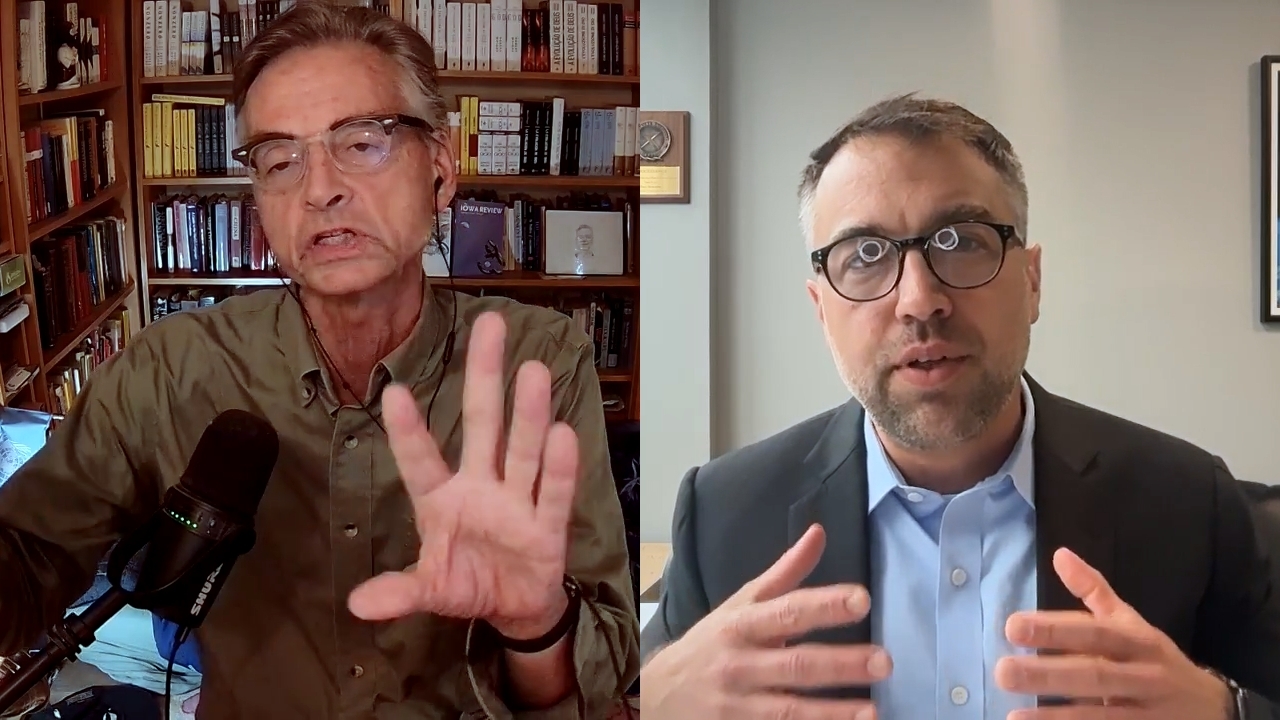
Free Will: The Good Absurd
Recorded: September 10  Posted: September 14
mvantony wrote on 09/14/2008 at 04:40 PM
Re: Free Will: The Good Absurd
Excellent diavlog, gentlemen. (And crazy and paradoxical meeting you here, Saul!)
Wonderment wrote on 09/14/2008 at 04:57 PM
Re: Free Will: The Good Absurd
איזה עולם קטנטו
mvantony wrote on 09/14/2008 at 05:13 PM
Re: Free Will: The Good Absurd
Quoting Wonderment: איזה עולם קטנטו Not only is it a small world, it's a small virtual world.
bkjazfan wrote on 09/14/2008 at 08:25 PM
Re: Free Will: The Good Absurd
Hello! I am curious to how many copies of the book written by Mr.Smilansky would sell? I know nothing about the publisihing world and very little about philosophy.
A life long reader I am currently reading Don Delillo's "White Noise" and Jonathan Kirsch's "a History Of The End Of The World." Now, I believe both of these books did well especially the former and can be found at many libraries.
This book here seems directed to a narrow range of readers and am wondering how it will do? Will the publisher sell 50,000 books or less or even more? Also, where could one buy this book without special ordering it? I have one more question: is it written just for academics?
John
Ocean wrote on 09/14/2008 at 09:11 PM
Re: Free Will: The Good Absurd
Will, I have bad news for you. When you turn 45 you will not be promoted to VP at Cato. We, baby boomers, are planning to be immortal and unretirable. Don't you know?
eric wrote on 09/14/2008 at 09:22 PM
fortunate misfortune: best anecdote ever
Mathematician Leonard Mlodinow, who recently wrote Drunkard's Walk, notes how his father lost his first wife in the Holocaust, and so, moved to New York, and met his mother. So he owes his life to Hitler, and the holocaust.
Ocean wrote on 09/14/2008 at 10:00 PM
Re: Free Will: The Good Absurd
I'm truly having difficulty imagining how to construct "morality" based on somebody's right to complain. Did I misunderstand this?
fedorovingtonboop wrote on 09/14/2008 at 10:12 PM
Re: Free Will: The Good Absurd
not a lot of substance here. what's the point of this discussion?
themightypuck wrote on 09/14/2008 at 10:12 PM
Re: Free Will: The Good Absurd
I always thought of David Foster Wallace as a GenXer but I guess he would have been demographically defined as a baby boomer. In any case, what people do at 45 is highly unpredictable notwithstanding environmental conditions.
themightypuck wrote on 09/14/2008 at 10:15 PM
Re: Free Will: The Good Absurd
I read into this argument a nascent attack on the entire concept of morality. My view after hearing this dvlog was to have an even greater respect for a previous dvlog Will did with (apologies for forgetting his name) another philosopher who's view was that morality is based far more in emotion that logical consistency.
Ocean wrote on 09/14/2008 at 11:30 PM
Re: Free Will: The Good Absurd
Quoting themightypuck: In any case, what people do at 45 is highly unpredictable notwithstanding environmental conditions. Environmental conditions being as they are, getting to be, say, ten years older, could be the luckiest strike for any of us. With or without promotions...
Ocean wrote on 09/14/2008 at 11:39 PM
Re: Free Will: The Good Absurd
Quoting themightypuck: I read into this argument a nascent attack on the entire concept of morality. I felt at times like this was a discussion on sociopath's morality, if such thing exists.
The first part of the diavlog about the effects of hardship or misfortune, seems to me more about "character building" than moral paradoxes.
And then the story about the right to complain seems to me very primitive, and again sociopathic. Setting the volume of your stereo so loud that it will disturb others is either right or wrong, independently of what your neighbors do. If your neighbors are constantly playing loud music, you may decide to do the same, but it doesn't change the moral value.
I just couldn't figure what the point was. But it didn't seem like a particularly inspired or inspiring discussion.
Wonderment wrote on 09/15/2008 at 12:19 AM
Re: Free Will: The Good Absurd
I think the interesting part is that it's hard to disentangle two contradictory courses of action that are both right (or wrong).
Normally, we say that if something is right, it can't be wrong, and vice versa.
So in the car thief's case, he is right to complain (because his car was stolen by some scumbag), but he is wrong to complain (because he is the scumbag who steals other people's cars).
The voluntary retiree is similar: Right to pursue her noble career of healing, but wrong to pursue her noble career of healing.
There may be all sorts of objections to these situations. Will tries, for example, to steer around the voluntary retirement paradox by raising arguments about the efficiencies of the market in a meritocracy (efficient Olympics trials, for example vs. inefficient university tenure systems).
But I think Saul's point, as he explains toward the end, is to find "crazy" ethical situations that resist our best theories (analogous to "weird" quantum physics).
Do such weirdnesses call into question the whole moral universe? Probably not. But they're interesting.
bjkeefe wrote on 09/15/2008 at 12:21 AM
Re: Free Will: The Good Absurd
Quoting Ocean: I felt at times like this was a discussion on sociopath's morality, if such thing exists. Sure, that one's easy. Three words: Don't get caught.
;^)
Ocean wrote on 09/15/2008 at 12:29 AM
Re: Free Will: The Good Absurd
Quoting bjkeefe: Sure, that one's easy. Three words: Don't get caught.
;^) Thanks. I'll try.
Ocean wrote on 09/15/2008 at 12:39 AM
Re: Free Will: The Good Absurd
Quoting Wonderment: I think the interesting part is that it's hard to disentangle two contradictory courses of action that are both right (or wrong).
Normally, we say that if something is right, it can't be wrong, and vice versa.
But I think Saul's point, as he explains toward the end, is to find "crazy" ethical situations that resist our best theories (analogous to "weird" quantum physics).
Do such weirdnesses call into question the whole moral universe? Probably not. But they're interesting. It isn't uncommon that in a given situation you can find different moral values or ethical standards that are contracting each other.
If I hold the following principles:
1. I should tell the truth.
2. I shouldn't hurt others' feelings.
I ran into someone that is extremely ugly and the person asks me: "how do I look?"
I don't think I will solve this dilemma by applying the other's right to complain. I will solve the dilemma by applying another ethical principle that negotiates the above. Or create a hierarchy of principles. What is more important in this situation, tell the truth or not hurt the other's feelings.
So, either I'm missing something, or I just don't see this diavlog as particularly informative or thought provoking.
Sorry, Brendan. It is a compulsion to think... aloud.
Christopher M wrote on 09/15/2008 at 12:43 AM
Re: Free Will: The Good Absurd
I thought Prof. Smilansky's views were quite strange, but that probably just reflects my (correct  but) unusual views on the nature of morality. First, I don't understand why so-called "fortunate misfortune" is any kind of paradox at all. So it sometimes turns out that, when bad things happen and cause unhappiness, that event clears a path back up to good things and happiness. What's the paradox? There are all kinds of analogies: Sometimes you lose money on a deal in the short-term, but end up ahead in the long-term. Sometimes a system's potential energy increases (out of a local minimum) and then has a path down toward a yet-lower minimum. (A ball gets pushed up a hill, and then it can roll down into an even deeper valley on the other side.)
If I really believed that my child's suffering a serious injury would cause him to have a better life, all things considered, than he otherwise would have had (and to agree himself that his life was better), then of course I would want him to have the accident. What kind of moral monster wouldn't?
Basically, Smilansky's views show one of the central problems with non-consequentialist moralities: you forget
Ocean wrote on 09/15/2008 at 01:15 AM
Re: Free Will: The Good Absurd
Quoting Christopher M:
Basically, Smilansky's views show one of the central problems with non-consequentialist moralities: you forget to consider the consequences. And then when you suddenly remember that outcomes matter, it seems like some huge paradox! Agree.
mvantony wrote on 09/15/2008 at 05:30 AM
Re: Free Will: The Good Absurd
Quoting bkjazfan: Hello! I am curious to how many copies of the book written by Mr.Smilansky would sell? Saul is too. He's hoping it will be lots and lots. (-;
where could one buy this book without special ordering it? If you didn't want to order it online from Amazon, etc., you'd likely need a book store with a well-stocked Western philosophy section.
I have one more question: is it written just for academics? No, it's meant to be accessible to non-specialists (like the diavlog is, though of course with much more detail) as well as specialists -- in the way that some good "popular science" writing is, or Dennett's books on consciousness, evolution, or religion, etc.
Francoamerican wrote on 09/15/2008 at 06:46 AM
Re: Free Will: The Good Absurd
Stimulating discussion. I especially liked the idea, broached near the end, that morality may be an incoherent or crazy institution. I have often felt that way.
Paradoxes are enjoyable because they make us think outside doxa, but the first paradox discussed here (fortunate misfortune) is one of the oldest in the book, the GOOD BOOK I mean. Speaking of Adam's fall some Christians (notably John Milton) have been known to exclaim:
O felix culpa quae talem et tantum meruit habere redemptorem! (O fortunate fault that merited such and so great a redeemer).
Christian theologians (followed in this respect by Kant) have always puzzled over the paradox, which seems to be the only conclusion that follows from the story of Adam and Eve and the insidious serpent, that God allows evil in order to bring forth good. Adam sins (proving his freedom) and thereby makes inevitable the coming of the redeemer... Translated into secular language, this has many applications.
ChrisCatanese wrote on 09/15/2008 at 11:43 AM
To: Will "Free Willy" Wilkinson
Not everyone thinks they are better than average at everything. We all accept faults in a least a few categories.
That comment should be refrenced to the agregate. E.g. The majority of people believe that they are better than they actualy are at a particular activity
I apologize for criticism based on such a stringent analysis, but I believe you know beter than being intellectualy lazy.
a Duoist wrote on 09/19/2008 at 11:31 PM
Re: Free Will: The Good Absurd
Morality is based upon choice; without 'choice,' there is no morality.
In making that choice, human emotions naturally intrude.
Those emotions are grounded in our psychologies.
Long before Freud, we noticed that we humans are both homicidal and suicidal, to an extent not found anywhere else in nature, possibly reflecting a very basic dichotomy in the human mind.
In the plethora of human psychologies, two are prevalent: 'improvability' and 'fallibility.'
It is the interaction between these two psychologies--their constant dueling interpretations of human behavior--which results in all the moral systems and social codes of the past five thousand years. Those of us who are fallibilist propose morality that seeks to ameliorate our natural homicidal behavior; those of us wo are improvabilist propose morality that seeks to prevent our too-common suicidal propensities.
Which means that, all times morality is pluralism--not relativism (suicidal) nor absolutism (homicidal)--but the complement of an eternally occuring alternative point of view. It also likely means that all of morality is biopsychological in origin, far beyond the purview of philosophers.

|