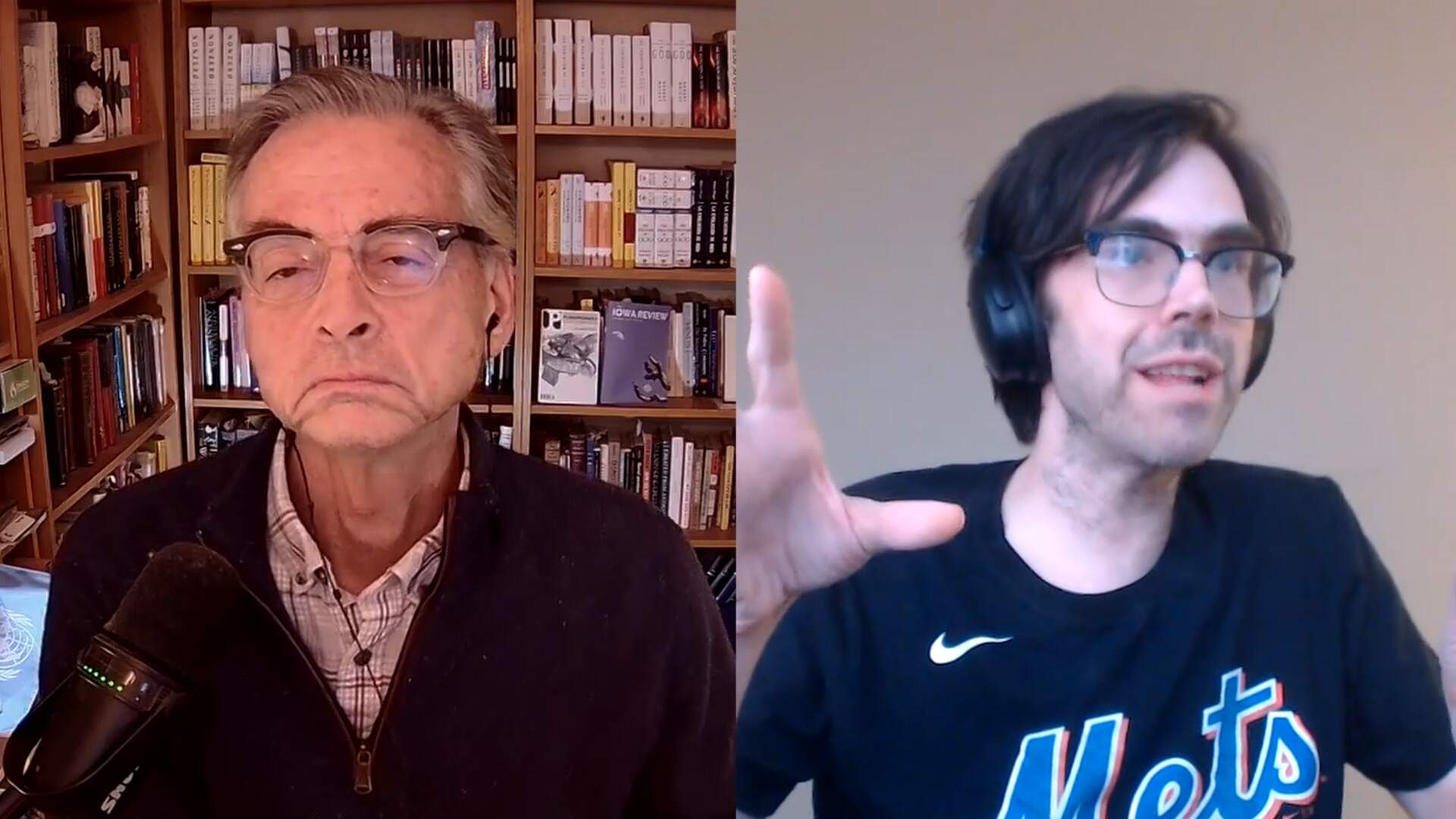
Science Saturday: The More Things Change…
Recorded: January 2  Posted: January 3
bjkeefe wrote on 01/03/2009 at 10:14 AM
Re: Science Saturday: The More Things Change...
The Edge Annual Question 2009: What Will Change Everything?
[Added] Upon refreshing the video page, I see there are now links in the sidebar, so I apologize for this redundancy.
bjkeefe wrote on 01/03/2009 at 10:29 AM
Re: Science Saturday: The More Things Change...
I disagree with the somewhat gloomy outlook expressed by one of the Edge contributors that John passed along. The view was that the explosion of blogs and emails indicated a Malthusian principle of sorts, in that the data growth is geometric, but the growth of the useful information content is only linear.
First, there are numerous easy ways to filter the unwanted stuff. No one reads 99.999...% of the blogs out there, and there is almost no way for a useless blog to get someone's attention -- it won't appear in search rankings, no one will recommend it through direct communication, and so on. I'll add that statistics tossed about concerning the number of new blogs should be taken with a large grain of salt -- overwhelmingly, blogs are created and quickly abandoned, or at least not updated, for a variety of reasons.
As to email, spam filters do a good job protecting inboxes, and most of what is missed by them is easily evaluated and dismissed with a second's glance at the sender's name and subject line. I doubt if I've unintentionally read more than five spam messages in the last
Simon Willard wrote on 01/03/2009 at 11:34 AM
Re: Science Saturday: The More Things Change...
I like George's description of the dangers of blogging.
osmium wrote on 01/03/2009 at 03:38 PM
Science Journalism, The last stage of the crucible
John on science journalism's purpose.
Knowledge has to go through several stages of scrutiny. For science that doesn't get killed on the vine, the union between the lab and the general public, provided by journalists or popularizers, offers a final stage. Weed out the bad and keep the good parts, even though it takes a while. John, the examples you gave are all ones where I feel the good fraction are as we speak being combed away from the crap--psychopharmacology, evolutionary psychology, etc. (e.g. there is certainly not a drug for every mental problem, but there probably is a drug for some mental problems.)
As for the journalists protect us part: Who qualifies to be called a journalist, though? Peter Woit (scientist) attacks string theory; Tom Wolfe (journalist)(or whatever) loves the meanest aspects of evolutionary psychology. Bad examples, I'm sure, but you see my poorly-stated point perhaps: why impose a false dichotomy? The argument as scientists vs. science journalists rings false to me. How about just: people who are personally invested vs. those not; or, people talking gibberish vs. those speaking clearly?
The internet has its sights on destroying not "journalism," but the very idea of a stable job title. (I'm thinking out loud, maybe it's crap.)
BornAgainDemocrat wrote on 01/03/2009 at 04:03 PM
Re: Science Saturday: The More Things Change...
Jesus, where to begin with these two guys? First they example Cosmic Variance as "quality" physics writing and dis string theory. How then explain that many of the world's top physicists for the past generation have signed on to string theory as the most promising, maybe the only way forward: Murray Gell Mann, Steven Weinburg, Edward Witten, . . .?
Do you just dismiss Lubos Motl as a mere blogger (and Harvard Fellow) just because he doesn't carefully "write" so much as vent? His criticisms of guys like Sean Carroll may be over the top (they are!) but at least his arguments are cogent. And he does write at length and constantly about the frontiers of string theory in a way that ex-science jocks from college -- there are tens of thousands of us out here -- can at least follow and appreciate in a general sort of way. Shades of Richard Feinman! How many people in the U.S. have an IQ over 145? (Roughly a million.) How many science journalists? (Vanishingly few.)
And then the notion that "having fewer science writers increases the chance of herd behavior." Are they serious?
Look at the whole climate science "consensus" for an
osmium wrote on 01/03/2009 at 05:42 PM
Re: Science Saturday: The More Things Change...
Quoting BornAgainDemocrat: Look at the whole climate science "consensus" for an example of herd behavior -- only equalled by the "financial engineers" on Walls Street! (Interesting tidbit: the general circulation climate models had their origins in the econometric global economic models, using the same "scientistic" (ie, pseudo-scientific) assumptions that everything could be (at least "in principle") described by linear equations!!!! No wonder econometrics is now dismissed as junk science. My God, you've convinced me. Excellent.
Eastwest wrote on 01/03/2009 at 07:29 PM
What Will Change Everything?
Answer: Nothing.
Curmudgeons Rule!
EW
bjkeefe wrote on 01/03/2009 at 08:44 PM
Re: What Will Change Everything?
Quoting Eastwest: Answer: Nothing.
Curmudgeons Rule!
EW LOL!
Still, I gotta say, "really good batteries" comes close.
Baltimoron wrote on 01/03/2009 at 09:55 PM
The Future Looks Bright
The blogosphere promised, that more people could both add their experience, AND, get more information. Yet, now that the flood gates are open, some people and organizations are pushing back at the dike with standards for self-serving reasons. No one questions the value of a person's opinion when the result is a statistical figure - or a fraction thereof - but when words are involved there is suddenly a level. And, few people knew how to challenge arguments based on statistical inference. So, instead of looking at it as "BS" or a geometric progression of worthless quanta, I see it as putting a face and a voice to what was serviceably passive quanta. I think the gates, or experts, are noticing how this change affects their margins of error.
Those gates, like newspapers, were often loss leaders, or vanity devices, for the same incompetent corporations suffering from debt. Some of the gates might have lost the ability to attract an audience, but others might just be collateral damage. So, I think there needs to be an evaluation of what worked and what didn't, not just accepting the current ugliness as proof of irrelevance. Perhaps one day the blogosphere can develop a standard, like
Francoamerican wrote on 01/04/2009 at 07:42 AM
Re: Science Saturday: The More Things Change...
Re: materialism
John and George are right to laugh at the idea of a non-materialistic science and call it airy-fairy nonsense. Science, almost by definition, concerns itself with the ultimate constituents of matter, from quarks to DNA. Science is scientific precisely to the extent that it limits itself to describing how all the pieces of matter fit together, and non-scientific to the extent that it is non-materialistic.
Science, however, does not concern itself with science (which is just Latin for "knowledge") or with "consciousness" (conscience in Latin and French). As Heidegger (the bęte noire of all rational anglosaxons) said: Science does not think, i.e. it does not think about itself as a human activity. Nor does it have anything of interest to say about "consciousness," as philosophers from Kant to William James to John Searle and many others, have pointed out.
So let us laugh at all the airy-fairy nonsense but remember, to paraphrase Hamlet to Horatio, that there are more things in heaven and earth than are dreamed of in scientific materialism.
AemJeff wrote on 01/04/2009 at 08:40 AM
Re: Science Saturday: The More Things Change...
Quoting BornAgainDemocrat: Jesus, where to begin with these two guys? First they example Cosmic Variance as "quality" physics writing and dis string theory. How then explain that many of the world's top physicists for the past generation have signed on to string theory as the most promising, maybe the only way forward: Murray Gell Mann, Steven Weinburg, Edward Witten, . . .? I'd recommend reading Peter Woit's Not Even Wrong before choosing sides in this debate.
It's probably good to remember that science is dialectic at its core. Disagreement and competition drive it forward as much as (I think more so) the simple will to know.
To be sure, "top physicists" don't always pick the right side. None of Poincaré, Planck, and Lorentz ever fully accepted Einstein's basic tenet that there is no fundamental, unchanging frame of reference (aether) for instance. (Though I should add that it's absolutely true that nobody was more helpful than Planck in enabling the general dissemination of Einstein's ideas.) And of course Einstein himself was never really sanguine with the implications of quantum theory and the latter part of his career was largely consumed by a fruitless attempt to devise an alternative.
The point is
bjkeefe wrote on 01/04/2009 at 12:55 PM
Re: The Future Looks Bright
Quoting Baltimoron: Perhaps one day the blogosphere can develop a standard, like peer review. Loosely speaking, we already have this. A blogger gains credibility, authority, and audience almost exclusively from the approval of others.
I hasted to admit that this means a lot of "bad" blogs become notable. So be it. Clearly, a lot of people like gossip, or salaciousness, or petty sniping, or crackpot political ideas, or whatever. But it's easy enough not to go to sites not to your taste, and it's also easy to find what does appeal by virtue of this process.
I'll add, partly in reaction to what you said just before this, that back in the heyday of newspapers, there were a lot of bad newspapers, and a lot of them made money.
I have a feeling that underlying your wish for "peer review" is an assumption, possibly unconscious, that there exists some group of people who are better than the rest of us, who would establish a set of guidelines and carry out the reviewing in accordance with these guidelines. I don't think that's realistic for much or most of what comprises "the news." There's just too much subjectivity involved.
I'll grant that there are certain principles that almost
a Duoist wrote on 01/04/2009 at 04:25 PM
Re: Science Saturday: The More Things Change...
"Protect" me from "crap" science? Why not, instead, put all of everyone's thinking out into the marketplace, and then let quality naturally rise to respectability? What kind of thinking goes into "protecting" people from alternative or contrary opinions from "professional" voices.
MemeInjector3000 wrote on 01/05/2009 at 10:32 AM
Re: Science Saturday: The More Things Change...
I'm a PhD scientist who has many times decried the poor quality of mainstream science reporting. However, the answer to this problem is certainly not to replace science journalism with blogging (getting our science news from ERV? No thanks), but to elevate the quality of existing science writing.
We need quality science journalists because:
1- Many scientists are non-native English speakers (over 50% in some disciplines);
2- Most scientists who are native speakers can't write, or at least can't write beyond the formal structure of the research paper;
3- Most scientists only know their own field, and lack a science-wide and/or historical perspective, which the best science journalists have;
4- Almost no active scientist has the time to write anything beyond grants, research papers, conference materials, etc, etc.;
5- Few scientists have the motivation/interest in translating their work into a form palatable to the average "Parade Magazine" reader;
6- Most scientists' work, most of the time, doesn't have the societal importance that would warrant an article in the mainstream media. Unfortunately, many scientists have an inflated sense of their work's importance, which brings me to the related point...
7- Most scientists (eg, PIs of biomedical labs) are mini-PR machines, bolstering their own work and dissing others (as John and
graz wrote on 01/05/2009 at 11:06 AM
Re: Science Saturday: The More Things Change...
Thanks for underscoring the relative vested interests in the fight between the "blogger" and the "journalist." Leading me to recognize that one doesn't have to choose a side in this fight.
As colorful as their disagreement is, it seems that they both want the same things.
AemJeff wrote on 01/05/2009 at 11:12 AM
Re: Science Saturday: The More Things Change...
Quoting graz: As colorful as their disagreement is, it seems that they both want the same things. Yup. That's what's in danger of being glossed over in this brouhaha. The real fight ought to be directed toward those responsible for crap, whatever their job or means of publication.
bjkeefe wrote on 01/05/2009 at 12:09 PM
Re: Science Saturday: The More Things Change...
Quoting MemeInjector3000: We need both. Exactly. And more to the point, there's no reason why we can't have both, there's every reason to believe that improvements in one will motivate improvements in the other, and that the two have different strengths that the one would have a hard time matching were the other to go away.
Good essay, overall. You've laid out a nice list of problems.
osmium wrote on 01/05/2009 at 12:22 PM
Re: Science Saturday: The More Things Change...
Quoting MemeInjector3000: It may happen, but for the sake of reversing the decline in US science literacy, I hope not. We need both. A very good post.
Wonderment wrote on 01/05/2009 at 02:22 PM
Re: Science Saturday: The More Things Change...
Very well-written and cogent essay on the debate that's emerged on Sci Sat on the past few sessions. You should blog about this (just kidding).
KevinWho wrote on 01/05/2009 at 04:19 PM
Re: Science Saturday: The More Things Change...
Does anyone else think it's funny that the brainiac on the left, only moments after discussing the overriding of communication barriers, is unable to fend off a ringing phone and answering machine?
(The hilarity begins at about 33:50.)
nikkibong wrote on 01/05/2009 at 04:30 PM
Re: Science Saturday: The More Things Change...
dingalink it!
KevinWho wrote on 01/05/2009 at 05:06 PM
Re: Science Saturday: The More Things Change...
Answering Machine 1, Brainiac Science Guy 0
Baltimoron wrote on 01/05/2009 at 05:29 PM
Re: Science Saturday: The More Things Change...
Are bloggers going to travel to visit labs and interview other scientists for comment on a story? Are they going to find and develop business, academic, and governmental contacts? Are they going to quit their day jobs and devote their lives to covering emerging stories full-time? Is the public going to comb through 100 blogs to get its science info? I think not, and it is naive to suggest otherwise. This assumes there's money out there. Would a blogger do the work for free, once, twice...??? No, realistically not. But, should a publication that isn't profitable last? I don't know about science mags, but most publications are in debt, and their corporate sponsors are too. One way or another, there will be less science writing.
Also, the types of science stories most consumers are interested in is not pure science, but drug research or industrial applications. That intersects with politics and regulation, areas where science writers are not competent.
If a commenter here decided to do an interview - and really prepared - what are the chances a scientist, an executive, etc, would sit down to be interviewed? None. And, it has little to do with skill and everything to do with credentials. I should be able to go
bjkeefe wrote on 01/05/2009 at 07:26 PM
Re: Science Saturday: The More Things Change...
Quoting Baltimoron: This assumes there's money out there. Would a blogger do the work for free, once, twice...??? No, realistically not. I don't know where you've been, but there is a whole planetful of good stuff out there, updated daily or more often, and most of it put up by people who aren't getting paid to do it.
Also, the types of science stories most consumers are interested in is not pure science, but drug research or industrial applications. That intersects with politics and regulation, areas where science writers are not competent. I had no idea consumers were so homogeneous.
If a commenter here decided to do an interview - and really prepared - what are the chances a scientist, an executive, etc, would sit down to be interviewed? Have you ever heard of email and IM interviews? Not to mention the telephone?
Sure, you have to have some way of getting your virtual foot in the virtual door, and no, you're not going to be able to talk to the Big Cheese on day 1. Same as it ever was.
Baltimoron wrote on 01/05/2009 at 07:55 PM
Re: Science Saturday: The More Things Change...
I don't know where you've been, but there is a whole planetful of good stuff out there, updated daily or more often, and most of it put up by people who aren't getting paid to do it. Is that the same people making a career of it, or different people taking first bites out of different pies?
I had no idea consumers were so homogeneous. I had no idea peer-reviewed journals were as popular as Scientific American?
Have you ever heard of email and IM interviews? Not to mention the telephone?
Sure, you have to have some way of getting your virtual foot in the virtual door, and no, you're not going to be able to talk to the Big Cheese on day 1. Same as it ever was. I guess this Board would count, too.
Overall, what MemeInjector3000 - kool moniker BTW - discusses intersects two sectors, education and media. Both have undergone important changes and played seminal roles during the pax americana in American culture. The same problems discussed in connection with the recent economic troubles impinges on them as well. I would distinguish between two perspectives. One, that the system works, but the execution is flawed. Two, the system is responsible for the poor
bjkeefe wrote on 01/06/2009 at 11:12 AM
Re: Science Saturday: The More Things Change...
Quoting Baltimoron: Is that the same people making a career of it, or different people taking first bites out of different pies? Hard to say. Of course, there is no one answer -- lots of people try it out and don't stick to it, others do it for a finite chunk of time that's connected to their meatspace life (e.g., during their years as grad students), others seem to be sticking to it without any indication that they have a firm stopping point in mind.
And as far as "career" goes, I'm not sure what that term means anymore. I'm sure you hear the same sort of numbers I do -- "the average person entering the workplace these days is expected to make N major changes" -- so if Joe Random blogs for five years, is that "making a career of it?"
I had no idea peer-reviewed journals were as popular as Scientific American? I have no idea how this is supposed to serve as a rebuttal.
I guess this Board would count, too. Don't know what this is supposed to mean, either.
Overall, what MemeInjector3000 - kool moniker BTW - discusses intersects two sectors, education and media. Both have undergone important changes and played seminal roles
dankingbooks wrote on 01/06/2009 at 08:31 PM
Blogs vs. MSM
I used to read the New York Times daily. But I can't stand it anymore. It is just so verbose - never use a 1000 words when 10,000 words will do. I don't have the patience to plow through it anymore. I think journalists must get paid by the word.
Needless to say, one of my favorite blogs is Instapundit.
It is astonishing that, in the catalogue of bogus science, these two esteemed, informed and ultra-arrogant journalists completely ignore the global warming hoax. BornAgainDemocrat has it exactly right.
Baltimoron wrote on 01/06/2009 at 09:20 PM
Re: Science Saturday: The More Things Change...
Looking at my handy online Merriam-Webster dictionary, the denotation of "career" emphasizes progressive achievement and training.The blogosphere is chock full of training, but how is "achievement" measured? Selling-out to Foreign Policy? A million visits? A million pings and trackbacks? Awards? There is no consensus.
And, how are consumers to know if a writer - of research and reporting et al, not community boards or private email and chat - is worth reading. I mentioned peer-review as the most important non-market form of evaluation. I was not advocating peer-review for the blogosphere. If anyone, MemeInjector3000 is advocating a top-down approach with better scientists working within the current framework to preempt the popularity of the blogosphere. I want a better blogosphere that will eliminate the clique of academic publishing - to include abolishing tenure - without sacrificing personal liberties. I stand by my free-market advocacy, but I think all Americans realize how messy and unequal market mechanisms are now. Consumer evaluation and lack of a career standard go together. That means of evaluation will be sui generis, but it should happen before the blogosphere is torn into private webs used by every profession using its own standards.
For instance, Slate has an article about how the newspaper industry
bjkeefe wrote on 01/06/2009 at 10:04 PM
Re: Science Saturday: The More Things Change...
Quoting Baltimoron: [...] Just wanted to let you know I saw this. I don't really have anything to say in response.
John Furie Zacharias wrote on 01/08/2009 at 07:21 AM
Re: Science Saturday: The More Things Change...
Interesting diavlog. I look forward to your next one.

|