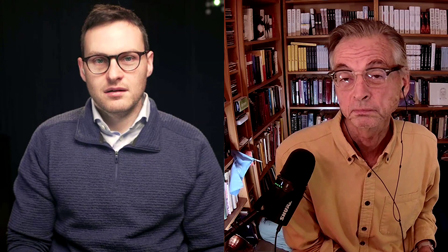
Percontations: Religiosity Rematch
Recorded: May 4  Posted: May 10

mmacklem wrote on 05/10/2009 at 04:04 AM
Re: Percontations: Religiosity Rematch
This exchange is a perfect example of why I find this debate so exhausting at times -- not the Yudkowsky-Frank version of it specifically, more the God/no-God debate generally. As a Christian myself, describing my interaction with the story of Job as one of "helpless reverence" is a complete misrepresentation of how one interacts with Scripture. And the response of using a parent's love for their chronically-ill child is something that I do find somewhat uncomfortable, if only that I think that this debate can too often be caricatured as one of intellect-versus-emotion, as though the only possible reason that one can hold a religious faith is because of an emotional response, and that one cannot be both rational and spiritual, which is essentially the argument that Eliezer is making in the first place.
mmacklem wrote on 05/10/2009 at 04:13 AM
Re: Percontations: Religiosity Rematch
On the other hand, I thought this was an 'artful' way of making this point that I hadn't considered before.
cmonsour wrote on 05/10/2009 at 04:56 AM
Re: Percontations: Religiosity Rematch
Well, I started out expecting to find Eliezer more persuasive in this one, but I have to say, Adam Frank carried the day. (I thought--I'm not sure why--Frank was going to be just a sort of apologist for some kind of wishy-washy, vague, New Age spirituality, but obviously he was nothing of the sort.)
Eliezer basically ends up arguing for what people often call a Stalinist approach to aesthetics: things are beautiful insofar as they are true and consonant with our intellectual and political understanding of the world. It seems that for him, if a story involves falsehood, or operates from different moral assumptions than ours, then its only value can be didactic, insofar as it points us to our errors.
I think there is a certain spare and lonesome nobility in Eliezer's insistence on accepting only two values: truth, and the imperative to improve the human condition. I don't think most people's aesthetics and morality are so limited, and unlike Eliezer, I don't think they ought to be. There is room for beauty in falsehoods, in stories that, with their strangeness, ambiguity, or even awfulness leave us no choice but to confront and interpret them thickly -- often precisely because we
cmonsour wrote on 05/10/2009 at 05:15 AM
Re: Percontations: Religiosity Rematch
I also think Eliezer's notion that emotions and values can "proceed wholly from the facts" is quite strange. Isn't this a basic is/ought fallacy? We can certainly come to understand why we have the values we have -- in terms of cultural or evolutionary forces, or psychologically, or neurologically, or whatever. But we still experience ourselves as agents in the world, and while rationality can constrain us to take the world as it is, I don't understand how Eliezer thinks it can possibly tell us how we should aim for the world to be, or how we should see it and its parts, aesthetically.
mmacklem wrote on 05/10/2009 at 05:28 AM
Re: Percontations: Religiosity Rematch
Not to runaway with this thread, but having now finished this DL (which got much more interesting in its latter half) I did feel the need to respond to this summation:
I think my confusion about the argument being posed here is very similar to my confusion to the general perspective expressed by Eliezer, in terms of the following question: Science has made great progress in solving many problems of the world, including many of the plagues described in the Scriptures (see footnote below). In the course of reading Scripture, I can look at the plagues and see them described as acts of God, and thus extrapolate that plagues now, say Swine flu, or natural disasters, say Katrina, are also acts of God, and thus interpret these events as describing something outside of the realm of human focus or achievement. Plagues and natural disasters are thus the realm of God and cannot be "solved" by humanity, even in the face of evidence of the influence of humanity in influencing some of these events due to our own activities, be it in the form of making climate change worse due to excessive carbon
bjkeefe wrote on 05/10/2009 at 06:39 AM
Re: Percontations: Religiosity Rematch
Quoting mmacklem: Not to runaway with this thread ... Please do not self-censor. If a diavlog moves you to muse at length, go with it.
I buy a lot of what you've said, here and in your other posts. I am going to pick out one thing to dispute:
Quoting mmacklem: As an example, considering the book of Job, Eliezer and Paul Frank propose two completely different interpretations/responses to this book in the course of their discussion, to which I would add a third -- and I would also add that anyone who reads that book and comes away having learned the lesson that it is an easy book to interpret and that "I" have the "correct" interpretation, is reading the text in a much too simple fashion. The book of Job is hard. The Bible is hard, and much damage has been caused by claims to the contrary. Humans can, and almost always do, imbue meaning into things or project meaning onto things. Humans can, and do, add the rest of their life experiences and thoughts to the reading of a given story and are inexhaustible at coming up with ways of interpreting that story. And ultimately, there are very few stories
mmacklem wrote on 05/10/2009 at 07:02 AM
Re: Percontations: Religiosity Rematch
Quoting bjkeefe: So, to return to the story of Job, it seems to me likely that the original intent was to illustrate the power of an all-powerful God and to advertise for the goodness of maintaining faith. And/or, perhaps, to create a parable from which comfort could be drawn by people mysteriously afflicted by any of life's random indignities.
You asked elsewhere, rhetorically, "Why is faith not also allowed to advance in our learning ...?" I would say that's exactly what has happened with the story of Job -- much brain power has been spent contemplating whether it might mean something more, and another big chunk has been applied to considering those considerations.
I'm not saying there's anything wrong with doing this, in and of itself. I'm just saying it's the way our minds work. While we do have some reductionist instincts, we are more prone to elaboration, making connections, and viewing anything as a foundation to be built upon. So, I do share with Eliezer some impatience with the thought that there is anything particularly special about the story of Job, or any other story that got added to the collection we now call
mmacklem wrote on 05/10/2009 at 07:22 AM
Re: Percontations: Religiosity Rematch
Quoting bjkeefe: I'm not saying there's anything wrong with doing this, in and of itself. I'm just saying it's the way our minds work. While we do have some reductionist instincts, we are more prone to elaboration, making connections, and viewing anything as a foundation to be built upon. So, I do share with Eliezer some impatience with the thought that there is anything particularly special about the story of Job, or any other story that got added to the collection we now call the Bible, in the sense of reverence given to how "deep" or "hard" these stories are said to be. Just to follow-up on your last point, I would be curious to hear your thoughts on a question that I had that arose out of this:
I think I understand the impatience that you mention about the special weight attached to the "depth" and "difficulty" of these texts, and I think I can certainly understand the source of annoyance at the self-importance that religious faith can take in terms of simultaneously "praising" (in the non-reverential sense of the word) the mystery of their own texts while claiming absolute knowledge of the shortcomings of the texts of
bjkeefe wrote on 05/10/2009 at 07:53 AM
Re: Percontations: Religiosity Rematch
Quoting mmacklem: [...] Here, you and I don't much agree, since I do not place any importance on believing in God or in considering how I ought to conduct my life under the assumption that God exists. It follows from this, obviously, that I do not think there is much to be learned from the story of Job or much to be gained from contemplating the story.
No biggie. Whatever works for you is fine. The only point that I wanted to make in my last is that one can assign importance, find meaning, however you want to put, in most anything. As the man said:
To see a world in a grain of sand,
And a heaven in a wild flower ... There are many grains of sand and many wild flowers, and we don't all have to focus on the same exact ones.
For the record, I am going to maintain that whatever you get out of the story of Job you could as well get elsewhere, and it is an accident of your birth and upbringing (or possibly other events later in life, if you're a recent convert) that makes that story resonant or instructive for you. I don't
mmacklem wrote on 05/10/2009 at 08:09 AM
Re: Percontations: Religiosity Rematch
Quoting bjkeefe: Also for the record, I should say that I did not mean to suggest that the what you get out of the story of Job is the result of your "twisting" it. It, like many, many other stories, is in my view a seed. It's sort of like this question: Is the entire essence of an oak tree contained within the acorn? Or is the case that absent water, sunlight, etc., that particular acorn amounts to nothing more than squirrel food? And no matter which one it is, isn't it true that it really doesn't matter, because there are lots of acorns, and water and sunlight are pretty much unavoidable? So, in my view, you're marveling at an oak tree but attributing too much significance to the particular acorn from which it began. You're not twisting things to say, "Pretty amazing that all of this magnificence came out of that little thing," because in some sense, it did. I just think you're forgetting about the other elements that contributed and all those other acorns.
I should also say that I do not think that is always the case one has to expend energy to read more deeply into a story; indeed, if
mmacklem wrote on 05/10/2009 at 08:27 AM
Re: Percontations: Religiosity Rematch
Sorry, it's late and I completely misunderstood your analogy. I'll have to sleep on it to put together a proper response, but at least I think I understand your point now.
bjkeefe wrote on 05/10/2009 at 08:49 AM
Re: Percontations: Religiosity Rematch
Quoting mmacklem: Just to follow-up on your last point, I would be curious to hear your thoughts on a question that I had that arose out of this:
I think I understand the impatience that you mention about the special weight attached to the "depth" and "difficulty" of these texts, and I think I can certainly understand the source of annoyance at the self-importance that religious faith can take in terms of simultaneously "praising" (in the non-reverential sense of the word) the mystery of their own texts while claiming absolute knowledge of the shortcomings of the texts of other faiths. But one concern that I've always had with Eliezer's arguments is that I often feel like he is attempting to place the scientists in a special role as "truth-tellers", in that to the extent that science is based on the scientific method, which is based on reason and on a clearly defined and understandable process and logic, and which expands the society's understanding of the observable parts of the world around them; and with the additional assumption that only the observable has value; then scientists, as the only members of society studying that
mmacklem wrote on 05/10/2009 at 09:00 AM
Re: Percontations: Religiosity Rematch
Quoting bjkeefe: I think like to think of the preference for being rational as more of an attitude than a creed. I think we should be rational, and should apply the scientific method, wherever possible; that over time, we have tended to find that it applies in areas where we didn't used to think it would; and that in the future, we are likely to widen its applicability still further. I think there are large areas where it is possible to be entirely rational or nearly so, and in these areas, I do think that "scientists" offer the best version of truth available at the moment, and assuming no confounding factors, yes, I do think their judgment should carry the day. I think this captured the main source of my confusion about Eliezer's arguments. I felt like part of the argument went as follows:
1. Presently there are many questions that science is investigating which 50 or 100 years ago were not considered in the realm of science, and which science was not viewed as the proper venue of investigation.
2. In 50 or 100 years, there will be additional questions that are not now considered in the realm of science, but which will be active
bjkeefe wrote on 05/10/2009 at 09:01 AM
Re: Percontations: Religiosity Rematch
Quoting mmacklem: Sorry, it's late and I completely misunderstood your analogy. I'll have to sleep on it to put together a proper response, but at least I think I understand your point now. Damn, and I had such a good response to your previous all ready to go.
;^)
bjkeefe wrote on 05/10/2009 at 09:21 AM
Re: Percontations: Religiosity Rematch
Quoting mmacklem: I think this captured the main source of my confusion about Eliezer's arguments. I felt like part of the argument went as follows:
1. Presently there are many questions that science is investigating which 50 or 100 years ago were not considered in the realm of science, and which science was not viewed as the proper venue of investigation.
2. In 50 or 100 years, there will be additional questions that are not now considered in the realm of science, but which will be active areas of investigation within science.
3. Just as 50 or 100 years ago, we did not now which research areas made this transition, we do not now know which areas will have made that transition 50 or 100 years from now.
4. We should assume that science will eventually address all questions, and that all approaches of investigating knowledge outside of the realms of science are unnecessary. (And dangerous and the cause of all of the world's problems and so forth.)
Obviously, I'm not being entirely fair here, but I do think that there's a big gap from 3 to 4. Personally, I'm more comfortable with using as many modes of investigation as available for all of the
mmacklem wrote on 05/10/2009 at 09:28 AM
Re: Percontations: Religiosity Rematch
Quoting bjkeefe: In any case, while I certainly agree with 1-3, I just as certainly reject #4. For the time being, and for the foreseeable future, I don't see how it's possible to be all science-y about, say, why I love the music that I love and hate the music that I hate. Sticking me in an MRI tube and playing first Duke Ellington and then Bob Seger, and then listing the differences in the two images of my brain scans isn't going to tell me anything useful. To borrow from Feynman, it's like thinking you understand a bird because you can give its Latin name. Not to be difficult here, but I actually did some non-neuropsychology work on this front on a very small feasibility study several years ago. We analyzed some of the frequencies of a number of song excerpts from a (small) number of CDs, and asked subjects for their favourite tracks on each CD. We then asked them to provide some of their favourite CDs, and used our subject-specific frequency decompositions to predict the favourite tracks on the subject-provided CDs. Given the constraints that the song excerpts were short, and that the musical styles were similar
bjkeefe wrote on 05/10/2009 at 09:34 AM
Re: Percontations: Religiosity Rematch
Quoting mmacklem: Not to be difficult here, but I actually did some non-neuropsychology work on this front on a very small feasibility study several years ago. We analyzed some of the frequencies of a number of song excerpts from a (small) number of CDs, and asked subjects for their favourite tracks on each CD. We then asked them to provide some of their favourite CDs, and used our subject-specific frequency decompositions to predict the favourite tracks on the subject-provided CDs. Given the constraints that the song excerpts were short, and that the musical styles were similar between the test set and the user-provided set, we were able to predict their favourite songs on both their selected CDs and on a set that we provided which they were previously unfamiliar with. So while we can't explain to you why you like something, we can use the knowledge that you like something to find something else that you might also like.
Now if you ask me to explain using science how a tree comes from an acorn, there I run into no end of trouble. Yeah, I believe that you could have
mmacklem wrote on 05/10/2009 at 09:37 AM
Re: Percontations: Religiosity Rematch
Quoting bjkeefe: Yeah, I believe that you could have some success in this limited fashion, and there may even be some worth in it. Amazon.com sure thinks so, at least.
But this doesn't begin to get at the question of why I love Duke Ellington and loathe Bob Seger. I did a quick analysis, and determined that you love both Duke Ellington and Bob Seger. I think that previous post must have a typo. Can't argue with science.
bjkeefe wrote on 05/10/2009 at 09:47 AM
Re: Percontations: Religiosity Rematch
Quoting mmacklem: I did a quick analysis, and determined that you love both Duke Ellington and Bob Seger. I think that previous post must have a typo. Can't argue with science. Heh. Yep, one nightmare that I have is the vision of a herd of Eliezers taking over the planet, and insisting that because I like Bob Dylan and Pete Seeger, logically, I must therefore like Bob Seger.
mmacklem wrote on 05/10/2009 at 09:50 AM
Re: Percontations: Religiosity Rematch
Quoting bjkeefe: Heh. Yep, one nightmare that I have is the vision of a herd of Eliezers taking over the planet, and insisting that because I like Bob Dylan and Pete Seeger, logically, I must therefore like Bob Seger. Or that because I like James Taylor and Jonathan Swift, I must like Taylor Swift.
graz wrote on 05/10/2009 at 10:07 AM
Re: Percontations: Religiosity Rematch
To cmonsour, mmacklem and bjkeefe,
Thanks for the Sunday sermon of sorts. It beats the hell out of having to dress up and go to any house of worship. And as a bonus the tone was respectful and forward looking and the coffee was hot.
basman wrote on 05/10/2009 at 10:48 AM
Re: job
With all due apologies for not having listened to this whole exchange and not having read anything posted, I felt an uncontrollable urge to make a point or three. Aren't there at least two fundamental misconceptions misinforming the discussion about Job? The first is Frank's interpretation of Job as meaningful for secularists: that's the way the world is; live with it. That interpetation belies the meaning of Job as faith transcending suffering giving way to higher reward, material and spritual. Job means nothing if not something like that. The second misconception is confusing literature with scripture. With literature, we willingly suspend disbelief and voyage through the provinces of our imagination; we forgo conventional understanding to embrace imaginatively other worlds, other visions of meaning. If the work is good or great we are enriched and understand more, correlatively. We do not act on our enrichment. Rather we pack it inside the luggage of ourselves and travel with broader conceptions of the world, the virtue of which is intangible but real. Scripture is like propaganda. It is revealed truth and is meant to affect, guide and effect action. A discussion of Job not mindful of this
maximus444 wrote on 05/10/2009 at 10:59 AM
Religiosity Rematch
Great Diavlog.
Keep them coming.
osmium wrote on 05/10/2009 at 11:20 AM
Re: Percontations: Religiosity Rematch
Quoting bjkeefe: Heh. Yep, one nightmare that I have is the vision of a herd of Eliezers taking over the planet, and insisting that because I like Bob Dylan and Pete Seeger, logically, I must therefore like Bob Seger. Ha, now that's funny.
BornAgainDemocrat wrote on 05/10/2009 at 02:36 PM
Re: Percontations: Religiosity Rematch
When somebody says there is nothing in the Bible of the same literary quality as Lord of the Rings, I mean, what are you supposed to say? Have they every read Tolstoy?
Bobby G wrote on 05/10/2009 at 02:51 PM
Re: Percontations: Religiosity Rematch
I haven't read all the tos and fros of this exchange so far, but three points:
First, sometimes people can express things they can't say. For instance, regardless of what the writer of Job could explicitly articulate, he might have trying to say something that he didn't have the vocabulary for; now that there has been progression in the concepts we use, we might be able to say what he was trying to express.
Second, there's a lot more to the meaning of a story than the text. I don't just mean subtext, though there's that, of course; I mean also what a story can reveal about a way a person or a community or an era thinks. Regardless of what you think of the book of Job, analyzing it is valuable, as it gives us insight into how the ancient Hebrews thought.
Third, if the Book of Job was divinely inspired, then both my first and second points develop added significance. After all, not only do we have to try to decipher the author's intention and the meaning of his story as it would have been understood in his time, but now we have to
Kolya wrote on 05/10/2009 at 03:15 PM
Re: Percontations: Religiosity Rematch
So far I've only heard until the end of the Job discussion. I'm not religious and I'm turned-off by New Ageism. I have to say, though, that Eliezer comes across as a self-righteous and arrogant man with a tin ear. On this particular issue, I'm in the Adam Frank camp. Eliezer doesn't like Job. That's fine. What is not fine is to be dismissive of those who are indeed moved by Job, even if like Adam they are atheist. Eliezer's reaction is rather disturbing. It reminds me of the reactions of dogmatic fundamentalists, whether Born Again Christians or Marxist-Leninist.
Besides Job, how about all the great poetry, painting, sculpture that is based on religion? Of course such art speaks to atheists! Atheists can be moved and find wisdom in such art even if they know that the religion or mythology on which it is based is false. Why? Because art is human.
claymisher wrote on 05/10/2009 at 03:20 PM
Re: Percontations: Religiosity Rematch
Quoting graz: To cmonsour, mmacklem and bjkeefe,
Thanks for the Sunday sermon of sorts. It beats the hell out of having to dress up and go to any house of worship. And as a bonus the tone was respectful and forward looking and the coffee was hot. Absolutely. Like a lovely rally in a tennis match.
Wonderment wrote on 05/10/2009 at 03:28 PM
Re: Percontations: Religiosity Rematch
I have to say that a lot of what Eliezer said in this diavlog made me a little embarrassed for our side. Kudos to you for admitting this. For me, he has come across as a rigid, raving fanatic on several occasions on BH, but he was at his obnoxious, condescending and dogmatic worst this time. A previous poster described his views as Stalinist, and -- minus the violence and megalomania -- I'd have to agree. It's not since Stalin and Mao that I've heard Eliezar's views on art and literature.
As you suggest, Eliezar is the poster boy for biblical literalists who will find all kinds of creepy (to use Eliezar's choice of words) analogies between the totalitarian-atheist philosophies of the 20th century and his views.
The equivalence of "The Hobbit" with the Book of Job, Bhagavad-Gita and Sermon on the Mount is a perfect example, and the "starting over" to build the new human being from the ashes of previous religious civilizations sounds like the Nazis' misinterpretation of Nietzsche as in the line often attributed to Goering, "When I hear the word 'culture' I reach for my gun."
Having said that, this is the exact debate
Thanks, dad! wrote on 05/10/2009 at 04:10 PM
Re: Percontations: Religiosity Rematch
Religion is tribal, genetic (degree of religiosity) and reserved for retards because it's not evidence based. The only scientific evidence that might lend itself to a creator is the c. Constant. I dare any religious person to go through a years worth of the archives of snuffx or ync.com and still try and say that that kind of off-the-charts suffering and violence was bestowed upon us by your "god."
nikkibong wrote on 05/10/2009 at 04:44 PM
Re: Percontations: Religiosity Rematch
Quoting Thanks, dad!: Religion is tribal, genetic (degree of religiosity) and reserved for retards because it's not evidence based. " Congratulations: you have successfully rebutted "retards" such as Augustine, Maimonedes, Santa Teresa de Avila, Erasmus, Thomas More, Albert Einstein, Dietrich Bonhoeffer, and, well, Glenn Loury, to bring it closer to home.
Take a bow.
Wonderment wrote on 05/10/2009 at 05:05 PM
Re: Percontations: Religiosity Rematch
Congratulations: you have successfully rebutted "retards" such as Augustine,... And worse -- increased the number of retarded humans by a few billion, causing a global health megacatastrophe that will make the Spanish Flu, plague and smallpox seem, by comparison, like a picnic.
nikkibong wrote on 05/10/2009 at 06:05 PM
Re: Percontations: Religiosity Rematch
Quoting Wonderment: And worse -- increased the number of retarded humans by a few billion, causing a global health megacatastrophe that will make the Spanish Flu, plague and smallpox seem, by comparison, like a picnic. Now look what you've done: my fellow library patrons are glaring at me angrily due to my laughing heartily at your comment!!!
Thanks, dad! wrote on 05/10/2009 at 06:05 PM
Re: Percontations: Religiosity Rematch
The fact that that argument is so weak and that you think someone with my debate capabilities would lower themselves to it...really just shows that you're one of the 'tards
Ray wrote on 05/10/2009 at 06:48 PM
Re: job
Quoting basman: We do not act on our enrichment. Sure we do.
Art can work as propaganda. Or, less sinister, it can simply inspire people to change the way they live.
basman wrote on 05/10/2009 at 07:15 PM
Re: job
Quoting Ray: Sure we do.
Art can work as propaganda. Or, less sinister, it can simply inspire people to change the way they live. Art is to be distinguished from propaganda. They inhabit different categories.
I have never known one person to have changed the way he or she lived as a result of a work of art, save to make someone want to be a writer, musician, etc. But no one I have ever known changed how they lived as inspired to do so by a work of art.
Do you?
Itzik Basman
basman wrote on 05/10/2009 at 07:36 PM
Re: Percontations: Religiosity Rematch
Bobby G:
These three points are fundamentally misconceived:
1. No one can express anything they can’t say (If saying includes writing.) This statement is self evidently incoherent.
2. There is no more meaning to a story than what the text says or implies. I suppose you can view it an artifact or some such. But as a critical proposition about works of literature, this is just just plain wrong. For all a story is what its words put together say.
3(a) I don’t know what you mean by divinely inspired, but, assuming you mean no visit by a deity, how an artist was inspired adds nothing to we can know about a work other than by what the work through its own artistic properties tells us. We will know nothing more about Paradise Lost or The Inferno than what the texts themselves say.
3(b) Now considering that God is reification pure and simple, if you mean divinely inspired by God, then your first and second and third points are quite beyond any coherent reckoning.
Itzik Basman
AemJeff wrote on 05/10/2009 at 10:02 PM
Re: Percontations: Religiosity Rematch
Quoting basman: Bobby G:
These three points are fundamentally misconceived:
1. No one can express anything they can’t say (If saying includes writing.) This statement is self evidently incoherent.
2. There is no more meaning to a story than what the text says or implies. I suppose you can view it an artifact or some such. But as a critical proposition about works of literature, this is just just plain wrong. For all a story is what its words put together say.
3(a) I don’t know what you mean by divinely inspired, but, assuming you mean no visit by a deity, how an artist was inspired adds nothing to we can know about a work other than by what the work through its own artistic properties tells us. We will know nothing more about Paradise Lost or The Inferno than what the texts themselves say.
3(b) Now considering that God is reification pure and simple, if you mean divinely inspired by God, then your first and second and third points are quite beyond any coherent reckoning.
Itzik Basman basman, I have to say that 2) seems awfully reductive to me. The meaning of any text is at least as much
Garrett wrote on 05/10/2009 at 10:04 PM
Re: Percontations: Religiosity Rematch
Quoting Kolya: Besides Job, how about all the great poetry, painting, sculpture that is based on religion? Of course such art speaks to atheists! Atheists can be moved and find wisdom in such art even if they know that the religion or mythology on which it is based is false. Why? Because art is human. I think that the point Eliezer was trying to make wasn't that anything that was ever associated with religion should be thrown out, burned, etc; but rather that some of the works of art associated with religion are only thought of as great because of being piggybacked onto religion (which was thought of as *literally true* for quite some time, but retreated as our ignorance about the world decreased (this fact seems to be missed, I think, by a lot of people on your side)). There is a big difference between being moved by a statue or painting that is religious and feeling a sense of awe as you read stories from the bible. I think the biggest point is that while reading stories from the bible, you are reading it and being moved because you think that
bjkeefe wrote on 05/10/2009 at 10:21 PM
Re: job
Quoting basman: Art is to be distinguished from propaganda. They inhabit different categories.
I have never known one person to have changed the way he or she lived as a result of a work of art, save to make someone want to be a writer, musician, etc. But no one I have ever known changed how they lived as inspired to do so by a work of art.
Do you?
Itzik Basman Maybe you're thinking only of abrupt night-into-day 180s, but I'd have to say that there must be at least a hundred -- no hyperbole -- works of art that have changed how I live. It may even be true that it's closer to a thousand, depending on how subtle a change you'll acknowledge.
uncle ebeneezer wrote on 05/10/2009 at 10:33 PM
Re: Percontations: Religiosity Rematch
Well said Garrett. I think that unfortunately, evaluations of the Bible on its literary merits are damn-near impossible because of the built-in bias due to it's cultural importance. To me it is just a book. I enjoy discussions of literary analysis and criticisms of books. A fair part of that means checking all the baggage at the door and treating a text as being no different than any other book and then evaluating it from the most leveled playing field possible. But this never happens with the Bible. People begin sentences about it's literary prowess, but then always end up pulling the "importance" card to remind us that it's not just ANY book. If anyone dares to compare it to The Hobbitt or some other book, outrage ensues. There are parts of the Bible that are great. And alot of parts that are shit. If a real book review was ever written of the Bible (yes, i know it's a series of books that weren't intended to necesarrily go together etc....bear with me) the reviewer would have to point out all the inconsistencies, boring sections, unexplained changes in time/place/perspective, and yes even the
bjkeefe wrote on 05/10/2009 at 10:41 PM
Re: Percontations: Religiosity Rematch
Quoting Wonderment: Having said that, this is the exact debate I wanted to see. An atheist who is not anti-religion vs. an atheist who villifies religion as part of his schtick.
I believe that is an important schism and goes far in explaining why people like Dawkins, Hitchens and Harris and Eliezar are so disturbing to a lot of atheists like me. Just for the record, I do not place EY in the same camp as D, H, and H. Part of the reason why is explained by something you said earlier:
A previous poster described his views as Stalinist, and -- minus the violence and megalomania -- I'd have to agree. It's not since Stalin and Mao that I've heard Eliezar's views on art and literature. More broadly, I do not get the feeling from D, H, and H that they are anywhere near as disparaging of all things non-rational as EY came across in this diavlog. For example, Dawkins often speaks of loving Christmas carols, Hitchens often speaks of his love of poets whom most people would call religiously inspired, and Harris has a serious appreciation for things that might be called transcendent or mystical.
However, I acknowledge that you do not care for
Unit wrote on 05/10/2009 at 11:20 PM
Re: Percontations: Religiosity Rematch
Quoting Wonderment: Kudos to you for admitting this. For me, he has come across as a rigid, raving fanatic on several occasions on BH, but he was at his obnoxious, condescending and dogmatic worst this time. A previous poster described his views as Stalinist, and -- minus the violence and megalomania -- I'd have to agree. It's not since Stalin and Mao that I've heard Eliezar's views on art and literature.
As you suggest, Eliezar is the poster boy for biblical literalists who will find all kinds of creepy (to use Eliezar's choice of words) analogies between the totalitarian-atheist philosophies of the 20th century and his views. It seems to me that EY was too much the gentleman here and used a little too much "understatement". For instance, when Frank brought up the crimes of communism and assigned them to rationality I would have liked to ask him: how did you get to this conclusion? Aren't you using rationality to determine what you just said? Moreover, there are also perfectly rational and scientific explanations (involving central planning and all that) to explain what went wrong in the Soviet experiment.
CinemaRing wrote on 05/10/2009 at 11:36 PM
Re: Percontations: Religiosity Rematch
Quoting mmacklem: Not to runaway with this thread, but having now finished this DL (which got much more interesting in its latter half) I did feel the need to respond to this summation:
I think my confusion about the argument being posed here is very similar to my confusion to the general perspective expressed by Eliezer, in terms of the following question: Science has made great progress in solving many problems of the world, including many of the plagues described in the Scriptures (see footnote below).
snip
But I see Eliezer arguing much more generally against all faith, basing his arguments on all faiths being some form of the above description of a terribly flawed faith
snip
Why is faith not also allowed to advance in our learning, in the application of rational arguments within the realm of our (finite and human) understanding of our sacred texts, in the same way that Eliezer describes in the summary clip above?
Quote end
Faith is not allowed to advance because faith is not the basis of knowledge. Faith-based thinking is like this: conclusion first, evidence later. Clearly that's flawed. Faith is not the basis of knowledge, and the history
AdamFrank wrote on 05/10/2009 at 11:39 PM
Re: Percontations: Religiosity Rematch (Eliezer Yudkowsky & Adam Frank)
My piont about Stalinism etc was simply that people can falsely use "reason" to back up their prejudices and bias and create their own form of horror. Of course we would all agree that it was reason perverted in the case of communism but that does not change the historical fact that it was claimed to be based on a science of history.
I was arguing that to be fully human is to embrace all our faculties of which reason is one. The great challenge of our age, I would say, is to find how the power of science fits into the broader context of a sustainable and humane culture.
Wonderment wrote on 05/10/2009 at 11:44 PM
Re: Percontations: Religiosity Rematch
Just for the record, I do not place EY in the same camp as D, H, and H. Fair enough. I agree that all three are much more cultivated than Eliezar.
One of his problems (and perhaps virtues at the same time) is that he's an autodidact and has developed very radical ideas in several fields that perhaps play well to a generalist Internet audience but would not win him respect or tenure at a good peer-reviewed university.
To cite three examples: He wants the world to adopt multiverses as factual in physics and "move on." He is pursuing "immortality" as a transhumanist. He is committed to purging our civilization of religion.
My hunch is that he's very talented in advanced physics and math and has thereby gained the attention of a few real experts in the field. But now he's marketing himself as a blogging Wunderkind know-it-all, so he feels qualified to discuss comparative literature and pontificate on religious studies based on his reading of Tolkien and his early Hebrew school education.
CinemaRing wrote on 05/11/2009 at 12:18 AM
Re: Percontations: Religiosity Rematch
Y is correct that religion has demonstrated its inability over centuries to figure out how things are. Instead, it's awful pretense and empty fearmongering. Let's simply apply our usual methods of figuring out what's what, especially when we encounter the religious methodologies of raising the stakes and lowering the evidentiary threshold. If we do that -- just use our usual methods -- religion will lose the ability to wreak its usual havoc.
The Book of Job (eg) is an awful story, no matter the dubious poetry. A pretty picture of a bloody nose is still a bloody nose.
consider wrote on 05/11/2009 at 12:47 AM
Re: Percontations: Religiosity Rematch (Eliezer Yudkowsky & Adam Frank)
Really good.
What bothered me about this discssion was when it got to 'saving the world'
It is clear that while Frank is an excellent scientist, he doesn't understand the first thing about economics or incentives with respect to what people consume or general behavior. Just like Diamond.
Yudkowsy doesn't really seem to get this either.
But since he seems to be an "overcoming bias" kind of guy, I expect at some point he'll sit down and study microeconomics. Hanson can give him pointers.
CinemaRing wrote on 05/11/2009 at 08:12 AM
Re: Percontations: Religiosity Rematch
Quoting cmonsour: I also think Eliezer's notion that emotions and values can "proceed wholly from the facts" is quite strange. Isn't this a basic is/ought fallacy? We can certainly come to understand why we have the values we have -- in terms of cultural or evolutionary forces, or psychologically, or neurologically, or whatever. But we still experience ourselves as agents in the world, and while rationality can constrain us to take the world as it is, I don't understand how Eliezer thinks it can possibly tell us how we should aim for the world to be, or how we should see it and its parts, aesthetically. It's not the naturalistic fallacy, no. He is saying that we should not proceed from falsehoods like those found in religious texts. The naturalistic fallacy does not say that 'is' CANNOT lead to an ought, it says that 'is' IS NOT EQUAL to ought.
Religious leaders endemically attempt to claim authority from their texts, but they're not authority, they're just texts that should be evaluated like any other. Beauty is still beauty, but the beautiful is not the good.
Frank should be ashamed of himself for attempting to get sympathy for his position by playing on our
basman wrote on 05/11/2009 at 08:42 AM
Re: job
bj keefe
Give me an example, if you don't mind.
Itzik Basman
Me&theboys wrote on 05/11/2009 at 10:53 AM
Irrelevancy
I am getting tired of northeastern elitist atheist religious advocates who speak publicly about what crap the religious texts are until they're interpreted through some convoluted laundering mechanism that removes all possible meaning they may have for the traditional religious folk but renders them more palatable to the rest of us. All this opining on and on about people who do not attend traditional church but would, apparently, be enthusiastic members of the "Church of the Sophisticated Believer" borders on irrelevancy. If you have not been raised around or spent significant time among and befriended the seriously, traditionally religious, I'm not sure you're qualified to opine about, much less represent to others, what is good and bad about religion. At least Eliezer knows what of he speaks. Not so sure about Adam's experiential credentials.
Every comment Adam made about the meaning bestowed by religion could also be made (and has been made, many times) without any mention of the Bible or religion. That makes religion only sufficient for but not necessary to the achievement of meaning and certainly implies no superiority for religion as the path
popcorn_karate wrote on 05/11/2009 at 12:42 PM
Re: Percontations: Religiosity Rematch (Eliezer Yudkowsky & Adam Frank)
when talking about Tolkien and the Bible Eliezer states:
"I can write better stories myself"
Elizer, you are an egomaniacal buffoon. if you can write better stories- do it.
you are completely laughable.
Starwatcher162536 wrote on 05/11/2009 at 12:59 PM
Re: Percontations: Religiosity Rematch (Eliezer Yudkowsky & Adam Frank)
Eliezer kind of reminds me of a guy who can't shut up about a lover who has scorned him.
I have the belief that people like Eliezer, Dawkings, Hitchens, etc are really the ones that want to believe in some supernatural world the most, are people who invested more in X religion then most of us, feel let down by it, and now have to spend so much time rallying against it now because of that.
For a philistine like me  , I just wish they could get over it and spend their time contemplating something more worthwhile. I know If I got the chance to understand all of the contents of a thousand books instantly, The Bible [or any other religious text] wouldn't be on that list.
Sorry if I am offensive, but I really do see the reasons people believe in X religion to be nothing but self-delusion and child indoctrination.
Edit:
Okay, maybe I was being a little hard. I can see how various religious texts do have some historical value, as they are a window into the psychology of past peoples.
popcorn_karate wrote on 05/11/2009 at 01:07 PM
Re: Percontations: Religiosity Rematch
Quoting CinemaRing: Faith is not allowed to advance because faith is not the basis of knowledge. Faith-based thinking is like this: conclusion first, evidence later. Clearly that's flawed. Faith is not the basis of knowledge,. Faith is often the basis of knowledge. nearly every discovery comes because of someone having faith that there IS an answer and the faith that they are capable of conceiving of that solution.
CinemaRing wrote on 05/11/2009 at 01:29 PM
Re: Percontations: Religiosity Rematch
Quoting popcorn_karate: Faith is often the basis of knowledge. nearly every discovery comes because of someone having faith that there IS an answer and the faith that they are capable of conceiving of that solution. That's not how religious faith works, so you're equivocating. In fact, what you're talking about is so different from it, let's call it something different: ambitious curiosity. And you're right, every discovery comes from someone curious ambitiously looking for an answer.
Unfortunately, religious faith involves a request that we believe something without evidence, or sometimes that we fit the evidence to the belief, then act like that made up answer is true. It's ridiculous on its face and if there wasn't a big scare thrown in we'd laugh it off immediately.
basman wrote on 05/11/2009 at 02:13 PM
Re: Percontations: Religiosity Rematch (Eliezer Yudkowsky & Adam Frank)
...bj keefe
Give me an example, if you don't mind...
I ask because I have lower and higher degrees in English literature, read still a fair amount, see movies, hear music, see plays and so on.
I can't think of one instance of any of these experiences changing my life as opposed to moving me, exciting me, causing me tears, laughter, whatever. I don't think art works that way--changing lives.
Aemjeff: I mean to answer you when I have more time.
Itzik Basman
Wonderment wrote on 05/11/2009 at 02:51 PM
Re: job
Here are a few that popped into my head in the first 60 seconds, reflecting on my adolescence. I'm sticking to English language in the 20th century just to keep all the names familiar to most readers here. Give me a half hour and I can expand the list to 100 or more:
Joan Baez -- There But for Fortune
Aretha Franklin - Respect
Otis Redding -- Try a Little Tenderness
Aldous Huxley - Brave New World
Eli Weisel - Night
Ray Charles -- What I Say
George Orwell -- 1984
Jack Kerouac - On the Road
Allen Ginsburg - Howl
RIchard Wright - Native Son
Albert Camus - The Stranger
Ralph Ellison - Invisible Man
Bob Dylan -- Collected Works
John Coltrane - A Love Supreme
uncle ebeneezer wrote on 05/11/2009 at 03:09 PM
Re: Percontations: Religiosity Rematch (Eliezer Yudkowsky & Adam Frank)
Basman, here's a couple of mine:
The first time I saw the band Living Colour in concert (made me decide to be a musician. Until then it was really just a hobby that I had never taken seriously.)
Reading the Shining on a trip to Colorado (I was 23 and had never read a book for pleasure, only for school. I loved the experience of immersing myself in a strange, fantastic world, that since then I have always read 2-3 books at a time and have even written a couple rough drafts of novels of my own.)
My first Phish concert. Completely changed my view of the "communal" aspect of the fanbase of the Grateful Dead and later Phish. The crowd at these shows shares an interest in their fellow concert-goers that is not usually found at concerts. Additionally, Phish completely changed my view of what is possible with 4 talented musicians and their instruments.
The Fountainhead- inspired me to stay true to my own artistic principles even to the very extremes.
Atlas Shrugged- taught me that libertarian/objectivism is full of shit! ;-)
Discovering jazz- I had been a rock player and felt like there was something missing to my
nautirony wrote on 05/11/2009 at 06:09 PM
Percontations and its discontents
Anyone who argues that reason has caused some major horrors to argue that reason can be polluted are actually showing why reason is better than belief based morality. When reason is polluted you can argue that it is wrong using reason itself. But when religious tradition is polluted, how do you argue against it?
When _faith_ and reason contradict, what are religionists supposed to do? Even something that may not make sense and/or that we find horrible should be perfectly fine to a 'true' believer who thinks that a. God knows everything and b. morality comes from God. Thus, God can state, for example, that some tribe is better than the others or that unbelievers could be treated as lesser beings...
But, if you are arguing that religion has been adapting itself (as many religionists are quick to point out: "you, atheists still think we religionists are living in medieval times, eh?"), you are then a. accepting that tradition itself does not have a value and b. it can be changed using reason. In other words, if religionists themselves have been changing their practices and (re)interpreting their holy texts to suit the knowledge of
Bobby G wrote on 05/11/2009 at 07:28 PM
Re: Percontations: Religiosity Rematch
Quoting basman: Bobby G:
These three points are fundamentally misconceived:
1. No one can express anything they can’t say (If saying includes writing.) This statement is self evidently incoherent. I guess you and I have different standards of self-evidence. But what I mean to say is that people can try to say something for which they don't have the proper vocabulary. An example, according to Michael Della Rocca, is Spinoza. Spinoza argued that body and mind are not two different substances, but two different modes of the same substance. Given how people understood "mode" back in Spinoza's day--as referring to a property of a substance--, to say that body or mind is a mode of anything struck them as--how shall I put it--self-evidently incoherent. And yet, with Donald Davidson's doctrine of anomalous monism--the idea that there is only one kind of substance out there (monism), but that mind is a different way of describing that same substance from the language of physics (anomalous)--we got some insight into what Spinoza might have been trying to say.
2. There is no more meaning to a story than what the text says or implies. I suppose you can view it
themightypuck wrote on 05/11/2009 at 08:43 PM
Re: Percontations: Religiosity Rematch (Eliezer Yudkowsky & Adam Frank)
I have the feeling a large number of people commenting here have no idea what EY is talking about. I certainly didn't get the sense that he was extolling the virtues of Tolkien. He was simply pointing out that there is no reason to grant biblical texts special privileges. If Job is a good story it is a good story in the same way The Hobbit or Anna Karenina are good stories. EY argues that in his view, Job is not a good story and, notwithstanding its aesthetic qualities, there is no reason to think of Job as somehow more sacred than any other work of art since in EY's point of view, nothing is sacred. Sacred is bad. Sacred is an excuse to give bad epistemology, bad aesthetics and bad morality a place in the canon. I can only recall two times in this DV why EY makes an aesthetic judgement and both times it is as an aside and irrelevant to his argument: (1) he hates Job (2) he liked a bit of Ecclesiastes.
claymisher wrote on 05/11/2009 at 09:36 PM
chat
Wow, this diavlog kinda stunk. I have a feeling that somebody more familiar with the issues here could have stepped in and said, "You guys are talking about [mumblemumblemumble] vs [mumblemumblemumble]" and left it at that. The whole reason vs emotion deal seems way off track, like they're using the wrong units completely. Too bad I'm not smart enough to do any better.
In spite of that, great thread guys!
As for art that has changed you, there are a couple of musicians that always soften me up. I can be harder than I'd like. Mostly though I wish I could be more easily changed. Most changes seem to be temporary. The feeling wears off, the lesson is forgotten, etc. I just keep going back to the same old.
themightypuck wrote on 05/11/2009 at 09:46 PM
Re: Percontations: Religiosity Rematch (Eliezer Yudkowsky & Adam Frank)
What are the other faculties?
Wonderment wrote on 05/11/2009 at 09:52 PM
Re: Percontations: Religiosity Rematch (Eliezer Yudkowsky & Adam Frank)
He was simply pointing out that there is no reason to grant biblical texts special privileges. If Job is a good story it is a good story in the same way The Hobbit or Anna Karenina are good stories. But that is ridiculous. "The Hobbit" has not been an integral part of Western civilization for 2500 years. It has played a minor role in shaping sensibilities of two or three generations of readers. That's all. How can you entertain for a nanosecond the suggestion that Bilbo Baggins is as important a character as Jesus or Job or Mary or Moses? You can't understand the first thing about the Western world, and by extension the rest of the world the West has colonized, without a familiarity with Old and New Testament themes, values and characters.
EY argues that in his view, Job is not a good story and, notwithstanding its aesthetic qualities, there is no reason to think of Job as somehow more sacred than any other work of art since in EY's point of view, nothing is sacred. It's clear that he is claiming that, but he cannot make people
nautirony wrote on 05/11/2009 at 11:22 PM
Re: Percontations: Religiosity Rematch (Eliezer Yudkowsky & Adam Frank)
Quoting Wonderment: You can't understand the first thing about the Western world, and by extension the rest of the world the West has colonized, without a familiarity with Old and New Testament themes, values and characters. How much influence does Greek and Roman thought has on our current society (as opposed to OT and NT)? Does this mean Greek and Roman texts are sacred?
Who cares if he thinks nothing is sacred? That's what Stalin and Mao thought. Hitler thought highly of Our Lord in Mein Kampf. Some killers claim that God told them to commit the murder. If we use your logic, what kind of conclusion would we come to?
The Chinese Cultural Revolution was an attempt to purge society of bad epistemology, bad aesthetics and bad morality. How'd that work out? Those commie heretics should be burned (but we should really consider using a cross since a. we can reuse the wood and b. keep our carbon footprint low...)
nikkibong wrote on 05/11/2009 at 11:24 PM
Re: Percontations: Religiosity Rematch (Eliezer Yudkowsky & Adam Frank)
I'm not trying to personalize this - or, in Eliezer's case, perhaps robotify this - but it seems that Eliezer is advocating for a very stunted, crippling form of human life, when he argues that the only thing that seperates us from animals is that we possess a quantifiably larger amount of "reason." (A property which goes undefined throughout this diavlog.) What a sad, uninspiring way to experience human life! I would count my ability to appreciate human love, and love others, (hey, I'm a bit of a sap) my ability to appreciate music (and feel the irrepressible urge to boogie) and my curiosity about things that seem unexplainable to be easily as satisfying and meaningful as my ability to, say, perform basic arithmetic. As Adam said, we are not robots. Eliezer should take this to heart. (Assuming he has one.)
CinemaRing wrote on 05/11/2009 at 11:52 PM
Re: Percontations: Religiosity Rematch (Eliezer Yudkowsky & Adam Frank)
Quoting themightypuck: I have the feeling a large number of people commenting here have no idea what EY is talking about. I certainly didn't get the sense that he was extolling the virtues of Tolkien. He was simply pointing out that there is no reason to grant biblical texts special privileges. If Job is a good story it is a good story in the same way The Hobbit or Anna Karenina are good stories. EY argues that in his view, Job is not a good story and, notwithstanding its aesthetic qualities, there is no reason to think of Job as somehow more sacred than any other work of art since in EY's point of view, nothing is sacred. Sacred is bad. Sacred is an excuse to give bad epistemology, bad aesthetics and bad morality a place in the canon. I can only recall two times in this DV why EY makes an aesthetic judgement and both times it is as an aside and irrelevant to his argument: (1) he hates Job (2) he liked a bit of Ecclesiastes. You're right. Frank was manipulative and disingenuous. EY was simply trying to make the common sense claim that religion has
Dinsdale wrote on 05/12/2009 at 03:07 AM
Job
EY rejects out of hand AF's allegorical treatment of Job as a modern invention.
The idea of the story being an allegory traces back at least to the third century, with Shimon ben Lakish. Later Spinoza would even suggest that the story was not orginally Jewish, due to the unusual relation between God and Satan in it.
EY's other objection to the allegory approach seems to be that it's too pessimist. As a Singularitarian, I suppose he believes in the future/history, which is a naturally optimistic viewpoint. A story of eternal pain does not fit to that mold.
On a completely different note:
It's clear to me that there are some questions that cannot be taken form metaphysics into science. For example, the altogether strange fact that we exist and have agency, or the question of is there a meaning of life that is not an artifact of our psychology? I don't see how science can solve those conundrums, and I say that as a researcher by profession.
bjkeefe wrote on 05/12/2009 at 03:53 AM
Re: Irrelevancy
Quoting Me&theboys: [...] Yes, yes, a thousand times yes.
Exactly right, and very well said.
mmacklem wrote on 05/12/2009 at 05:49 AM
Re: Irrelevancy
Sorry, need to pushback on some of this:
Quoting Me&theboys: [...] At least Eliezer knows what of he speaks. Not so sure about Adam's experiential credentials. Can you expand on this statement? In what sense do you mean that "Eliezer knows what of he speaks" in the sense of experience? This isn't intended as a rhetorical question, I honestly know little about him aside from his diavlogs with Adam Frank.
Quoting Me&theboys: Every comment Adam made about the meaning bestowed by religion could also be made (and has been made, many times) without any mention of the Bible or religion. That makes religion only sufficient for but not necessary to the achievement of meaning and certainly implies no superiority for religion as the path to meaning. To the extent that religion is inferior to other paths available (and it is), it should be the path of last resort. Unfortunately, religion is usually promoted as the path of first resort. It is often promoted as such by people like Frank who have in mind some sort of Oprahfied religiosity that bears no relation to religion as expressed by its multitude of true believers. Would you
mmacklem wrote on 05/12/2009 at 05:58 AM
Re: Irrelevancy
Quoting Me&theboys: I am getting tired of northeastern elitist atheist religious advocates who speak publicly about what crap the religious texts are until they're interpreted through some convoluted laundering mechanism that removes all possible meaning they may have for the traditional religious folk but renders them more palatable to the rest of us. All this opining on and on about people who do not attend traditional church but would, apparently, be enthusiastic members of the "Church of the Sophisticated Believer" borders on irrelevancy. If you have not been raised around or spent significant time among and befriended the seriously, traditionally religious, I'm not sure you're qualified to opine about, much less represent to others, what is good and bad about religion. At least Eliezer knows what of he speaks. Not so sure about Adam's experiential credentials.
Every comment Adam made about the meaning bestowed by religion could also be made (and has been made, many times) without any mention of the Bible or religion. That makes religion only sufficient for but not necessary to the achievement of meaning and certainly implies no superiority for religion as the path
wordmoose wrote on 05/12/2009 at 06:36 AM
Re: Percontations: Religiosity Rematch (Eliezer Yudkowsky & Adam Frank)
>> Orcs are Chaotic Good or Chaotic Evil
Dear me. That's not even Tolkien, that's Dungeons & Dragons. So, Mr. Yudkowsky, what's with the D&D?
themightypuck wrote on 05/12/2009 at 07:01 AM
Re: Percontations: Religiosity Rematch (Eliezer Yudkowsky & Adam Frank)
I don't think EY ever argues for Stalin of Mao style reeducation. Are you suggesting that a desire to rid the world of religious epistemology is doomed to lead to something akin to the cultural revolution? What about The Enlightenment? As for privileging ancient texts, why is it so wrong to challenge them? Torture has been around for a very long time but it is hardly the consensus that it is a good thing.
bjkeefe wrote on 05/12/2009 at 07:07 AM
Re: job
Quoting basman: bj keefe
Give me an example, if you don't mind.
Itzik Basman Here are a few that come to mind (a few more than you asked for), in roughly chronological order as I experienced them. I have neglected to explain why each was life-changing to me, since doing so would probably make for a book, tentatively titled (with apologies to Eggers) An Eye-Rolling Work of Navel-Gazing Twaddle.
Hearing the stories of the Garden of Eden and Noah's Ark.
Hearing the story of Doubting Thomas.
Bugs Bunny.
Reading Charlie and The Chocolate Factory and James and the Giant Peach.
Reading The Phantom Tollbooth. (To save electrons, I have not repeated this entry at about nineteen points in the following, but it really does belong there.)
Hearing "Up, Up With People." (dunno if that's the exact title)
Hearing "I'd Like to Teach the World to Sing."
That anti-littering TV commercial with the crying Indian.
Seeing Pete Seeger live, especially hearing him sing "Little Boxes" and "This Land if Your Land."
Hearing "I-Feel-Like-I'm-Fixin'-To-Die Rag," live, although probably it wasn't Country Joe and the Fish.
Hearing Simon and Garfunkel's version of "Silent Night."
Visiting Stonehenge (when you were still allowed to climb all over it).
"Conjunction Junction."
Seeing a copy
themightypuck wrote on 05/12/2009 at 07:25 AM
Re: Irrelevancy
Must have missed this my first time through. Simply brilliant.
popcorn_karate wrote on 05/12/2009 at 11:19 AM
Re: Percontations: Religiosity Rematch
Quoting Garrett: There is a big difference between being moved by a statue or painting that is religious and feeling a sense of awe as you read stories from the bible. no, actually there is no difference. the fact that you have a mental block about seeing the beauty of some stories from the bible says a lot more about your hang-ups with religion than it does about the quality of those stories.
graz wrote on 05/12/2009 at 11:40 AM
Re: Percontations: Religiosity Rematch
Quoting popcorn_karate: no, actually there is no difference. the fact that you have a mental block about seeing the beauty of some stories from the bible says a lot more about your hang-ups with religion than it does about the quality of those stories. And you continue to fetishize your so called belief in stories. While acting the defender of all who wish to revere and literalize what may only be fiction, you attack reflexively but fail to contend with the critics who only ask for evidence.
You took Garrett out of context. He didn't claim that beauty was absent from the bible stories. He offered that no special privilege should be accorded the text. Big difference.
popcorn_karate wrote on 05/12/2009 at 12:20 PM
Re: Percontations: Religiosity Rematch
Quoting graz: And you continue to fetishize your so called belief in stories. my "so called belief in stories"? I believe stories are just as beautiful as many other forms of art (if not more so) and that regardless of their "truth" value (in some objective sense), they can lead to insights and emotions which are "true" in my life.
Quoting graz: While acting the defender of all who wish to revere and literalize what may only be fiction as far as I am concerned there is no "may" about it, but attaching "only" to "fiction" shows that you are pretty much a cretin like EY, who doesn't value anything outside the "rational".
To both Adam (as he expressed in the DV - which you may want to actually watch) and I, the value of stories has nothing to do with "revering" and "literalizing" them and everything to do with the subjective experience of being human and the glorious fact that rationality is not the start and end of being.
Quoting graz: you attack reflexively but fail to contend with the critics who only ask for evidence. what evidence, exactly are you asking for?
Quoting graz: You took Garrett out of context. He didn't claim
Me&theboys wrote on 05/12/2009 at 12:29 PM
Re: Irrelevancy
Quoting mmacklem: Sorry, need to pushback on some of this:....... Where to start....... First, to clarify, my comments were not directed toward anyone who is a religious believer. I rarely engage in religious debates because they tend to not be very logical, and I don't have time for the illogical, nor do I have any interest in disuading individuals from their personal beliefs. Rather, my comments were directed toward atheists who advocate for and defend a strawman version of religion they themselves do not believe and which they present as if it is representative of mainstream religion. They were also directed to the elitist faithful who deride the mainstream practitioners of religion as being unsophisticated and uneducated about religion and who accuse them of not understanding Christian theology and of not practicing the faith correctly. That is a useless, elitist argument designed more to defend a pet philosophy than to address the real problems associated with and exacerbated by organized religion.
I care about what actual people actually do, and I have zero patience for debates with philosophers of religion regarding abstract notions of what religion should be or is to some
kevinjudd wrote on 05/12/2009 at 01:28 PM
Re: Percontations: Religiosity Rematch (Eliezer Yudkowsky & Adam Frank)
Someday, after you meet one of your hypothetical thinking religious person, maybe you can redo this conversation.
Interesting, because the one author Eliezer quotes was Tolkien, a religious author.
CinemaRing wrote on 05/12/2009 at 01:44 PM
Re: Job
Quoting Dinsdale:
On a completely different note:
It's clear to me that there are some questions that cannot be taken form metaphysics into science. For example, the altogether strange fact that we exist and have agency, or the question of is there a meaning of life that is not an artifact of our psychology? I don't see how science can solve those conundrums, and I say that as a researcher by profession. Meaning is a feature of the map not of the territory, so: No, there is no meaning to life (or anything else) outside of psychology. Unless you can point out a feature of psychology that does not involve mapping.
Existence/Agency is a strange fact? Calling it a strange fact is an artifact of mapping it. What is the outstanding question to be answered?
Wonderment wrote on 05/12/2009 at 02:33 PM
Re: Irrelevancy
Can you expand on this statement? In what sense do you mean that "Eliezer knows what of he speaks" in the sense of experience? He has mentioned in a previous appearance that he was raised an Orthodox Jew.
geoffrobinson wrote on 05/12/2009 at 03:23 PM
Argument from Reason
Here would be a more interesting question for the atheists to discuss.
Given that you don't believe that you were designed and that the thoughts in your head are due to chemistry and physics causing the atoms to bounce around in your head in a certain way, what basis do you have to trust your own rationality let alone your critique of religion?
geoffrobinson wrote on 05/12/2009 at 03:31 PM
Why is this reductionist atheist using objective morality?
One more thing. Does anyone find there is a disconnect between the one atheist who is a reductionist (everything is just matter in motion) and his use of objective morality?
Thanks, dad! wrote on 05/12/2009 at 03:42 PM
Re: Argument from Reason
the energy fields exist regardless of whether we want them to or not. religion is just made up bullshit.
Wonderment wrote on 05/12/2009 at 04:00 PM
Re: Irrelevancy
Rather, my comments were directed toward atheists who advocate for and defend a strawman version of religion they themselves do not believe and which they present as if it is representative of mainstream religion. I suppose you mean people like me, although the "strawman" characterization is gratuitous. Nor do I advocate for religion; I merely tolerate a democratic plurality of cultures and religions.
As I've said, I, an atheist, have lived for 27 years with a practicing Mexican Roman Catholic. I also grew up in a religious Orthodox Jewish milieu. Theologically, both experiences have been virtually conflict-free. There are always conflicts in any human relationship, but in my life they haven't been about religion. Religious people, of course, can be cruel and dogmatic, but so can secular people.
So I have a hard time understanding all the hostility toward religion that I see here in the forum. In my experience, college-educated religious people are generally just as liberal and enlightened as their atheist counterparts. Liberal branches of religion have flourished in the USA, and as education and democracy increase, they are likely to flourish elsewhere as well.
Yesterday, for example, there was an article in our local newspaper on the lesbian rabbi who was elected
Starwatcher162536 wrote on 05/12/2009 at 04:11 PM
Re: Argument from Reason
Quoting geoffrobinson: Here would be a more interesting question for the atheists to discuss.
Given that you don't believe that you were designed and that the thoughts in your head are due to chemistry and physics causing the atoms to bounce around in your head in a certain way, what basis do you have to trust your own rationality let alone your critique of religion? Well,leaving morality aside, as I find morality to be arbitrary constructs that were created to let a large amount of people cooperate within a society for a net benefit for all, I can trust in reason and logic because it has a much better track record then everything else.
mmacklem wrote on 05/12/2009 at 04:18 PM
Re: Irrelevancy
Quoting Me&theboys: Where to start....... First, to clarify, my comments were not directed toward anyone who is a religious believer. I rarely engage in religious debates because they tend to not be very logical, and I don't have time for the illogical, nor do I have any interest in disuading individuals from their personal beliefs. Rather, my comments were directed toward atheists who advocate for and defend a strawman version of religion they themselves do not believe and which they present as if it is representative of mainstream religion. They were also directed to the elitist faithful who deride the mainstream practitioners of religion as being unsophisticated and uneducated about religion and who accuse them of not understanding Christian theology and of not practicing the faith correctly. That is a useless, elitist argument designed more to defend a pet philosophy than to address the real problems associated with and exacerbated by organized religion. I guess this does clarify some of the response, although I will say that I think the statement of "representative of mainstream religion" is also a strawman, as there is enormous variation within mainstream practitioners of Christianity that spans the
mmacklem wrote on 05/12/2009 at 04:20 PM
Re: Irrelevancy
And one last thing, on the topic of the divide between groups in a)-b) and c)-d) (on the off chance that anyone is still reading). When Barack Obama was elected, in advance of his inauguration TPM asked for submissions of what his inauguration meant to them. I wrote the following, which I didn't send in, but which captures my experience of this perceived divide better than words that I could come up with on the fly at present:
My take on this inauguration is inextricably drawn together with my faith. I became a Christian in the summer of 2000, in my final year of my undergraduate studies in mathematics. I knew almost nothing about politics at the time (mathematics being mostly unpolitical) but Jesus' message of caring for widows and orphans, and of humility and of caring for others before ourselves, and of the power of love and forgiveness, spoke truth to me and transformed my heart.
When I started my graduate studies several months later, I moved into a multidisciplinary graduate residence. As the election coverage heated up, among many of my friends I became the de-facto person to ask questions about Christianity in the context of the 2000 U.S. election, a
CinemaRing wrote on 05/12/2009 at 04:20 PM
Re: Why is this reductionist atheist using objective morality?
Quoting geoffrobinson: One more thing. Does anyone find there is a disconnect between the one atheist who is a reductionist (everything is just matter in motion) and his use of objective morality? My perception is that you're misunderstanding. Perhaps you should elaborate your conclusion that EY uses objective morality so that it's clear. I'm pretty sure he would say that morality (our values) are not in the territory, they're in the map.
AemJeff wrote on 05/12/2009 at 06:36 PM
Re: Argument from Reason
Quoting geoffrobinson: Here would be a more interesting question for the atheists to discuss.
Given that you don't believe that you were designed and that the thoughts in your head are due to chemistry and physics causing the atoms to bounce around in your head in a certain way, what basis do you have to trust your own rationality let alone your critique of religion? None, as a matter of proof. However, rationalism does seem to have some advantages. It's humble, for one thing. That primarily means two things - first it makes no ontological claims, at all, its domain is purely epistemic. Secondly, it's provisional, it makes no claim that it asserts is final, unquestionable. Also, it seems to work. No other epistemic system has had the record of success shown by rationality. Compare the modern world to any other period in history in terms of the overall degree of human happiness, technological proficiency, medical success, overall wealth, etc... Despite the continued existence of deep misery, measured as a statistic we are off the charts by any of these metrics, as compared with any other moment in time. And we achieve this despite the existence of six billion of
claymisher wrote on 05/12/2009 at 07:52 PM
Re: Percontations: Religiosity Rematch (Eliezer Yudkowsky & Adam Frank)
This reason vs religion thing isn't doing it for me. I get reason. Religion I don't get. But most of what people think and do is neither reason or religion. Creativity, humor, pranks, stunts, adventure, love, friendship, art, music, curiosity, inspiration, folly, and connectedness have nothing to do with either reason or religion.
Science is at most half reason. When you're calculating your confidence intervals and r-squareds, okay, that's reason. But where do the new ideas come from? Where does curiosity and motivation come from?
I'd bet most people don't spend more than an hour a day being rational or religious.
Me&theboys wrote on 05/12/2009 at 09:58 PM
Re: Irrelevancy
MMacklem - I think the real problem is a definitional one - I think there are people who want to "rescue" Christianity from what it is and claim the name for something it is not. Anyone can believe in God; anyone can believe in and admire Jesus; anyone can believe in the good bits that Christianity offers; but if you want to be a Christian, there is a core set of tenets that one must believe. To do otherwise is to be something other than a Christian. (And this is true for all religions). George Bush believes these core tenets, which makes him a Christian by definition. In contrast, the most wonderful, kind, generous, caring, selfless person you can imagine who does not believe these tenets is not a Christian by definition and is not going to have salvation and eternal life, by definition. Which leads me back to my original point: taking the crap out of Christianity (for example, rejecting the core tenet of the faith that only those who believe in Jesus as the Son of God will have salvation and eternal life) leaves you with something other than Christianity. It may be a
Me&theboys wrote on 05/12/2009 at 10:04 PM
Re: Irrelevancy
Quoting Wonderment: I suppose you mean people like me, although the "strawman" characterization is gratuitous. Nor do I advocate for religion; I merely tolerate a democratic plurality of cultures and religions. Well then, clearly I don't mean you. And didn't when I wrote that post.
Wonderment wrote on 05/13/2009 at 12:38 AM
Re: Irrelevancy
Anyone can believe in God; anyone can believe in and admire Jesus; anyone can believe in the good bits that Christianity offers; but if you want to be a Christian, there is a core set of tenets that one must believe. To do otherwise is to be something other than a Christian. (And this is true for all religions). Actually, this is not true of Judaism and never has been. The notion of a religion as a set of beliefs that one subscribes to is relatively modern. It exists in Christianity and Islam, but the Hebrew Bible does not even contain the word "religion." In the ancient Middle East (and elsewhere) you were born into a tribe and practiced the customs of that tribe.
Early Christianity may not have invented the concept of a religion when the J but the Jesusists who were persecuted by the Roman Empire certainly popularized and globalized the idea of a religion of choice.
The tribal aspect of Judaism persists to this day, and even the most ultra-Orthodox Jews consider atheists like me to be as Jewish as they are.
bjkeefe wrote on 05/13/2009 at 03:37 AM
Re: Irrelevancy
Quoting Me&theboys: MMacklem - I think the real problem is a definitional one - I think there are people who want to "rescue" Christianity from what it is and claim the name for something it is not. Anyone can believe in God; anyone can believe in and admire Jesus; anyone can believe in the good bits that Christianity offers; but if you want to be a Christian, there is a core set of tenets that one must believe. To do otherwise is to be something other than a Christian. (And this is true for all religions). George Bush believes these core tenets, which makes him a Christian by definition. In contrast, the most wonderful, kind, generous, caring, selfless person you can imagine who does not believe these tenets is not a Christian by definition and is not going to have salvation and eternal life, by definition. Which leads me back to my original point: taking the crap out of Christianity (for example, rejecting the core tenet of the faith that only those who believe in Jesus as the Son of God will have salvation and eternal life) leaves you with something other than Christianity. It may be a
AemJeff wrote on 05/13/2009 at 08:12 AM
Re: Irrelevancy
Bravo. (I might quibble slightly about Galileo, who in fact bore a substantial degree of the responsibility with regard to his trial; but, that's just one of my pet issues and isn't even close to the center of the point you're making.) You identified and clearly articulated the tension between generic support for freedom of conscience and the ways in which I think the notion can be (and is, certainly) abused.
bjkeefe wrote on 05/13/2009 at 08:43 AM
Re: Irrelevancy
Quoting AemJeff: ... (I might quibble slightly about Galileo, who in fact bore a substantial degree of the responsibility with regard to his trial; ... A fair point. I acknowledge the story is more complicated than the allusion I made would suggest.
Thanks, otherwise.
CinemaRing wrote on 05/13/2009 at 09:38 AM
Re: Percontations: Religiosity Rematch
Quoting basman: Bobby G:
These three points are fundamentally misconceived:
1. No one can express anything they can’t say (If saying includes writing.) This statement is self evidently incoherent.
2. There is no more meaning to a story than what the text says or implies. I suppose you can view it an artifact or some such. But as a critical proposition about works of literature, this is just just plain wrong. For all a story is what its words put together say.
3(a) I don’t know what you mean by divinely inspired, but, assuming you mean no visit by a deity, how an artist was inspired adds nothing to we can know about a work other than by what the work through its own artistic properties tells us. We will know nothing more about Paradise Lost or The Inferno than what the texts themselves say.
3(b) Now considering that God is reification pure and simple, if you mean divinely inspired by God, then your first and second and third points are quite beyond any coherent reckoning.
Itzik Basman There are other things to know about texts than what they say. A map can be mapped, in which case the
Me&theboys wrote on 05/13/2009 at 09:46 AM
Re: Irrelevancy
BJ - First, let me state that my comments were NOT about the content of any one person's beliefs. They were about using a specific term to refer to a specific set of beliefs. I couldn't care less what name someone wants to call their personal belief system, but I don't see how anyone can have a conversation about Christianity or any particular religion if there is no clear understanding of what Christianity or any other particular religion entails. As soon as someone begins to speak about Christianity and Christians as a group or about the erroneousness of what other Christians believe, as opposed to their own personal beliefs, I think we have to agree on a definition. Otherwise, the conversation is meaningless.
There is no shortage of people on BHTV who make value judgments about the content of others' beliefs. MMacklem made 2 over the course of 2 posts, one toward what Bush believes and one towards what my daughter's friend believes. We have heard people on BHTV and elsewhere talking about the unsophisticated masses who don't understand Christianity. I have no doubt that, if a Christian came on BHTV espousing some unpalatable interpretation of Christianity, plenty of
Me&theboys wrote on 05/13/2009 at 09:57 AM
Re: Irrelevancy
I thought belief in one god versus many gods was a core tenet of Judaism.
bjkeefe wrote on 05/13/2009 at 11:04 AM
Re: Irrelevancy
Me&:
BJ - First, let me state that my comments were NOT about the content of any one person's beliefs. Okay, although I hope you realize how I might have misunderstood:
Quoting Me&theboys: Anyone can believe in God; anyone can believe in and admire Jesus; anyone can believe in the good bits that Christianity offers; but if you want to be a Christian, there is a core set of tenets that one must believe. To do otherwise is to be something other than a Christian. Back to your most recent ...
They were about using a specific term to refer to a specific set of beliefs. I couldn't care less what name someone wants to call their personal belief system, but I don't see how anyone can have a conversation about Christianity or any particular religion if there is no clear understanding of what Christianity or any other particular religion entails. As soon as someone begins to speak about Christianity and Christians as a group or about the erroneousness of what other Christians believe, as opposed to their own personal beliefs, I think we have to agree on a definition. Otherwise, the conversation is meaningless. Perhaps, but the point I argued in
claymisher wrote on 05/13/2009 at 12:06 PM
Re: Irrelevancy
Quoting Wonderment: Actually, this is not true of Judaism and never has been. The notion of a religion as a set of beliefs that one subscribes to is relatively modern. It exists in Christianity and Islam, but the Hebrew Bible does not even contain the word "religion." In the ancient Middle East (and elsewhere) you were born into a tribe and practiced the customs of that tribe.
Early Christianity may not have invented the concept of a religion when the J but the Jesusists who were persecuted by the Roman Empire certainly popularized and globalized the idea of a religion of choice.
The tribal aspect of Judaism persists to this day, and even the most ultra-Orthodox Jews consider atheists like me to be as Jewish as they are. Yep. Most spiritual traditions are syncretic. People like a diversified portfolio.
Isn't this what Bob's new book is kind of about? That the monotheism meme drives out other memes in a way that say, Hinduism, doesn't?
Me&theboys wrote on 05/13/2009 at 01:42 PM
Re: Irrelevancy
Well, BJ, we clearly disagree about some fundamental issues here or else neither of us understands the other. Not sure which. I suspect the latter. I prefer to say the Emperor has no clothes. If you prefer to say instead that the Emperor considers nakedness to be a form of attire, fine.
BTW, my conversation with MMacklam proceeded exactly as you suggested. MMacklam referred to himself as a Christian and implied that what my daughter's friend's church teaches is bad Christian theology. I was curious about the basis for this, so I asked him to describe what he believed. He was not forthcoming. I responded with my comments that this was a definitional problem. Not between me and him. Between him and other Christians such as Bush and the 10,000 people who attend my daughter's friend's church. I said this because what my daughter's friend believes is one of the 4 tenets of Christianity that are commonly agreed upon (see below, per Wikipedia). Perhaps MMacklam does not agree with them, but how does he get from "I don't agree with it" to "It's bad Christian theology", which takes it out of the realm of his personal belief and into the realm
bjkeefe wrote on 05/13/2009 at 02:05 PM
Re: Irrelevancy
Quoting Me&theboys: Well, BJ, we clearly disagree about some fundamental issues here or else neither of us understands the other. Not sure which. I suspect the latter. You are probably right. Or at least, that is the better choice of those two, especially given how you conclude:
Lastly, I am completely baffled by how you could agree with my first post in this thread given your latest post. No biggie.
Wonderment wrote on 05/13/2009 at 03:27 PM
Re: Irrelevancy
I thought belief in one god versus many gods was a core tenet of Judaism. Not really. Monotheism developed out of an early monolatry (my god is better than your god, but I'm not denying your god exists), which is present in a lot of the OT. Later Jewish texts opt for Adonai as THE only God (your other gods don't even exist!), demoting other gods to angel status.
To this very day, part of the daily Jewish liturgy contains prayers like "Mikhamokha" "Who is as great as you, Adonai, AMONG THE GODS?"
The dogmatic aspect of Judaism as a "religion" only begins in earnest when the Christians want to debate it after gaining power and ultimately displacing the Roman gods, and as the Jewish diaspora grows.
The main point I wanted to make, however, is that Judaism is not (except in a few cases of conversion) a religion that you sign up for and whose tenets you accept. Today if you go to Israel, the Jewish state, you will find that 80% of the population is Jewish. Of that 80% who are self-identified as Jews, maybe half believe in God.
Tyrrell McAllister wrote on 05/13/2009 at 04:40 PM
Re: Argument from Reason
Quoting geoffrobinson: Given that you don't believe that you were designed and that the thoughts in your head are due to chemistry and physics causing the atoms to bounce around in your head in a certain way, what basis do you have to trust your own rationality let alone your critique of religion? Here's the answer to your question that I think Eliezer would give, which I consider to be a good one, so far as it goes:
Because I believe that my mind is a material process, I conclude that what happens in my mind is causally correlated with what is going on in the material world around it. Therefore, by inspecting and properly interpreting the contents of my mind, I extract real information about what is going on in the outside world. "Rationality" is nothing other than this process of inspection and proper interpretation.
I say that this answer works "so far as it goes" because a skeptic could say that it just kicks the can down the road. You could, for example, ask, "What justifies your belief that you're properly interpreting the contents of your mind?"
To reply in a productive manner, I would need
Tyrrell McAllister wrote on 05/13/2009 at 04:56 PM
Re: Why is this reductionist atheist using objective morality?
Quoting geoffrobinson: One more thing. Does anyone find there is a disconnect between the one atheist who is a reductionist (everything is just matter in motion) and his use of objective morality? Eliezer wasn't assuming an objective morality in the sense you imply. He only assumed that he and his interlocutor evaluate morality in the same way. This makes his morality objective in the sense that it's not particular to him, but this sense of "objective" doesn't assume anything non-material. Just as two material calculators make the same arithmetic evaluation given the same input, so too could two people make the same moral evaluation given the same scenario.
Moreover, just as you can make arithmetic mistakes and later realize that you made an error, so too could you make a moral mistake and later realize that you miscalculated how your own system of morality evaluates the given scenario.
From what Eliezer has written elsewhere, he believes in objective morality in a fairly strong sense, actually. He believes that, at bottom, every normal adult human being has very nearly the same moral system imprinted on his or her mind by his
Uhurusasa wrote on 06/06/2009 at 01:55 PM
Re: Percontations: Religiosity Rematch (Eliezer Yudkowsky & Adam Frank)
Quoting Uhurusasa: forty years ago, i whipped out my "Webster's Seventh New Collegiate Dictionary", copyright 1965, and looked up religion. i embraced this definition, "4:a cause, principle, or system of beliefs held to with ardor and faith". i actually presented it in federal court(but that is another issue!!).
my issue here is that by this definition "Rationality" could be considered a "Religion"! the "1 a (1) :the service and worship of God or the supernatural" definition of religion has become an accepted brand.
the dichotomy between atheism and religion to me, is a false dichotomy!
the most eloquent reasoning on a false dichotomy,however nuanced,is high sounding nonsense.
classic buddhism(the child of hindu monism) is essentially an atheist religion, that has morphed into theist kinds of stuff!
if what gets us from "A to B" is "Rationality", then it seems that whether we are aware of it or not, everything is rational(talk or verbiage included)!!??
even on the bleeding edge of "The Arrow Of Time", the wildest talk and thinking is based on a coherent past!! we get here from somewhere through
some kinds of processes blah, blah, blah! then the photon and the anti-photon momentarily fuse, and we think we have seen the "LIGHT". we plunge

|