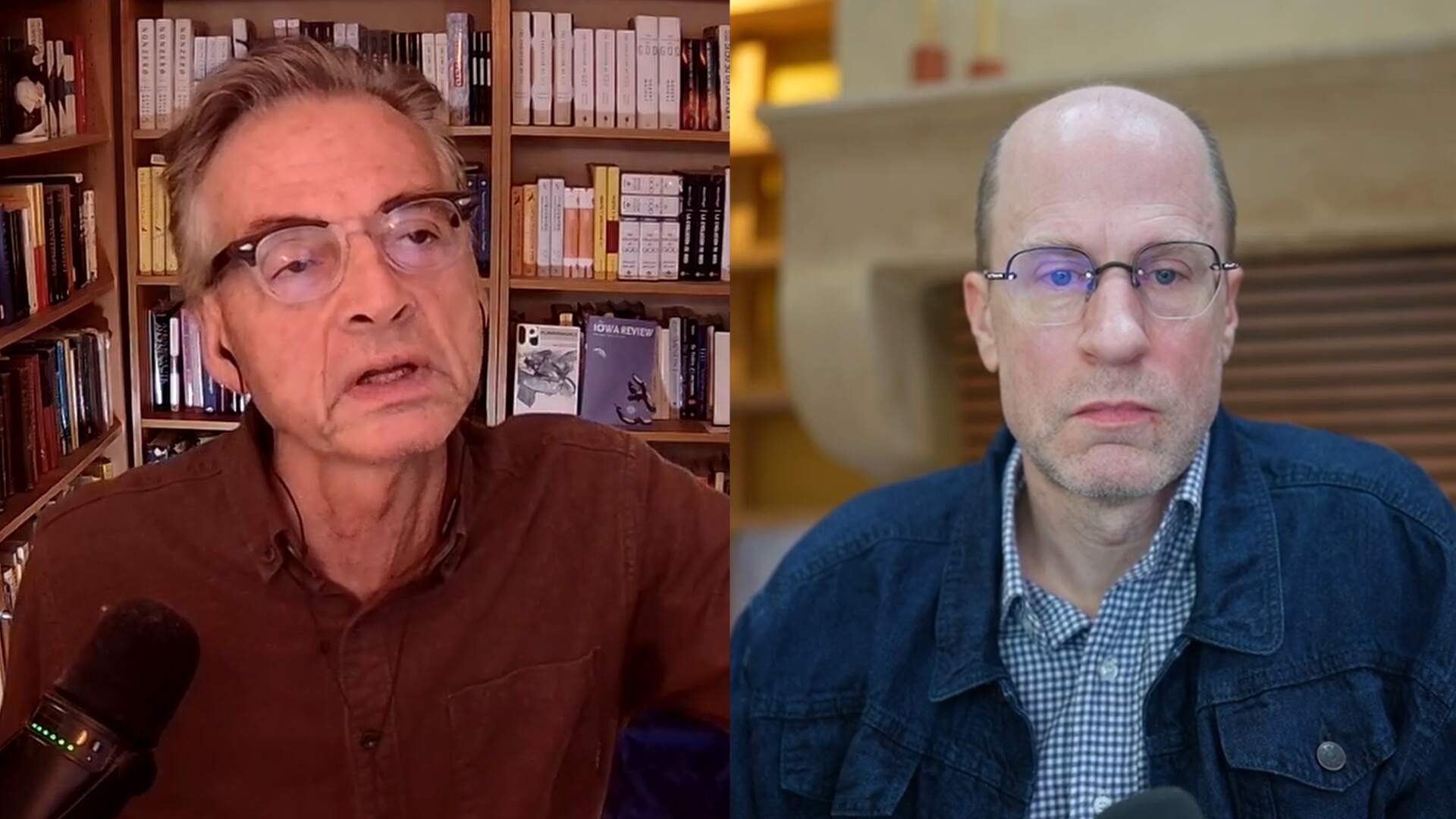
Percontations: The Elusive Hand of God
Recorded: June 6  Posted: June 7

Bloggin' Noggin wrote on 06/07/2009 at 04:47 PM
Morality vs. Moral Sense
I think Karl should have distinguished between two sorts of explanation of the moral sense: debunking and non-debunking explanations.
A non-debunking explanation of some set of beliefs at some level invokes the truth of those beliefs in explaining how we came to have them.
Why do I believe you are standing in front of me? Because you are standing in front of me and my eyes are working properly and light is reflecting off you and entering my eyes, etc. etc. That's a non-debunking explanation.
If the explanation is that I have taken a powerful hallucinogen and am looking at a photograph of you, then that is a debunking explanation (even though it's possible that my belief is by chance true -- you might be standing right behind the picture, unnoticed by me.
Richard Joyce offers an evolutionary explanation of our sense of right and wrong that is debunking in that it never invokes the actual rightness or wrongness of anything. And he concludes that we should, as a result, suspend our belief in right and wrong.
Does Bob feel that he can offer a non-debunking explanation of our sense
mvantony wrote on 06/07/2009 at 04:57 PM
Re: Percontations: The Elusive Hand of God
First, congratulations Bob on your book coming out! Very much looking forward to reading it. Second, I thoroughly enjoyed the diavlog, so thanks to both Bob and Karl.
I'd like to ask Bob if he could tell us more (some time?) about his metaethical position, in particular, whether he considers himself a moral realist or not -- understood, say, as the view that there are mind-independent moral facts, facts e.g., that we can discover, facts we can be right or wrong about, etc. (If that's been made clear in any of Bob's earlier books or in other diavlogs and I've missed it, my apologies.)
I ask because although most of the time in the diavlog Bob focused on our sense of right and wrong, and whether there's anything mysterious about it that evolution can't in principle explain, sometimes he also spoke about right and wrong itself -- e.g., in his Buddhisty reflections toward the end where he speculated about "a radical reorientation of consciousness that might bring us more in line with moral truth". The distinction between our sense of morality, on the one hand, and the facts about morality, on the other, also seems implicit in Bob's Nonzero picture
Me&theboys wrote on 06/07/2009 at 04:58 PM
Re: Percontations: The Elusive Hand of God
Why is evolution always (pejoratively) being called a "just so" story but explanations involving god and the supernatural are never called "just so" stories? The latter seem to me to be the epitome of '"just so" stories.
Wonderment wrote on 06/07/2009 at 05:03 PM
In the Beginning was the word
Philo's interpretation of the Greek "In the beginning..." was surely a riff on the original "In the Beginning," which is the first word of the Torah.
This is even more obvious taking into consideration that the Books of the Torah are named in Hebrew by their first word. For example, Genesis is called Brayshit (first word), Exodus is called "Shmot" after its first word ("The names"), and so on.
The interesting part is that Jewish scholars have been debating the meaning of the first word of Genesis (actually the first vowel in the first word) for at least 1000 years (discussed by Rashi). Is it "brayshit" or "barashit"? In THE beginning or in A beginning? (Talk about angels on the head of a pin!)
The argument first came up to explain who Cain's offspring's mother might be. Surely she couldn't be Eve, Cain's mother, but Eve was the only woman alive. On the other hand, if Genesis said "In A beginning" there could have been other beginnings.
From the "modern" perspective, of course, "a" beginning can suggest multiple worlds and many opportunities for the Logos to play out. Makes the whole universe more random and less Yahwehcentric.
holyworrier wrote on 06/07/2009 at 05:32 PM
Re: Percontations: The Elusive Hand of God
Giberson states: I have a direct and intimate experience of free will that is not subverted by anything... so too bad for your philosophical challenge.
What he means is that he knows he has free will because he can feel it. That's like saying I know God is talking to me because I can hear Him. It's hard to argue with that, and the 'nits to your challenge' non-rebuttal is hard to rebut....
Bob, how can you say that events in the material universe are commonly understood to have no cause? Is it also a common understanding that the limits of the material universe are known?
I'm newly familiar with the venerable Institute for Religion in an Age of Science, and am attending their annual conclave, this year in Chautauqua on 'The Mythical Reality of the Autonomous Individual'. I'm wondering if Giberson has had any affiliation with IRAS. My guess is no, because he is probably an evangelical...?
I'm SO awesome! wrote on 06/07/2009 at 06:21 PM
Re: Percontations: The Elusive Hand of God
i'm five minutes in a i've never been more afraid of bheads. am i supposed to take this seriously?......"Do they have roads in heaven?"...oh, boy......
thprop wrote on 06/07/2009 at 06:21 PM
Re: Morality vs. Moral Sense
Religionists trying to hang on in the face of science. Jerry Coyne, author of Why Evolution is True, said all that needed to be said in the New Republic - Seeing and Believing: The never-ending attempt to reconcile science and religion, and why it is doomed to fail.
BTW, Coyne declined to appear on BHtv (see the first comment and reply) because of the funding from the Templeton Foundation.
Coyne is not a fan of Joan Roughgarden, one of the first Percontations guests. In his talk with Roughgarden, Bob never brought up that Joan used to be Jonathan. Many scientists have a probelm with her objectivity because of this. Roughgarden does not shy from this criticism - read this article posted on a a site friendly to her.
pampl wrote on 06/07/2009 at 06:27 PM
Re: Morality vs. Moral Sense
Quoting Bloggin' Noggin: If no naturalistic theory of morality can justify our belief in right and wrong (as opposed to merely explaining it), then this seems like a powerful argument in favor of a non-naturalistic theory, if such a theory is better at justifying our sense that some things are right and some things are wrong (not necessarily all our detailed views about which actions are which). What do you mean by justification? Isn't our sense of right and wrong a source of justification, not contingent on justification?
Bloggin' Noggin wrote on 06/07/2009 at 06:36 PM
Re: Percontations: The Elusive Hand of God
Quoting Me&theboys: Why is evolution always (pejoratively) being called a "just so" story but explanations involving god and the supernatural are never called "just so" stories? The latter seem to me to be the epitome of '"just so" stories. I'm not so sure that ALL evolutionary explanations are being regarded as "Just so stories".
Speaking only for myself, I would distinguish between cases where the thing to be explained (structure or behavior) clearly has to be explained as an adaptation vs. cases where there is no such clear and compelling case.
The eye has to be an adaptation -- there's no way that all their parts just come together by chance to perform the function of seeing.
On the other hand, look at Bob's explanation (in Moral Animal) of selfishly motivated self-deception.
It's far from clear that this requires an explanation based on natural selection. If natural selection has given us desires for our own pleasure and satisfaction as well as a "moral sense" which sometimes requires us to act against our heart's desires for the sake of others, conflict between the two systems is going to be natural, and if, like other systems designed
uncle ebeneezer wrote on 06/07/2009 at 06:38 PM
Re: Extra! Extra! Bob kills God!
http://bloggingheads.tv/diavlogs/202...1:57&out=12:03
Just trying to help you sell more books, Bob.
Bloggin' Noggin wrote on 06/07/2009 at 06:56 PM
Re: Morality vs. Moral Sense
Quoting pampl: What do you mean by justification? Isn't our sense of right and wrong a source of justification, not contingent on justification? Sorry, I don't understand -- could you amplify your second sentence a bit?
I don't see quite what you mean or why I would obviously agree with that.
By justification, I mean epistemic justification. To amplify my point, if you were to give an explanation of our ordinary senses in terms of evolution, your explanation would probably tend to presuppose the truth of many standard perceptual judgments. Snakes are dangerous to humans, we are more likely to survive if we can see snakes, so natural selection has developed in us the ability to detect snakes. This explanation presupposes that there really are snakes and that humans' beliefs that they are detecting snakes are often justified (in this epistemic sense).
Many evolutionary explanations of our moral sense seem not to presuppose that there really are any moral facts or that our "moral sense" is really detecting these moral facts. These debunking explanations treat our moral beliefs as epistemically unjustified (whether they somehow happen to be true or not).
We can give explanations of why
bjkeefe wrote on 06/07/2009 at 07:03 PM
Re: Morality vs. Moral Sense
Quoting thprop: BTW, Coyne declined to appear on BHtv (see the first comment and reply) because of the funding from the Templeton Foundation. Interesting. Thanks for noting that. I know he's not the only person who wants nothing to do with anything associated with that outfit.
When the TF started sponsoring diavlogs here, I made a tentative defense of Bob taking their money, but I do have to say that since then, even leaving aside any possible sinister underlying motives, these Percontations have not been doing it for me. I'm tired of hearing the sort of stuff they discuss and I miss Free Will. The former in my memory seem all a jumble of meanderings about morality and not much else (except excessive forelock-tugging to religion) and the latter I remember as covering a much wider range of topics, most of them more applicable and nearly all of them more interesting. To my tastes, anyway; I am aware that others here can't get enough of these philosophical diavlogs.
Could also be that I'm extra irritated by them because yesterday's purported Science Saturday was yet another philosophical diavlog.
Thanks for the other links, too, thprop. Reading now ...
Me&theboys wrote on 06/07/2009 at 07:10 PM
Re: Percontations: The Elusive Hand of God
Thanks, BN. Point taken. I agree the term is sometimes appropriate and my use of always was definitely hyperbolic (on purpose). In the context of this diavlog the use of the term seemed pejorative, as the person employing it against the evolutionary explanation has an alternative explanation that also qualifies as a just so story, though he probably doesn't think so.
PS - enjoyed your comment on the other diavlog about the directionality of time.
bjkeefe wrote on 06/07/2009 at 07:19 PM
Re: Percontations: The Elusive Hand of God
Quoting Me&theboys: Why is evolution always (pejoratively) being called a "just so" story but explanations involving god and the supernatural are never called "just so" stories? The latter seem to me to be the epitome of '"just so" stories. Good point.
I did like Bob's answer to this (paraphrased): It is not so much that he's claiming certainty about evolutionary (and evolutionary psychological) explanations. But what he is doing, at minimum, is offering a plausible argument to those who say there is no way one could explain human morality as coming from evolutionary pressures.
pampl wrote on 06/07/2009 at 07:26 PM
Re: Morality vs. Moral Sense
Quoting Bloggin' Noggin: Sorry, I don't understand -- could you amplify your second sentence a bit?
I don't see quite what you mean or why I would obviously agree with that.
By justification, I mean epistemic justification. To amplify my point, if you were to give an explanation of our ordinary senses in terms of evolution, your explanation would probably tend to presuppose the truth of many standard perceptual judgments. Snakes are dangerous to humans, we are more likely to survive if we can see snakes, so natural selection has developed in us the ability to detect snakes. This explanation presupposes that there really are snakes and that humans' beliefs that they are detecting snakes are often justified (in this epistemic sense).
Many evolutionary explanations of our moral sense seem not to presuppose that there really are any moral facts or that our "moral sense" is really detecting these moral facts. These debunking explanations treat our moral beliefs as epistemically unjustified (whether they somehow happen to be true or not).
We can give explanations of why people believe in witches and why sticks placed partly in water look bent which do not assume that
Simon Willard wrote on 06/07/2009 at 07:33 PM
Re: Percontations: The Elusive Hand of God
Quoting holyworrier: Bob, how can you say that events in the material universe are commonly understood to have no cause? The laws of Quantum Mechanics state that events in the sub-atomic realm have a probability, not a certainty, of occuring. This does not simply reflect our inability to measure things. Quantum theory states that exact predictions are impossible in principle. A electron might randomly go left or go right, but if it "decides" to go right you can never assign a cause to that.
This might sound like excessive attention to detail in a discussion about God, except for one thing: Quantum Mechanics and the "Standard Model" of Physics comprise the most successful and precise scientific theory ever devised. This probabilistic situation is understood and accepted (sometimes uncomfortably) by all serious scientists. That's what Bob meant by "commonly understood".
I'm SO awesome! wrote on 06/07/2009 at 08:14 PM
Re: Morality vs. Moral Sense
holy crap that's what's going on? thanks for telling us cuz i really wasn't paying attention to this. you summed it up well. i'll add: this stinks! just do REAL science talks. wow,this is not good. is bob an ideologue now? i think he might be.
here's a random link on the evolution of religion for anyone who's interested:
http://www.boingboing.net/2009/06/06...eligion-s.html
Wonderment wrote on 06/07/2009 at 08:39 PM
Re: Morality vs. Moral Sense
In his talk with Roughgarden, Bob never brought up that Joan used to be Jonathan. Many scientists have a probelm with her objectivity because of this. What?!!! What on Earth does Roughgarden's gender have to do with her "objectivity?" Have you lost your mind? Who are these "many scientists?"
thprop wrote on 06/07/2009 at 09:21 PM
Re: Morality vs. Moral Sense
Quoting Wonderment: What?!!! What on Earth does Roughgarden's gender have to do with her "objectivity?" Have you lost your mind? Who are these "many scientists?" Her gender is not the issue - rather her experience as a transgendered person switching from male to female is considered relevant by some. I suggest you read the Nature article I linked to - one that is friendly to Roughgarden. You can find a lot that are not friendly to her. From that article -
But some scientists privately wonder if — whether she likes to admit it or not — Roughgarden's own experiences of social exclusion have biased her view of the natural world. Even the broadly supportive Shuster, who is open to the idea of social selection operating alongside sexual selection, feels that Roughgarden goes too far in attacking Darwin's theory. "She throws out a very healthy baby with some slightly soiled bathwater," he says. I cannot find a free link to the Science article, but this from her Wikipedia entry -
In addition to a seminal ecology textbook written with Paul R. Ehrlich, Roughgarden published a 2004 challenge to certain tenets of sexual selection titled Evolution's Rainbow (2004): this is
Wonderment wrote on 06/07/2009 at 10:00 PM
Re: Morality vs. Moral Sense
But some scientists privately wonder... Oh, some scientists privately wonder. Well, THAT certainly backs up the accusation.
Some scientists privately practice astrology, suck their thumbs and wet their bed too.
Ideophile wrote on 06/07/2009 at 10:52 PM
Re: Percontations: The Elusive Hand of God Hey Bob!!
Bob claimed that there was an opening for god to intervene at the quantum level. I don't see how that's the case, if physics at every level above quantum level is completely deterministic. If randomness at the quantum level is not reflected in higher levels, then god's interventions at the quantum level will also not be reflected at higher levels. Am I wrong in thinking this?
pampl wrote on 06/08/2009 at 12:18 AM
Re: Percontations: The Elusive Hand of God Hey Bob!!
Quoting Ideophile: Bob claimed that there was an opening for god to intervene at the quantum level. I don't see how that's the case, if physics at every level above quantum level is completely deterministic. If randomness at the quantum level is not reflected in higher levels, then god's interventions at the quantum level will also not be reflected at higher levels. Am I wrong in thinking this? The deterministic view of the universe was always just a theoretical view, it's not like we actually have a deterministic understanding of most of what goes on around us. The line of reasoning was that if this small stuff behaved deterministically than everything made of it must as well. The universe at that level can't even in theory be reduced to a set of initial values and iterated formulae though so that argument is scuppered.
That doesn't mean it's wrong necessarily, just that the assertion "physics at every level above quantum level is completely deterministic" needs a new justification.
Nate wrote on 06/08/2009 at 12:46 AM
Mustache
Stache' vs clean shaven.
Bloggin' Noggin wrote on 06/08/2009 at 12:52 AM
Re: Morality vs. Moral Sense
Quoting pampl: Yes, I think it does. I think my problem here is that I don't think epistemically justifying our moral beliefs in this way is necessarily a positive. Based on this line I think we're substantively in agreement:
"I personally think that moral truth is consistent with naturalism and that the evolutionary explanation of our sense of right and wrong need not debunk all our views about right and wrong."
What I don't agree with (assuming I'm understanding it right) is that being able to offer a non-debunking explanation is a powerful positive. Moral sentiments are intrinsically motivating and compelling: I think it's wrong to hurt people so I don't do it, I don't need to be convinced of some external reality of this rightness or wrongness. Epistemic justification doesn't offer any intrinsic motivation: I'm more convinced of my own existence than I am of anything else, yet it doesn't motivate me or influence me at all. So why is it necessarily valuable that morality has some external justification?
I'm not trying to argue against moral objectivism here, just (what I read as) the presupposition that there's value in supporting that position. I'm not sure what kind of value
Starwatcher162536 wrote on 06/08/2009 at 12:53 AM
We stupid humans.
I wonder if some Alien species that had cognitive functions far surpassing ours would think after seeing this..." those dumbasses!, can't they see all those numerous parameters only rely on a single variable?". [For example, I know at one time the people working on supersymmetry thought that all the forces are just one force at high energies. So all the variables that had to be "tuned" all depended on one variable]
If you have a puzzle thats only half assembled[can't tell the picture yet], trying to explain why they came together in that particular configuration seems very hard to do. One could even say God planned it that way.
Once you have it completely assembles though, you would feel a little silly saying God must be the cause. [Lets not be dumb and ignore that puzzles are designed that way].
Starwatcher162536 wrote on 06/08/2009 at 12:56 AM
If I were a Christian...
If I were a Christian...I would feel alot safer saying God suspends natural law when no one is looking then trying to fit God's actions into a window of ignorance that science keeps on narrowing.
mvantony wrote on 06/08/2009 at 01:42 AM
Re: Morality vs. Moral Sense
Quoting pampl: What I don't agree with (assuming I'm understanding it right) is that being able to offer a non-debunking explanation is a powerful positive. Moral sentiments are intrinsically motivating and compelling: I think it's wrong to hurt people so I don't do it, I don't need to be convinced of some external reality of this rightness or wrongness. Epistemic justification doesn't offer any intrinsic motivation: I'm more convinced of my own existence than I am of anything else, yet it doesn't motivate me or influence me at all. So why is it necessarily valuable that morality has some external justification?
I'm not trying to argue against moral objectivism here, just (what I read as) the presupposition that there's value in supporting that position. Assuming you're right that whether or not there are objective moral facts is irrelevant to accounting for our motivations to behave in ways we deem moral (and I'm not sure that is right, e.g., for the sorts of reasons BN layed out), why think motivation is the only thing to be explained? If part of our conception of morality involves powerful intuitions to the effect that people can be wrong about
pampl wrote on 06/08/2009 at 01:51 AM
Re: Morality vs. Moral Sense
Quoting Bloggin' Noggin: "Should I go around hurting other people" is hardly a very likely moral question. But consider the kinds of moral question you face all the time. If your Mom wanted you to be a banker and you want to become an actor, it may hurt her that you follow your own course. From what you've said so far, it sounds like you should just become a banker then.
But, as this example begins to show, morality is often about balancing the interests of different people.
[1]Husband and wife might argue about whether the husband does enough to clean the house. Perhaps the husband is a total jerk and just takes up a negotiating position that gets him out of as much housework as he possibly can get out of. But some husbands would actually reflect on the issue and come to a fair decision about whether they need to do more. If there are no moral truths, what are such husbands even thinking about?
[2]Many of us worry about whether we are doing the right thing, and we consult our friends in the hope that they can
AemJeff wrote on 06/08/2009 at 01:57 AM
Re: Morality vs. Moral Sense
Quoting Bloggin' Noggin: ...
Husband and wife might argue about whether the husband does enough to clean the house. Perhaps the husband is a total jerk and just takes up a negotiating position that gets him out of as much housework as he possibly can get out of. But some husbands would actually reflect on the issue and come to a fair decision about whether they need to do more. If there are no moral truths, what are such husbands even thinking about? ... BN, isn't the question really "Are moral truths objective or normative ?", rather than "Are there any moral truths?" pampl's point about the lack of a need for external justification doesn't seem inconsistent with the idea of a normative basis for morality.
AemJeff wrote on 06/08/2009 at 02:05 AM
Re: Morality vs. Moral Sense
Quoting mvantony: To sharpen the question, imagine a species of intelligent extraterrestrials whose evolved moral sense leads them hold opinions they judge to be moral but which our moral sense disposes us to judge as immoral. Our moral sense will explain our (relevant) motivation to think and behave as we do, and their moral sense will explain theirs. Moreover, our moral sense will explain why we judge their opinions as morally wrong, and their moral sense will explain why they judge ours as morally wrong. But do you believe that's all there is to be said? Do you believe there is, and can be, no fact about which of us is closer to the truth? That there is no fact of the matter? Many people believe that, but I think it must be acknowledged that that's a pretty counterintuitive result, even if true. So at least one advantage of recognizing objective moral truths is that is allows for a theory of morality to avoid such counterintuitive results. I've floated an argument pretty similar to this in the past. I'd have to say that I'm convinced that it's consistent to believe that
mvantony wrote on 06/08/2009 at 02:11 AM
Re: Morality vs. Moral Sense
Quoting AemJeff: I've floated an argument pretty similar to this in the past. I'd have to say that I'm convinced that it's consistent to believe that two moral systems could be be entirely incompatible, and each could be, by its own lights, perfectly reasonable. Perhaps. But my question concerns what can be said about the truth or falsity of the systems. (After all, false beliefs can sometimes be reasonably held.)
ADDED: Take the case of scientific disputes. At least in some cases, it's natural to think that both sides of a dispute (e.g., regarding the truth or plausibility of some scientific theory) can be reasonably held. But we still think that at most one side can be right.
AemJeff wrote on 06/08/2009 at 02:30 AM
Re: Morality vs. Moral Sense
Quoting mvantony: Perhaps. But my question concerns what can be said about the truth or falsity of the systems. (After all, false beliefs can sometimes be reasonable held.) I'm not sure by what standard you judge the truth or falsity of a moral system, except in terms of its consistency. I understand what it means to disprove a proposition within a particular system, but I really don't know how you would disprove the system itself.
mvantony wrote on 06/08/2009 at 03:04 AM
Re: Morality vs. Moral Sense
Quoting AemJeff: I'm not sure by what standard you judge the truth or falsity of a moral system, except in terms of its consistency. I understand what it means to disprove a proposition within a particular system, but I really don't know how you would disprove the system itself. As someone with strong realist inclinations (not just on questions of morality but pretty much across the board) I'm inclined to keep metaphysical questions -- about how things are, about what's true, etc. -- separate from epistemological questions -- about how we could come to know or prove how things are or what's true -- to the extent possible. Realists often point out that they're inclined to keep metaphysical and epistemological questions separate when they don't know how to answer hard epistemological questions (like yours); and they maintain the hope that a satisfactory answer to the hard epistemological questions might eventually be found, or at least that there is an answer, even if we can't know it. That's more or less my current position for the case of morality (I hope, partly because I'm not that familiar with the philosophical literature on metaethics, and haven't
holyworrier wrote on 06/08/2009 at 07:34 AM
Re: Percontations: The Elusive Hand of God
Thanks, Simon. I'm familiar with the uncertainty principle, I'd just not heard the quizzical behavior of the electron described as 'uncaused'.
Bloggin' Noggin wrote on 06/08/2009 at 07:41 AM
Re: Morality vs. Moral Sense
Quoting AemJeff: I've floated an argument pretty similar to this in the past. I'd have to say that I'm convinced that it's consistent to believe that two moral systems could be be entirely incompatible, and each could be, by its own lights, perfectly reasonable. Well, of course it's consistent, Jeff -- at least if we don't put too many constraints on what can count as a "moral system" -- if we mean only that this is the deepest set of customs according to which a society regulates the interactions of individuals.
The question is whether it's what you really believe. Suppose that the extraterrestrials are exterminating us so they can have a nice human-free planet or raising us to be used in gruesome medical experiments and that this is perfectly OK by their lights (even though they are aware that we are intelligent, though less advanced, beings).
If you did not think moral claims were especially problematic (ultimately for the kind of bad positivist arguments which have made this view seem commonsensical) would you not be very strongly inclined to think that the aliens were wrong, not by our standard
holyworrier wrote on 06/08/2009 at 07:53 AM
Re: If I were a Christian...
Quoting Starwatcher162536: If I were a Christian...I would feel alot safer saying God suspends natural law when no one is looking then trying to fit God's actions into a window of ignorance that science keeps on narrowing. If a god(s) exists, it must exist within the realm of possibilities for things to exist, which realm is the Natural realm, characterized by all the possibilities for behavior of all the things which exist, rules being the descriptions of those behaviors. Under this view, there is no such thing as 'supernatural'. What's more, each aspect of the Natural realm would interface with every other aspect, and so if god wanted to influence the universe of mankind, there would be no issue of suspension of law, existing as we do in a small (infinitely?) corner of the Natural realm.
In other words, if a god(s) exists, it is made out of something that exists, and is quantifiable in some way. Things don't exist that are not made out of anything. I don't think there is any question of whether a god could have made everything that exists, if the god itself exists, eh?
As to the question of morality vis a vis
Bloggin' Noggin wrote on 06/08/2009 at 07:57 AM
Re: Morality vs. Moral Sense
Quoting AemJeff: I'm not sure by what standard you judge the truth or falsity of a moral system, except in terms of its consistency. I understand what it means to disprove a proposition within a particular system, but I really don't know how you would disprove the system itself. mavantony's response is excellent, as usual. Let me just ask whether you would say the same about science? There are any number of (perhaps highly implausible) theories that are consistent with all the evidence we have at any particular time. (This is a point developed over and over by W.V.O. Quine, if you'd like to see more on the subject than this brief note.) Such alternative theories can be made quite consistent with enough ad hoc hypotheses, but
(a) as mvantony points out, this doesn't mean we don't believe that only one of them is true
and
(b) we actually do feel able to choose between, say, a Ptolemaic conception of the solar system updated with enough additional ad hoc assumptions to make it consistent with the data and our current updated Copernican view, even though both are consistent and consistent with the data.
I suspect that you
Simon Willard wrote on 06/08/2009 at 08:16 AM
Re: If I were a Christian...
An atheist should not declare that religion and science are irreconcilable. It takes a religious believer to make that judgement.
Simon Willard wrote on 06/08/2009 at 08:36 AM
Re: Percontations: The Elusive Hand of God Hey Bob!!
I think this is where you can bring in "chaos theory", i.e., the recently-appreciated way that a small action can sometimes have huge, unforseeable effects. Most quantum fluctuations don't have effects that propagate into our macroscopic world. But what if you ask "Why did my computer chip fail at exactly 12:29 before my scheduled 12:30 backup, causing me to lose my data, causing me to lose my job?" It might be that there was a single quantum event somewhere in the nearly infinite sea of events which, if you changed it, could have altered the macroscopic outcome.
Also, Schrodinger's famous gedenken "cat" experiment is a way of forcing a single quantum event to produce macroscopic effects.
So there is plenty of room for an omnipotent, omnicient God to operate through the quantum fog. Of course, once you have infinity on your side (omnipotent, omnicient) you can do just about anything.
pampl wrote on 06/08/2009 at 08:44 AM
Re: Morality vs. Moral Sense
Quoting Bloggin' Noggin: Well, of course it's consistent, Jeff -- at least if we don't put too many constraints on what can count as a "moral system" -- if we mean only that this is the deepest set of customs according to which a society regulates the interactions of individuals.
The question is whether it's what you really believe. Suppose that the extraterrestrials are exterminating us so they can have a nice human-free planet or raising us to be used in gruesome medical experiments and that this is perfectly OK by their lights (even though they are aware that we are intelligent, though less advanced, beings).
If you did not think moral claims were especially problematic (ultimately for the kind of bad positivist arguments which have made this view seem commonsensical) would you not be very strongly inclined to think that the aliens were wrong, not by our standard or their standard, but by the correct standard? This example is really problematic for your own position. The aliens are presumably working with the same kind of evidence we are, so you'd have no reason to think you were closer to
pampl wrote on 06/08/2009 at 08:50 AM
Re: If I were a Christian...
Quoting Simon Willard: An atheist should not declare that religion and science are irreconcilable. It takes a religious believer to make that judgement. I agree with you in the emotional sense of reconciliation. I don't see why atheists are unqualified to weigh in on whether they're logically irreconcilable, i.e. contradictory, though.
Simon Willard wrote on 06/08/2009 at 08:55 AM
Re: If I were a Christian...
Quoting pampl: I agree with you in the emotional sense of reconciliation. I don't see why atheists are unqualified to weigh in on whether they're logically irreconcilable, i.e. contradictory, though. Yeah, the difficulty is that religious arguments are slippery, and at some point they always transcend logic.
BornAgainDemocrat wrote on 06/08/2009 at 09:18 AM
The Elusive Hand of God
Confining ourselves to the Hebraic conception of God as found in the patriarchal narratives in Genesis (which is not, btw, inconsistent with other conceptions in other parts of the Bible, but is much more restricted) I would like to make a possible naturalistic argument in favor of the existence of such a God which I have not heard before, at least in Bob's books:
But, first, what is that Hebraic conception? Very simply, it is the idea that God is just and that he has sufficient power to judge the behavior of human beings in their relations to each other according to the standards of justice. I should point out that the word for justice in the Hebrew Bible (sometimes translated more nebulously as "righteousness") is derived from the two words zedec and tamen, which literally meant straight and whole: these were the terms used to describe the weights and scales used in ancient commerce, the weights having to be "whole" and the balance beam "straight" in order to have an honest measuring device.
In other words, justice comes down to fair dealing -- as opposed to the use of force and fraud
holyworrier wrote on 06/08/2009 at 10:22 AM
Re: The Elusive Hand of God
Quoting BornAgainDemocrat: ....But, first, what is that Hebraic conception? Very simply, it is the idea that God is just and that he has sufficient power to judge the behavior of human beings in their relations to each other according to the standards of justice. The just nature of the Judeo/Christian god is problematic. The concept of justice among the tribes of Israel and among their Arab brethren was primitive, involving blood-for-blood. It also involved genocide.
The central doctrine of Christianity, that of Propitiation, is based on ancient codes of justice. Blood for blood. God's senses of Perfect Justice and Perfect Mercy harmonized in the death of the sinless Jesus, who took the punishment which mankind deserves, making mankind presentable to God. The only problem is, now we understand justice in a different light. We know that to punish someone for a crime they did not commit is a miscarriage of justice. The death, burial and resurrection of Jesus is rendered pointless by a sophisticated understanding of justice.
Tyrrell McAllister wrote on 06/08/2009 at 10:26 AM
Re: Morality vs. Moral Sense
Quoting thprop: Her gender is not the issue - rather her experience as a transgendered person switching from male to female is considered relevant by some. I suggest you read the Nature article I linked to - one that is friendly to Roughgarden. You can find a lot that are not friendly to her. From that article -
But some scientists privately wonder if — whether she likes to admit it or not — Roughgarden's own experiences of social exclusion have biased her view of the natural world. Even the broadly supportive Shuster, who is open to the idea of social selection operating alongside sexual selection, feels that Roughgarden goes too far in attacking Darwin's theory. "She throws out a very healthy baby with some slightly soiled bathwater," he says. That is annoyingly bad journalism on Nature's part. (I'm assuming that your quote doesn't omit some exculpating context.) The author makes the claim that some scientists believe that her own experiences make her unobjective. Then, as evidence, the article quotes a scientist who is skeptical of some of her scientific claims. So that scientist believes that her theories are wrong to some extent. But, totally absent
Tyrrell McAllister wrote on 06/08/2009 at 10:30 AM
Re: Morality vs. Moral Sense
Quoting bjkeefe: When the TF started sponsoring diavlogs here, I made a tentative defense of Bob taking their money, but I do have to say that since then, even leaving aside any possible sinister underlying motives, these Percontations have not been doing it for me. I'm tired of hearing the sort of stuff they discuss and I miss Free Will. Wait, Free Will has been replaced by these Percontations? It true, that is really a shame. I enjoy these Percontations, and I have no issue with the TF funding, but if it's a choice between these and Will Wilkinson, well, it's not the choice that I would have made.
BornAgainDemocrat wrote on 06/08/2009 at 11:43 AM
Re: The Elusive Hand of God
Quoting holyworrier: The just nature of the Judeo/Christian god is problematic. The concept of justice among the tribes of Israel and among their Arab brethren was primitive, involving blood-for-blood. It also involved genocide. The Hebrew Bible -- and indeed the whole history of Judaism for that matter -- can be read as a struggle between these two conflicting conceptions of God: one universalistic, associated with Abraham, the other tribal, associated with Moses, with the later prophets constantly calling Israel back to the original conception and explaining disaster as God's punishment for failure to live up to it. To their credit the Jewish people have been honest enough to record both the good and the bad when it comes to telling their story. To me, this is what makes it so fascinating.
As for New Testament theology -- including the idea of the vicarious sacrifice of the Son of God for the sins of humanity -- I see it, like all theology, as being more about church politics than the content of faith -- much in the same way as modern literary theory is really all about academic politics, not literature.
"There is a God and
nikkibong wrote on 06/08/2009 at 11:44 AM
Re: Morality vs. Moral Sense
Quoting bjkeefe:
When the TF started sponsoring diavlogs here, I made a tentative defense of Bob taking their money, but I do have to say that since then, even leaving aside any possible sinister underlying motives, these Percontations have not been doing it for me ... I don't see why it had to be, to use a Bobian term, zero-sum; why can't we have our libertarian cake and eat it too? (Translation: have both Free Will & Percontations.) I tend to agree with your sentiment, Brendan, although I really liked the diavlog about time with the Patrick Stewart lookalike which ran a few weeks back. That being said, my knowledge of philosophy is pure dilletantism, so I don't have much to add to the comments on these 'vlogs.
What I really miss are the diavlogs that dealt with issues outside of the philosophy/politics realm: discussions of cultural events such as movies, or sports, or problems in the academy. Been forever since we've had movie critics on the site. (My dream is an Armond White / Stephanie Zachareck diavlog.)
And I've been agitating for almost a year to get Patrick Smith on here to do a Mile High Club diavlog. Especially in the light of the recent
DoctorMoney wrote on 06/08/2009 at 11:50 AM
Re: Morality vs. Moral Sense
Quoting Bloggin' Noggin: My point first of all is that, whether there's value to believing it or not, we DO believe that there is moral truth, and in pretty much the way we believe in the external world -- i.e., if we are convinced by some skeptical argument, we can't help believing that we have two hands and that if someone tortures us for no particular reason they are doing something wrong. I'm one of those people who thinks that empathy describes what we do a whole lot better than morality. We have a visceral sense of empathy that you're describing here (like your visceral sense of your hands) that can be altered with training but is fundamental to our ability to socialize.
AemJeff wrote on 06/08/2009 at 12:10 PM
Re: Morality vs. Moral Sense
Quoting Bloggin' Noggin: Well, of course it's consistent, Jeff -- at least if we don't put too many constraints on what can count as a "moral system" -- if we mean only that this is the deepest set of customs according to which a society regulates the interactions of individuals.
The question is whether it's what you really believe. Suppose that the extraterrestrials are exterminating us so they can have a nice human-free planet or raising us to be used in gruesome medical experiments and that this is perfectly OK by their lights (even though they are aware that we are intelligent, though less advanced, beings).
If you did not think moral claims were especially problematic (ultimately for the kind of bad positivist arguments which have made this view seem commonsensical) would you not be very strongly inclined to think that the aliens were wrong, not by our standard or their standard, but by the correct standard?
Two bonus points for you:
1. What evidence would we use that their standard is wrong? My evidence would be that they would object if our positions were reversed -- the same kind of evidence
uncle ebeneezer wrote on 06/08/2009 at 01:00 PM
Re: Morality vs. Moral Sense
I have to agree. I enjoy these Percontations chats, but find myself skipping them more and more. Free Will was always (almost) must-see in my book. It's time to Free Free Will!
AemJeff wrote on 06/08/2009 at 01:09 PM
Re: Morality vs. Moral Sense
Quoting Tyrrell McAllister: Wait, Free Will has been replaced by these Percontations? It true, that is really a shame. I enjoy these Percontations, and I have no issue with the TF funding, but if it's a choice between these and Will Wilkinson, well, it's not the choice that I would have made. I get the feeling it's at least partly a choice that Will made, after he got his new job in a new town.
Starwatcher162536 wrote on 06/08/2009 at 01:19 PM
Re: Morality vs. Moral Sense
I agree with you, I'd say a good 25-35% of diavlogs Id rate with an A were wilkinson ones
maximus444 wrote on 06/08/2009 at 04:20 PM
The Elusive Hand of God
These conversations are interesting as always (mostly). But as Karl said he's not coming at it from a scientific perspective but from a christian perspective and also doesn't seem to care much if natural selection can or cannot explain the human condition.
But from a personal perspective this type of religious view should be encouraged to counter act the more extreme views.
bjkeefe wrote on 06/08/2009 at 04:22 PM
Re: Morality vs. Moral Sense
Quoting Tyrrell McAllister: Wait, Free Will has been replaced by these Percontations? I should have made clear that I am just conjecturing that, based on my memory of the past several Sundays. And it's also possible ...
Quoting AemJeff: I get the feeling it's at least partly a choice that Will made, after he got his new job in a new town. ... that Jeff is right.
Quoting nikkibong: I don't see why it had to be, to use a Bobian term, zero-sum; why can't we have our libertarian cake and eat it too? (Translation: have both Free Will & Percontations.) That'd be fine with me, assuming it's an option as far as all parties are concerned. However, it seems to be the case that Bh.tv is fairly set on eight diavlogs per week, for whatever reason (and I can imagine a few arguably good ones).
Quoting nikkibong: What I really miss are the diavlogs that dealt with issues outside of the philosophy/politics realm: discussions of cultural events such as movies, or sports, or problems in the academy. Agreed. I'm always up for broadening the topics addressed. I would like more science and more technology, as well as some of the things you suggested.
Quoting nikkibong: And I've been agitating for almost a year to get Patrick
AemJeff wrote on 06/08/2009 at 04:38 PM
Re: Morality vs. Moral Sense
Quoting Bloggin' Noggin: mavantony's response is excellent, as usual. Let me just ask whether you would say the same about science? There are any number of (perhaps highly implausible) theories that are consistent with all the evidence we have at any particular time. (This is a point developed over and over by W.V.O. Quine, if you'd like to see more on the subject than this brief note.) Such alternative theories can be made quite consistent with enough ad hoc hypotheses, but
(a) as mvantony points out, this doesn't mean we don't believe that only one of them is true
and
(b) we actually do feel able to choose between, say, a Ptolemaic conception of the solar system updated with enough additional ad hoc assumptions to make it consistent with the data and our current updated Copernican view, even though both are consistent and consistent with the data.
I suspect that you are emplying a standard when it comes to morality that you would not employ when it came to science. But whether or not it's fair to do that is the whole question at issue between realists and anti-realists about morality. I understand what it
bjkeefe wrote on 06/08/2009 at 04:41 PM
Re: The Elusive Hand of God
Quoting maximus444: These conversations are interesting as always (mostly). But as Karl said he's not coming at it from a scientific perspective but from a christian perspective and also doesn't seem to care much if natural selection can or cannot explain the human condition. Which sort of makes the discussion pointless, from my point of view.
But from a personal perspective this type of religious view should be encouraged to counter act the more extreme views. Agree somewhat, and certainly, I'd be delighted if all religious people were more like Karl. On the other hand, there is the real problem that the more moderate religious points of view provide cover for, and/or encourage the growth of, more extreme versions of religious belief and practice. It's hard to say where to draw the line, but I will say that someone who adopts the attitude that he doesn't much care what science has to say about evolution (or any other topic) has got at least one foot across that line.
bjkeefe wrote on 06/08/2009 at 04:44 PM
Re: Morality vs. Moral Sense
Quoting bjkeefe: And it's also possible ...
... that Jeff is right. While having a quick look at Will's blog to see if there was anything to substantiate Jeff's hypothesis, I noticed a link from him to a piece by Bob on Cato Unbound. Links here.
AemJeff wrote on 06/08/2009 at 04:51 PM
Re: Morality vs. Moral Sense
Quoting bjkeefe: While having a quick look at Will's blog to see if there was anything to substantiate Jeff's hypothesis, I noticed a link from him to a piece by Bob on Cato Unbound. Links here. I seem to recall Will indicating in one of the last Free Will episodes that it was becoming difficult for him to maintain a weekly schedule. Unfortunately I don't remember precisely which one. I don't think he announced that he was going to quit doing them, but it wasn't much later when episodes stopped appearing altogether.
Wonderment wrote on 06/08/2009 at 04:59 PM
Re: The Elusive Hand of God
...there is the real problem that the more moderate religious points of view provide cover for, and/or encourage the growth of, more extreme versions of religious belief and practice. On what basis do you say that's a "real problem?" My lifelong experience with religious people strongly suggests to me that the contrary is true: moderate, liberal practitioners of religion inhibit, discourage and limit the growth of the more extreme versions. Sort of like community policing. For example, Christians like Martin Luther King, Jr. make it less (not more) likely that extreme Christians will resort to murderous violence. Reform Jews are likely to reduce Jewish support for Israeli extremist Settlement growth.
I know Hitchens and others have promulgated a view of liberal religion as the just-as-toxic enabler of radical religion, but I have never understood what they base it on.
Wonderment wrote on 06/08/2009 at 05:17 PM
Re: Morality vs. Moral Sense
I seem to recall Will indicating in one of the last Free Will episodes that it was becoming difficult for him to maintain a weekly schedule. Unfortunately I don't remember precisely which one. I don't think he announced that he was going to quit doing them, but it wasn't much later when episodes stopped appearing altogether. Yep. That is my recollection too.
graz wrote on 06/08/2009 at 05:31 PM
Re: Morality vs. Moral Sense
Quoting bjkeefe: I wouldn't mind hearing from him, either, but I have the impression that "Patrick Smith" is a pseudonym. I could be wrong, but I have a memory that this is so. If I'm right, though, he or she might not want to appear on camera. The name has been changed to protect the innocent.
In case the bookers are reading!
Wonderment wrote on 06/08/2009 at 05:31 PM
Re: Morality vs. Moral Sense
Perhaps I'm missing something here, but it seems to me that any society in any part of the universe that has evolved separate conscious selves would base social interaction on some notion of entitlement, rights, fairness. There would be rules of interaction: Can I kill you? Can you take my stuff? Who gets to make the decisions? How do we resolve disputes? Who has standing?
What else is there to explain? Where's the philosophical conundrum?
Any extraterrestrial civilization that thought it would be okay to consume us, use us for target practice or subject us to medical experimentation would do so on the basis of whether we had standing and rights.
They might conclude -- as we do with mice -- that we're too stupid and simple to have rights or standing, or that it's a good idea to put us out of our misery (perhaps they live ecstatic, pain-free lives). They might decide we're too incorrigibly dangerous for other civilizations -- another reason to exterminate us. Or they might let us make our case for survival, standing and rights.
AemJeff wrote on 06/08/2009 at 06:02 PM
Re: Morality vs. Moral Sense
Quoting Wonderment: Perhaps I'm missing something here, but it seems to me that any society in any part of the universe that has evolved separate conscious selves would base social interaction on some notion of entitlement, rights, fairness. There would be rules of interaction: Can I kill you? Can you take my stuff? Who gets to make the decisions? How do we resolve disputes? Who has standing?
What else is there to explain? Where's the philosophical conundrum?
Any extraterrestrial civilization that thought it would be okay to consume us, use us for target practice or subject us to medical experimentation would do so on the basis of whether we had standing and rights.
They might conclude -- as we do with mice -- that we're too stupid and simple to have rights or standing, or that it's a good idea to put us out of our misery (perhaps they live ecstatic, pain-free lives). They might decide we're too incorrigibly dangerous for other civilizations -- another reason to exterminate us. Or they might let us make our case for survival, standing and rights. I really don't think we have a reason to assume anything at all, even things as
bjkeefe wrote on 06/08/2009 at 06:09 PM
Re: Morality vs. Moral Sense
Quoting Wonderment: Yep. That is my recollection too. Thanks to you and Jeff for letting me know.
bjkeefe wrote on 06/08/2009 at 06:09 PM
Re: Morality vs. Moral Sense
Quoting graz: The name has been changed to protect the innocent.
In case the bookers are reading! Ah, I stand corrected. Thanks.
bjkeefe wrote on 06/08/2009 at 06:16 PM
Re: The Elusive Hand of God
Quoting Wonderment: On what basis do you say that's a "real problem?" My lifelong experience with religious people strongly suggests to me that the contrary is true: moderate, liberal practitioners of religion inhibit, discourage and limit the growth of the more extreme versions. Sort of like community policing. For example, Christians like Martin Luther King, Jr. make it less (not more) likely that extreme Christians will resort to murderous violence. Reform Jews are likely to reduce Jewish support for Israeli extremist Settlement growth.
I know Hitchens and others have promulgated a view of liberal religion as the just-as-toxic enabler of radical religion, but I have never understood what they base it on. Yes, I am following along the lines of Hitchens, and more so, Harris on this. It'd be better for you to read them directly, since I cannot reproduce their arguments completely, but I will say that there are occasions when more moderate religious people act as a buffer or apologists for their extremist cousins. I will also say that it seems to me that they could be doing more to distance themselves. And, to the point here, a guy like Karl putting forth the proposition that he considers his religious
Anyuser wrote on 06/08/2009 at 06:40 PM
Re: Percontations: The Elusive Hand of God
I finished Evolution of God yesterday. Everybody on earth should read all of Bob’s books. He is an invaluable public intellectual.
Having said that, I can’t help but wonder if Bob’s enterprise in EOG is doomed from the get-go. His argument (radically dumbed down by me) is that (i) a conception of right and wrong is developed by natural selection, (ii) the content of right and wrong is determined by natural selection in a culture, and (iii) the outcome of that cultural contest, the aggrandizement of right and wrong in a way he approves of, shows improvement over time and suggests a promising future. Throughout the argument, he goes back and forth between (i) contending that philosophical hocus pocus is unnecessary and suspect (and that, by the way, anybody who believes in the literal, that is historical, truth of religious texts is an idiot), and (ii) obviously craving something beyond the mindless, material world. He would like it to be that evolution in the material world signifies divinity outside the material world, although he is very diffident, expressly so, on this ultimate point.
I’m a hard rock atheist, but that’s not going to stop me from saying that those who contend that
themightypuck wrote on 06/08/2009 at 06:56 PM
Grrrrr Arggggg
I actually enjoy a lot of the Percontations dvlogs but this one is just silly. Kierkegaard is the last word on God. It may not be irrational to believe in God but it is impossible to discuss it rationally.
Edit: you could replace God for dualism for the purposes of this dvlog.
themightypuck wrote on 06/08/2009 at 07:00 PM
Re: Morality vs. Moral Sense
While it isn't evidence, the source of information is a useful heuristic.
themightypuck wrote on 06/08/2009 at 07:01 PM
Re: Mustache
Someone needs to get out the Occam's razor.
themightypuck wrote on 06/08/2009 at 07:12 PM
Re: The Elusive Hand of God
Well, one could argue that religion is so pervasive that it isn't religion itself that makes someone like MLK important. Rather it is the fact that he could hang rational moral principles off of religion that makes MLK important. This is one of those problems with history. We can't roll back the clock.
holyworrier wrote on 06/08/2009 at 07:14 PM
Re: Percontations: The Elusive Hand of God
Quoting Anyuser: I’m a hard rock atheist, but that’s not going to stop me from saying that those who contend that evolution can’t explain the whole shebang are making an argument with at least more potential, more bang for the buck, than Bob’s. At the end of the diavlog he excepts consciousness from that which can be explained by evolution. That’s a hell of an exception, isn’t it? How could there be reason or meaning or morality without consciousness? Bob talks about the evolution of the concept of right and wrong. What about the evolution of the ability to have any concept to begin with? Can evolution explain our ability to formulate and linguistically express concepts? Mind itself? I don’t think so, or at least I haven't heard a convincing argument that it can. Moreover, there is an ontology to consciousness and, to a Platonist, concepts that is non-material. Maybe that’s where god hangs out. One doesn't need a convincing argument when debating the origins of consciousness once the question is posed that if mind has not emerged from matter, how do you describe the relationship between the two? The only alternative description involves magic. Can't
themightypuck wrote on 06/08/2009 at 07:23 PM
Re: Percontations: The Elusive Hand of God
Exactly. It's the old and true saw that Pworld+god < Pworld.
Anyuser wrote on 06/08/2009 at 07:28 PM
Re: Percontations: The Elusive Hand of God
Quoting holyworrier: . . . .if mind has not emerged from matter, how do you describe the relationship between the two? The only alternative description involves magic. Not necessarily. Perhaps a new kind of physical force? Philosophers like David Chalmers and some quantum physicists speculate on this. Too deep for me.
Quoting holyworrier: It will eventually be seen, I believe, that the emergence of mind from matter was not a long shot, but rather, inevitable. Why inevitable? Even if a neuroscientist could someday satisfactorily explain the emergence of mind, why would it be inevitable?
Wonderment wrote on 06/08/2009 at 07:28 PM
Re: The Elusive Hand of God
And, to the point here, a guy like Karl putting forth the proposition that he considers his religious beliefs the ultimate trump card no matter what science may have to say about a given topic exacerbates this attitude in people who are less intellectual than he is. I agree that Karl wants to have his cake (religion) and eat it too (science).
I also felt that Bob let him off the hook too easily. How does one make the leap from the kind of amorphous and tentative speculation Bob likes to make about some sort of moral nonzerosummy directionality to I-believe-in- Jesus-and-miracles?
It's hard to engage in intellectual discourse with some of the Percontationistas. Paul Bloom had a similar difficulty with the dude who was serious about "the argument for the historicity of the Resurrection."
At some point you get to an idea that would make Christopher Hitchens' head explode. But it's disturbing and inimical to the Templeton Foundation's mission statement to have (another) head-exploding dialogue, so some odd beliefs pass unchallenged.
themightypuck wrote on 06/08/2009 at 07:39 PM
Re: The Elusive Hand of God
Roughgarden was probably the best of the bunch.
Anyuser wrote on 06/08/2009 at 08:00 PM
Re: If I were a Christian...
Quoting holyworrier: Things don't exist that are not made out of anything. Does mathematics exist? Is consciousness made out of something?
Quoting holyworrier: This is why I see the attempt to harmonize science and religion as rather pointless. I agree. Like you, I won't admit even the possibility of something supernatural. But what about science and philosophy? A big difference among Bob's books: Nonzero and The Moral Animal are essentially philosophical, and The Evolution of God is essentially religious.
Simon Willard wrote on 06/08/2009 at 08:47 PM
Re: Percontations: The Elusive Hand of God
Quoting Anyuser: Perhaps a new kind of physical force? Philosophers like David Chalmers and some quantum physicists speculate on this. Once a new physical force has been identified, it becomes part of physics. Not magic.
Bloggin' Noggin wrote on 06/08/2009 at 09:06 PM
Re: Morality vs. Moral Sense
Quoting pampl: [1]Such husbands are weighing their positive feelings towards their wife, especially a sense of obligation to be an equal partner, with their negative feelings towards housework. That doesn't rely on any external truths, it's similar to deciding whether to eat a hot dog (yum!) that has some mayo on it (yuck!). It's more serious, but not any more reliant on some justification for why they're having these conflicting feelings.
[2]We're struggling with conflicting emotions. These emotions may be caused by the divine grace present within us or whatever, or by monkey teamwork genes. Maybe there's some way this conflict can be resolved that's 'objectively right' but that's not a given, and it's certainly not such a given that any explanation of morality needs to take account of it!
[3]The proposition 'there are no requirements of justice' isn't a meta-ethical position, it's an ethical position. It doesn't conflict with your position: it could be a moral truth that there are no duties, and we're getting it wrong by thinking that there are. It isn't a consequence of the opposing position: trying to do the right thing is one of the most important
bjkeefe wrote on 06/08/2009 at 09:06 PM
Re: The Elusive Hand of God
Quoting Wonderment: I agree that Karl wants to have his cake (religion) and eat it too (science).
I also felt that Bob let him off the hook too easily. How does one make the leap from the kind of amorphous and tentative speculation Bob likes to make about some sort of moral nonzerosummy directionality to I-believe-in- Jesus-and-miracles?
It's hard to engage in intellectual discourse with some of the Percontationistas. Paul Bloom had a similar difficulty with the dude who was serious about "the argument for the historicity of the Resurrection."
At some point you get to an idea that would make Christopher Hitchens' head explode. But it's disturbing and inimical to the Templeton Foundation's mission statement to have (another) head-exploding dialogue, so some odd beliefs pass unchallenged. Quite so. While I can appreciate (if not think very possible) the TF's goal of harmonizing science and religion, it is indeed a worrisome consideration that under their aegis, claims that should be more rigorously rebutted get an easy pass.
jeremyr wrote on 06/08/2009 at 09:12 PM
Re: Percontations: The Elusive Hand of God
Ummmm... I'll see your Mother Theresa and raise you one Torquemada.
Wright was too polite. Giberson made some incredibly bad arguments. If you're going to claim that "a relationship with God" makes you more moral then you've got an aweful lot to answer for. Furthermore, you can't just make the blanket claim that if one abductive argument is no good then all abductive arguments are bad. Wright just let that absurd claim slide right by unchallenged. Have Giberson back but put him up against some one that hasn't bought into the religionist biasing of conversational norms that says it's "offensive" to really assertively challenge "deeply held beliefs".
bjkeefe wrote on 06/08/2009 at 09:14 PM
Re: Morality vs. Moral Sense
Quoting AemJeff: Added: it wouldn't be unreasonable to accuse me of having read far too much science fiction. I don't think that's anything to apologize for. While it's arguable that the writing is not always top-notch, that some of the ideas are silly, and that it's possible for someone to think that everything will be explained or solved RSN by some technological wizardry, it is also true that the very concept of science fiction has contributed significantly to helping us think outside the box.
bjkeefe wrote on 06/08/2009 at 09:16 PM
Re: Percontations: The Elusive Hand of God
Quoting jeremyr: Ummmm... I'll see your Mother Theresa and raise you one Torquemada.
Wright was too polite. Giberson made some incredibly bad arguments. If you're going to claim that "a relationship with God" makes you more moral then you've got an aweful lot to answer for. Furthermore, you can't just make the blanket claim that if one abductive argument is no good then all abductive arguments are bad. Wright just let that absurd claim slide right by unchallenged. Have Giberson back but put him up against some one that hasn't bought into the religionist biasing of conversational norms that says it's "offensive" to really assertively challenge "deeply held beliefs". Hear, hear.
AemJeff wrote on 06/08/2009 at 09:22 PM
Re: Morality vs. Moral Sense
Quoting bjkeefe: I don't think that's anything to apologize for. While it's arguable that the writing is not always top-notch, that some of the ideas are silly, and that it's possible for someone to think that everything will be explained or solved RSN by some technological wizardry, it is also true that the very concept of science fiction has contributed significantly to helping us think outside the box. Oh, I agree completely - I probably should have appended a smiley. I just wanted to acknowledge what seems like an obvious comeback to what I was saying.
Wonderment wrote on 06/08/2009 at 09:59 PM
Re: Morality vs. Moral Sense
I really don't think we have a reason to assume anything at all, even things as seemingly basic as a survival instinct, or a general sense of fairness. Maybe. But I think what Bob is investigating and speculating about is a kind of mathematics of fairness -- moral rules that would apply anywhere throughout the universe.
I think we can entertain that idea. I see how it can be built from principles of evolutionary psychology. Bob, however, wants to stretch it to the breaking point and posit some kind of divine order and directionality at the core. I see no reason to go down that road.
Bob's intellectual project is beginning to sound all Templetonian now -- looking for a common ground where science and religion meet. Not very persuasive for me, but it goes well with Bob's conciliatory personality.
Simon Willard wrote on 06/08/2009 at 10:01 PM
Re: The Elusive Hand of God
Quoting bjkeefe: While I can appreciate (if not think very possible) the TF's goal of harmonizing science and religion, it is indeed a worrisome consideration that under their aegis, claims that should be more rigorously rebutted get an easy pass. Despite being a fairly hard-nosed materialist, I sense a kind of hyper-sensitivity from many of the commenters to the discussion of connections between science and religion. I can't see anything troubling with the Templeton Foundation. I just read their mission statement and it doesn't even use the word "religion". I also feel much enthusiasm for Bob's program - to the extent I understand it.
I sense a kind of arrogance around here, that says "We know religion is wrong -- get these clowns out of the conversation."
Here's my request of the rationalists in the room: Remember the point made by P. W. Anderson in his famous paper "More is Different". There are reasons why there are various fields of inquiry: the world naturally falls into different levels of organisation. The study of Chemistry is essentially independent of the study of Physics, even though we accept that Chemistry is completely explained by Physics. That physical explanation is rather sterile in
holyworrier wrote on 06/08/2009 at 10:06 PM
Re: Percontations: The Elusive Hand of God
Quoting Anyuser: Why inevitable? Even if a neuroscientist could someday satisfactorily explain the emergence of mind, why would it be inevitable? That is the nature of emergence. Self-organizing systems, by dint of the biases and constraints imposed by stochastic forces on myriad possible states, produce more complex levels of organization that are virtually the only possible outcomes of the respective processes. And all according to the laws of thermodynamics.
The human mind was built from the bottom up, not the top down. It was a completely natural and beautiful process.
I've been reading a lot of Terrence Deacon, such as "Emergence: The Hole at the Wheel's Hub". Terrific stuff.
Simon Willard wrote on 06/08/2009 at 10:16 PM
Re: Percontations: The Elusive Hand of God
Quoting holyworrier: That is the nature of emergence. Self-organizing systems, by dint of the biases and constraints imposed by stochastic forces on myriad possible states, produce more complex levels of organization that are virtually the only possible outcomes of the respective processes. Not so fast, Holy. How many millions of years have there been large animals with brains roaming the surface of the earth? Why is a salamander little advanced (in terms of intelligence) over its ancestors a billion years ago? Human civilization seems to have burst forth quite rapidly, but salamanders are not going to read Plato any time soon. While I don't deny the emergence of complexity, it is not pre-ordained. I can imagine a planet of salamanders that stays primitive throughout the life of the planet.
holyworrier wrote on 06/08/2009 at 10:32 PM
Re: Percontations: The Elusive Hand of God
Quoting Simon Willard: Not so fast, Holy. How many millions of years have there been large animals with brains roaming the surface of the earth? Why is a salamander little advanced (in terms of intelligence) over its ancestors a billion years ago? Human civilization seems to have burst forth quite rapidly, but salamanders are not going to read Plato any time soon. While I don't deny the emergence of complexity, it is not pre-ordained. I can imagine a planet of salamanders that stays primitive throughout the life of the planet. I would say that a salamander is a salamander and a human being is a human being. It's all about increasing complexity, but of course, some systems die, others change imperceptibly, while others considerably more perceptibly. All based on random responses to what has come before. A fundamental principle of emergence is supervenience. What emerges from below is based, again, on biases and constraints imposing themselves to preclude countless possible states in favor of, in a random sense, one particular state that is the result of many interactions and reactions. What happens is the only thing that could have happened. That is not fore-ordination.
pampl wrote on 06/08/2009 at 10:49 PM
Re: Morality vs. Moral Sense
Quoting Bloggin' Noggin: Regarding [1], it's possible that some husbands are simply doing what you say. But I'm not picturing such a case. I might have in mind a husband with a very mousy wife who would serve him without complaint and without even thinking that she had a right to complain. Nevertheless, he might start to worry whether or not he is taking advantage of her. My point is that such a husband will engage in a kind of reasoning concerning principle and putting himself in his wife's shoes that does not make any sense if we just see him as looking for as much yum and as little yuck as possible. It is a kind of reasoning which would strike anyone who hadn't already bought into non-cognitivism as truth-based reasoning.
[2] My point is not that we actually are objectively right, but that our practices presuppose that there really is a truth of the matter about moral issues independent of what we believe or what we happen to feel. Your responses seem to assume non-cognitivism. Non-cognitivism strikes me as wildly implausible as a view
Bloggin' Noggin wrote on 06/09/2009 at 12:32 AM
Re: Morality vs. Moral Sense
Jeff,
What counts as a "moral system" for you -- any set of social rules or customs whatsoever? Are the rules of football a moral system (or part of a moral system? Are the rules of etiquette (e.g., invitations in the 3rd person must be answered in the third person) a moral system? How about traffic laws?
Could the rule that everyone should behave completely selfishly be a moral system? Ayn Rand actually seems to propose this, but I think she is assuming that (a) people will limit their selfishness when it comes to simply stealing others' property and (b) I think she supposes that society as a whole is better if everyone looks out for his own interests. Given those assumptions, particularly the latter, I can see how this might count as a "moral system". But what if you take away both of those assumptions and you are left with Hobbes's war of all against all. Could that count as a morality?
Or what if someone translates our aliens as saying "knitting is wrong -- but of course, I don't expect that to give anyone the slightest reason not to knit." Does that make sense?
Ideophile wrote on 06/09/2009 at 01:32 AM
Re: Percontations: The Elusive Hand of God Hey Bob!!
1) Doesn't this mean that quantum randomness undermines the laws of physics? For example, if there are two molecules bouncing off one another, can one of them bounce in a skewed direction because of random quantum actions? If this sort of thing does happen, why does our set of macro physical laws work? Is it that the number of these aberrations are so few that they are ignored by physicists?
2) If God used the quantum-level/chaos theory method for miracles, then it would be a very limiting tool. He couldn't use the breeze to turn a pitch from a ball into a strike without affecting a whole slew of other things as well, and he would have to start the chain of events well in advance. He might have to make choices between better and worse outcomes, like us. For example, turning that ball into a strike might make a mailman late tomorrow, and start an earthquake in China. Even given infinite time and infinite power, this pitch will occur only once, and can't be changed without incurring costs. This is a very limited way to have power in the world. Even
bjkeefe wrote on 06/09/2009 at 02:13 AM
Re: The Elusive Hand of God
Quoting Simon Willard: Despite being a fairly hard-nosed materialist, I sense a kind of hyper-sensitivity from many of the commenters to the discussion of connections between science and religion. I can't see anything troubling with the Templeton Foundation. I just read their mission statement and it doesn't even use the word "religion". Yeah, they're good at PR, and they've scrubbed their language. You should note, however, that their Mission Statement says, in part:
Our vision is derived from Sir John Templeton’s commitment to rigorous scientific research and related scholarship. and if you follow that link, you see, in part (emph. added):
In 1972, he [John Templeton] established the world's largest annual award given to an individual, the £1,000,000 Templeton Prize, which is announced in New York and presented in London. The Prize is intended to recognize exemplary achievement in work related to life's spiritual dimension. Its monetary value always exceeds that of the Nobel Prizes—Templeton's way of underscoring his belief that advances in the spiritual domain are no less important than those in other areas of human endeavor.
[...]
Most of the Foundation's grant-making supports scientific research at top universities, in such fields as theoretical physics, cosmology, evolutionary biology, cognitive science, and social science relating to love, forgiveness, creativity, purpose, and
bjkeefe wrote on 06/09/2009 at 02:15 AM
Re: The Elusive Hand of God
(Continued from last post)
Quoting Simon Willard: There is much in the scriptures that is interesting. If the percontations throw people together who talk past each other sometimes, this is not a bad thing. Think of religion as a field of study which might be explainable by science, but is far removed from it, just as Biology is far removed from Physics. One can make connections between the fields. That's the whole question, isn't it? I can easily imagine biology and the state of the art of computers progressing to the point where one could sensibly derive and usefully model biological processes from physical first principles (arguably, we already are starting to), but I am highly dubious that we will ever make useful connections between science and religion.
About the only two possibilities I see are these: the nice one and the not so nice one. The nice one is a series of temporary measures, where one can come up with ways to fit scientific understandings into an existing religious framework while asking as little as possible adjustment on the part of the religious framework, so that those who would like to continue
bjkeefe wrote on 06/09/2009 at 02:41 AM
Re: Morality vs. Moral Sense
Quoting AemJeff: Oh, I agree completely - I probably should have appended a smiley. I just wanted to acknowledge what seems like an obvious comeback to what I was saying. The Bush Administration schooled you on the value of a preemptive strike, eh?
;^)
claymisher wrote on 06/09/2009 at 04:05 AM
Re: The Elusive Hand of God
Quoting Simon Willard: Here's my request of the rationalists in the room: Remember the point made by P. W. Anderson in his famous paper "More is Different". There are reasons why there are various fields of inquiry: the world naturally falls into different levels of organisation. The study of Chemistry is essentially independent of the study of Physics, even though we accept that Chemistry is completely explained by Physics. That physical explanation is rather sterile in terms of its utility to the chemist. In most cases the chemist is better served by studing chemical law as a separate field. This is because of the intractability of any quantum problem involving more than a few particles, to say nothing of 10^23 particles.
There is much in the scriptures that is interesting. If the percontations throw people together who talk past each other sometimes, this is not a bad thing. Think of religion as a field of study which might be explainable by science, but is far removed from it, just as Biology is far removed from Physics. One can make connections between the fields. In the long run this will alter the beliefs of
Simon Willard wrote on 06/09/2009 at 08:25 AM
Re: The Elusive Hand of God
Quoting bjkeefe: Yeah, they're good at PR, and they've scrubbed their language. Thanks for your essay on TF. You are right -- there is quite a lot of nonsense being funded. Personally, I don't see BHtv as being compromised by a loose association with TF. But I do take your point.
Simon Willard wrote on 06/09/2009 at 09:09 AM
Re: The Elusive Hand of God
Quoting bjkeefe: ... I am highly dubious that we will ever make useful connections between science and religion.
... The not so nice one is where science continues to progress and we are ever better able to understand why our species is so predisposed to believe in God; i.e., it might be the case that we'll have some fairly comprehensive biological/neurological theory of religion before not too much longer. I say this is "not so nice" based on how I expect religious people to react and how much discomfort I expect will be caused. None of this will happen overnight. There will be reason for religious people to feel discomfort, but their days in this life are numbered. Religion will evolve. Future generations of religious people may be closer to the truth than today's religious people, so the discomfort will be less. We could make progress on what's really true in the scriptures, and tie these things to scientific insights.
What does it mean: "love your enemy"? Is there anything useful here? Does it work? Is there a connection to game theory? Is there a reason why Christians quote this phrase, beyond the belief that Jesus said it? (Incidentally, in
AemJeff wrote on 06/09/2009 at 11:42 AM
Re: Morality vs. Moral Sense
Quoting Bloggin' Noggin: Jeff,
What counts as a "moral system" for you -- any set of social rules or customs whatsoever? Are the rules of football a moral system (or part of a moral system? Are the rules of etiquette (e.g., invitations in the 3rd person must be answered in the third person) a moral system? How about traffic laws?
Could the rule that everyone should behave completely selfishly be a moral system? Ayn Rand actually seems to propose this, but I think she is assuming that (a) people will limit their selfishness when it comes to simply stealing others' property and (b) I think she supposes that society as a whole is better if everyone looks out for his own interests. Given those assumptions, particularly the latter, I can see how this might count as a "moral system". But what if you take away both of those assumptions and you are left with Hobbes's war of all against all. Could that count as a morality?
Or what if someone translates our aliens as saying "knitting is wrong -- but of course, I don't expect that to give anyone the slightest reason not to knit." Does that make sense? I think any
nikkibong wrote on 06/09/2009 at 11:44 AM
Re: The Elusive Hand of God
Thanks guys: I must say that I usually learn more from the comments sections in Percontations diavlogs than the diavlogs themselves.
We now return to our regularly scheduled intellectual discourse.
Me&theboys wrote on 06/09/2009 at 12:19 PM
The Evolution of Male Moral Progress
I want to preface my remarks by stating that I am speaking about men and women generally and broadly, in full recognition of the fact that there is great variation at the individual level. At the risk of being shot, I’d like to point out that the Bible provides us with a picture of a decidedly masculine morality. To read the Bible as a story of moral progress over the course of history is really to read a story of the moral progress of men over the course of history. To further view this, as Bob seems to, as indicative of God’s wisdom and plan strikes me as the height of masculine anthropocentrism. It justifies the entire history of violent and anti-social male behavior because of evidence that the course of history shows that men are becoming less and less violent and anti-social and that this represents moral progress. Moral progress for men. So that they can ultimately achieve a level of violence and pro-social behavior that is at least comparable to that of women. How typically masculine to take inordinate pride (to
popcorn_karate wrote on 06/09/2009 at 01:39 PM
Re: Percontations: The Elusive Hand of God Hey Bob!!
Quoting Ideophile: 1) Doesn't this mean that quantum randomness undermines the laws of physics? no. i think it means that quantum randomness defines the laws of physics. It does mean that a newtonian model of physics is undermined.
Quoting Ideophile: 1) For example, if there are two molecules bouncing off one another, can one of them bounce in a skewed direction because of random quantum actions? If this sort of thing does happen, why does our set of macro physical laws work? macrophysical, or newtonian, laws work in spite of quantum randomness because of the size of the set in the statistical sample. one or two quantum bits of weirdness are not going to affect the outcome of two billiard balls hitting each other because of the number of quantum objects involved.
popcorn_karate wrote on 06/09/2009 at 02:10 PM
Re: The Elusive Hand of God
Quoting themightypuck: Well, one could argue that religion is so pervasive that it isn't religion itself that makes someone like MLK important. Rather it is the fact that he could hang rational moral principles off of religion that makes MLK important. This is one of those problems with history. We can't roll back the clock. bullshit. what are "rational moral principles"? where did they come from? MLK got his moral principles from religion regardless of how uncomfortable that may make you. his greatness is inextricable from his religious beliefs.
AemJeff wrote on 06/09/2009 at 02:29 PM
Re: The Elusive Hand of God
Quoting popcorn_karate: bullshit. what are "rational moral principles"? where did they come from? MLK got his moral principles from religion regardless of how uncomfortable that may make you. his greatness is inextricable from his religious beliefs. I don't think this assertion has as strong a basis as you'd like. Just because his background was religious and he saw his conclusions in that light, it's not inevitable that he wouldn't have reached the same conclusions regardless of his religious background. It's definitely true ithat an awful lot of people from similar religious backgrounds didn't reach his conclusions.
popcorn_karate wrote on 06/09/2009 at 04:36 PM
Re: The Elusive Hand of God
Appropriating people as symbols for you to manipulate as you see fit is quite disrespectful. If you want to be an atheist and you find MLK's leadership and moral influence to be laudable, then it seems you have to accept him as a whole person and contend with what that means for your system of beliefs. to cast aside a huge part of who he was because it makes it easier for you to reconcile your ideas is lazy and disingenuous (traits i've never noticed in your arguments, jeff).
sure, it is possible that MLK would have had the same set of convictions with out religion - but that is pure speculation. and if you are going to put stock into something as unproveable as that, why not just believe in god too?
we all have those odd facts that disrupt our just-so stories we tell ourselves. MLK was a large part of what made me start re-thinking my complete opposition to organized religion - because religion is just so obviously fundamental to his life - even aside from beliefs or morals, the way his life
Don Wacome wrote on 06/09/2009 at 05:31 PM
Re: Percontations: The Elusive Hand of God
Worries about deism?
Should fear of deism motivate Christian theists to be suspicious of scientific attempts to explain morality, consciousness, or any other feature of human nature? I don’t see why. Christianity stands or falls with the claim that God has decisively intervened in this world in the life, death and resurrection of Jesus, and in the community of persons who put their trust in this God, not with any other supposed general “coupling” of God to his creation which could compete with scientific explanations. Christian faith presupposes that particular historical events are miraculous, i.e., things that would not have happened in the natural course of events, but it’s not obvious that Christians have a stake in the failure of any scientific research program, i.e., in any attempt to ascertain what does happen in the natural course of events, even if it threatens to undermine the traditional image human beings have of themselves.
Markos wrote on 06/09/2009 at 06:48 PM
Re: Percontations: The Elusive Hand of God
Unless I missed something, Karl seems to set up the notion of behavior based on "sentiment" against behavior based on a belief in God. It seems to be that moral behavior is always driven by a "sentiment" of one form or another. If a person is taught that there is a Heaven and that the only way to get there for all eternity is to obey a certain idea of what God or Jesus requires of a person in order to get into Heaven and not go to Hell, it seems to me that such beliefs generate a pleasure-driven sentiment to doing what's "right". But that sort of belief is not really based on doing what's right for the sake of what's right. It is, rather, doing what's right for a reward that generates a sentiment of anticipation of a superior pleasure that is promised in exchange for a certain behavior.
I really don't see how that differs from any non-Divinely-driven sentiment.
I wish I'd been a part of this conversation. I enjoyed it.
nikkibong wrote on 06/09/2009 at 07:02 PM
Re: The Elusive Hand of God
Quoting popcorn_karate: Appropriating people as symbols for you to manipulate as you see fit is quite disrespectful. If you want to be an atheist and you find MLK's leadership and moral influence to be laudable, then it seems you have to accept him as a whole person and contend with what that means for your system of beliefs. Actually it is you who is disrespectful to King when you say he wouldn't have been the moral giant he was without subscribing to a particular religious faith. His moral brilliance came from within himself - not from an external source.
bjkeefe wrote on 06/09/2009 at 08:17 PM
Re: The Elusive Hand of God
Quoting Simon Willard: Thanks for your essay on TF. You are right -- there is quite a lot of nonsense being funded. Personally, I don't see BHtv as being compromised by a loose association with TF. But I do take your point. You're welcome, and thanks for acknowledging.
Yes, I agree that Bh.tv is unlikely to be compromised -- much -- by taking TF's money. It is true that the TF has bought themselves a weekly slot, though. (Is that compromise?)
On the other hand, at least it's above board, and no one is forced to watch it.
bjkeefe wrote on 06/09/2009 at 08:27 PM
Re: The Elusive Hand of God
Quoting Simon Willard: None of this will happen overnight. There will be reason for religious people to feel discomfort, but their days in this life are numbered. Religion will evolve. Future generations of religious people may be closer to the truth than today's religious people, so the discomfort will be less. Mostly agreed, although I think the progress will not be quite as friction-free as you suggest. You have only to look at the ongoing creationist backlash to see that. You can also see the debate over stem cells, abortion, contraception, sex education, women's rights, many aspects of international relations, and probably a lot of other issues in this light, too.
We could make progress on what's really true in the scriptures, and tie these things to scientific insights.
[...] I'm talking about trying to "divine" real truths buried in religious traditions and explain the success of religion in terms of the utility of these truths. I guess the way I see it is that there are truths in religious traditions, but that these come from human nature and evolving thought. I also believe that these truths became religious traditions as a way of codifying behavior for societies as humans developed
claymisher wrote on 06/09/2009 at 08:31 PM
Re: The Elusive Hand of God
Quoting bjkeefe: You're welcome, and thanks for acknowledging.
Yes, I agree that Bh.tv is unlikely to be compromised -- much -- by taking TF's money. It is true that the TF has bought themselves a weekly slot, though. (Is that compromise?)
On the other hand, at least it's above board, and no one is forced to watch it. I wonder how much they paid. I'd like to buy a weekly slot for livable streets/transportation alternatives outreach.
Bloggin' Noggin wrote on 06/09/2009 at 08:48 PM
Re: Morality vs. Moral Sense
Quoting AemJeff: I think any set of rules that provide a value system other than the direct measure of benefit to oneself counts as a system of ethics. I think you're right, there's an exact analogy to the rules of team sports . From a game theoretical POV, I doubt there's any real difference between a "system of morals" and the rules of team sports. I don't think the content of the rules has any bearing on whether such a system counts as a "system of morals," so, by my lights, Ayn Rand's ideas don't have a lesser claim to being a member of the class. But, if the assumptions she makes leads to a Hobbesian environment in which everybody just does what's in their direct interest, then by my definition it doesn't count as a member of the class.
I don't think there's any reason why the ET's ethics would be coherent in comparison to ours. If "knitting is wrong" is even a possible formulation in an alien system of ethics, its applicability to us would be questionable. So, am I right in taking you to concede that consistency of two putative "moral systems" is not
AemJeff wrote on 06/09/2009 at 09:42 PM
Re: Morality vs. Moral Sense
I don’t think my distinction contains a good basis for a value judgment. Certainly one set of rules might emphasize behavior that is much further from a direct expression of self-interest than another set of rules might. Is that a good measure of the comparative value of a pair of systems? At best I think it’s insufficient. I might propose the degree to which “zero-sumness” in interactions between players is an attractive feature of a moral system, but why should that be universally true? For example I can imagine a morality that might emphasize benefit to an individual’s group in a way such that almost any interaction with an outsider would have to be played to the individual’s benefit.
Quoting Bloggin' Noggin: But once you have enough agreement for two groups to disagree with each other on the same subject, there's no way to be certain ahead of time that the disagreement can't be rationally resolved. There isn't a guarantee that it can be, either.
If you're going to get anywhere in argument with another person or group, you're going to have to hold some principles of reason in common
Bloggin' Noggin wrote on 06/09/2009 at 11:55 PM
Re: Morality vs. Moral Sense
Quoting pampl:
The problem, I think, is that you see any kind of reasoning as resting on an implicit assumption that there's some truth to the matter. We reason about issues where we know there's no truth to the matter all the time, though. If we want to decide where to go out to dinner, the process looks just like making moral judgments - weigh different impulses, consult with friends who you think have similar sentiments or especially respectable advice. Do you think that if you told people there's no objective tastiness they could only make these judgements reflectively- analogously to being limited to throwing themselves on grenades, they'd be limited to throwing themselves on hot dog carts? Sorry, pampl, your responses to the numbered points are so compressed that I can't seem to make them out. I think I understand your final section a bit better -- though your final remark is a bit puzzling. I guess by "reflectively" you mean "reflexively"?
I understand a valid argument to be a truth-preserving argument -- if the premises are true, then the conclusion must be true (or in the case of inductive argument, if the assumptions are true, then the conclusion is
Bloggin' Noggin wrote on 06/10/2009 at 08:07 AM
Re: Morality vs. Moral Sense
Quoting AemJeff: I have a hard time imagining the analog to a microscope in ethics. In science, assuming we’re not solipsists (or Copenhagenists), there’s the assumption of an outside world independent of ourselves. The instruments used in science are signal amplifiers, or classifiers, of one sort or another, that enhance our ability to observe the outside world. What is the domain of the “moral signal” that such an instrument would be used to measure? I don’t understand what content there is to morality that isn’t strictly self-referential. That’s why, after logical consistency, I have a hard time identifying something sufficiently universal that might provide a basis for the sort of yardstick necessary to effect a reliable means of judging the systems we’re discussing. I was not imagining some kind of moral microscope. My point was that the principle that made it hard for those who might have liked to reject the findings of microscopes and telescopes) was one that would have escaped your very abstract and cursory look at what might come into moral reasoning (consistency) as well. If we take the same perspective on science that you take on morality, we will come to
Francoamerican wrote on 06/10/2009 at 01:36 PM
Re: Percontations: The Elusive Hand of God (Robert Wright & Karl Giberson)
I hope that the Templeton Foundation continues to support BHTV, but I wonder if Sir John (if he hasn't already gone to meet the Supreme Non-Being) is investing his well- or ill-gotten gains wisely. The attempt to bring about a rapprochement between science and religion has been going on since the birth of modern science, but only someone already convinced of the "religious hypothesis" (as Hume called theism) is likely to be convinced by the kind of arguments bandied about in this dialogue, with the possible exception of the "moral argument" (à la Rousseau and Kant) which seems to appeal to both speakers, though no doubt for different reasons. When Bob Wright says, "our ability to transcend evolution is the product of evolution," he is, whether he knows it or not, coming perilously close to a kind of Kantianism that flourished in the late 19th century in the wake of Darwinism: for what he is saying is that we are "free" to invent ourselves despite our brutish past by inventing the rules and moral laws by which we want to live.
Otherwise, unless you ALREADY accept one of three monotheistic faiths, there is nothing left
AemJeff wrote on 06/10/2009 at 08:56 PM
Re: Morality vs. Moral Sense
Quoting Bloggin' Noggin: I was not imagining some kind of moral microscope. My point was that the principle that made it hard for those who might have liked to reject the findings of microscopes and telescopes) was one that would have escaped your very abstract and cursory look at what might come into moral reasoning (consistency) as well. If we take the same perspective on science that you take on morality, we will come to the same conclusion about both -- no rational resolution to any such questions because the aliens might have completely consistent and different physics from ours.
Not sure exactly what you mean by denying that morality has any content that isn't "self-referential". But insofar as i understand it, it seems like part of the overall point of my last post -- that you are depriving the term of any meaning (beyond "a system of rules somehow related to behavior"). You think this makes it easy to demonstrate that the aliens and we (or another tribe fo humans and we) are in radical conflict over morality. My point is that when you make radical
Bloggin' Noggin wrote on 06/10/2009 at 10:45 PM
Re: Morality vs. Moral Sense
Quoting pampl: This example is really problematic for your own position. The aliens are presumably working with the same kind of evidence we are, so you'd have no reason to think you were closer to a "correct" standard than they are. The subjectivist at least can claim to be justified in decrying the alien behavior as wrong and acting to stop it - the objectivist is caught between two apparently equally justified positions and can't just use his own intuitions to resolve it because there's nothing privileged about his own subjective access to moral intuitions. I don't think it's problematic in the least. I bet you agree that smoking causes cancer --at least I assume you admit that there is a truth of the matter about whether it does or doesn't. Before the cigarette companies admitted that their product caused cancer, was it necessary for us all to suspend judgment about whether it did or didn't cause cancer? Is the only solution to this problem to give an emotivist, non-cognitive definition of "carcinogen"? If not, then the believer in moral truth need not do so either.
To believe that
Bloggin' Noggin wrote on 06/11/2009 at 12:04 AM
Re: Morality vs. Moral Sense
Quoting AemJeff: Let me be clear that I'm not saying morality has no content. I'm saying it requires a context. It's not like geometry or number theory or physics in the sense that those things tell us truths that don't reference ourselves. The ratio of a circle's circumference to its radius is the same regardless of who you are or what your history is. Let me see exactly what you are saying. Are you simply pointing out that judgments about people's interest necessarily mention those people whose interests we are talking about? Yes, there'd be no human biology without humans, and psychology is the study of sentient beings, not unsentient particles, but surely you'd admit that there are objective truths of biology and psychology -- and many of these truths are knowable.
Or are you claiming that whether something is in my interest or not is completely indeterminate if we look only at me and the "something" that might happen to me. Are you saying that whether something is in my interest or not is entirely dependent upon the identity of some third-party observer of me
Wonderment wrote on 06/11/2009 at 12:18 AM
Joyce v. Bob
Did you check out Richard Joyce's response to Bob's book?!!
bjkeefe wrote on 06/11/2009 at 01:35 AM
Re: Joyce v. Bob
Quoting Wonderment: Did you check out Richard Joyce's response to Bob's book?!! Permalink, for posterity's sake.
AemJeff wrote on 06/11/2009 at 04:19 AM
Re: Morality vs. Moral Sense
Quoting Bloggin' Noggin: Let me see exactly what you are saying. Are you simply pointing out that judgments about people's interest necessarily mention those people whose interests we are talking about? Yes, there'd be no human biology without humans, and psychology is the study of sentient beings, not unsentient particles, but surely you'd admit that there are objective truths of biology and psychology -- and many of these truths are knowable.
Or are you claiming that whether something is in my interest or not is completely indeterminate if we look only at me and the "something" that might happen to me. Are you saying that whether something is in my interest or not is entirely dependent upon the identity of some third-party observer of me and my situation? A 65 degree room is a determinate temperature, but it is only "cold" or "hot" relative to some observer and his sensitivities. Are you saying (in a similar vein) that, except relative to some third party observer's reactions to my sitatuin, there is no fact of the matter about whether it's in my interest to be deprived of sleep for weeks on end and repeatedly
Bloggin' Noggin wrote on 06/11/2009 at 07:32 AM
Re: Morality vs. Moral Sense
Quoting DoctorMoney: I'm one of those people who thinks that empathy describes what we do a whole lot better than morality. We have a visceral sense of empathy that you're describing here (like your visceral sense of your hands) that can be altered with training but is fundamental to our ability to socialize. It's a bit hard to know precisely what you are saying.
Are you saying that when people behave morally, a feeling of empathy is the explanation? This is extremely dubious. If a poor man borrows from a rich man is it empathy for the rich man's plight that gets him to pay it back? Surely not -- the sense of indebtedness that in some contexts we call "gratitude" or a desire to be the kind of person who keeps his word will be relevant motivations. Empathy would tend to work in the other direction -- motivating outside judges to feel that the rich man hardly needs the money as much as the poor man.
Are you suggesting that we could replace morality with empathy -- that an empathetic person would have no need
popcorn_karate wrote on 06/11/2009 at 01:54 PM
Re: The Elusive Hand of God
Quoting nikkibong: Actually it is you who is disrespectful to King when you say he wouldn't have been the moral giant he was without subscribing to a particular religious faith. go ahead and actually read what i wrote, nikki. I am not the one making any claim about alternate histories, I am saying that it is obviously true that religion was a very large part of his life, and that speculating about who he would be without it is a waste of time. the facts are the facts - deal with them instead of writing alternate histories that support your ideology.
Bloggin' Noggin wrote on 06/11/2009 at 10:08 PM
Re: Morality vs. Moral Sense
Quoting AemJeff: But it seems to me that our notions of what’s important are parochial in that sense. If we deeply didn’t resemble our current selves; that is, if we had different senses, different notions of what it means to be an individual, altogether different needs, a significantly differently organized nervous system, in what ways could our sense of morality be the same as it is currently?
You and I agree on the differences between mountains and molehills because the context in which that definition makes sense is something we share. We have deep similarities and however different we may be as people, we share an awful lot of wiring. As long it’s a conversation strictly between us, we at least have the ability to agree on what things are and what their relationship is to us. Somebody who emerged from a different soup would not seem likely to have access to our particular way of organizing the world. All those notions of fairness, etc…, on which we build our notions of morality would have no guarantee of coherence within such a mind. Torture has no meaning to somebody who
AemJeff wrote on 06/12/2009 at 09:06 PM
Re: Morality vs. Moral Sense
I think we’re on the same page, insofar as what I’ve been trying to say. I appreciate your patience while I found a way to express myself relatively clearly. Did the Greeks have an idea of rational agency expansive enough to hold the belief that human culture might not be a universally descriptive idea?
I prefer to think of morality in the way I think of language. We seem to be wired such that understanding grammatical structures seems innate – but we have to share a specific language before we can understand each other. There’s obviously a mapping from grammar to logic, and I certainly believe that logic is an aspect of something truly universal. But I wouldn’t say that there’s something universal about language. So, maybe it’s just a word game, but I believe in something like a universal meta-ethics, maybe – but I think that that only constrains an ethical system formally, but not in terms of content.
Having said that, I don’t reject what you argued in (B), I’m just not sure how to reconcile my instincts with what you've said. I’m trying to work that out…
Bloggin' Noggin wrote on 06/13/2009 at 08:22 PM
Re: Morality vs. Moral Sense
Quoting AemJeff: I think we’re on the same page, insofar as what I’ve been trying to say. I appreciate your patience while I found a way to express myself relatively clearly. Did the Greeks have an idea of rational agency expansive enough to hold the belief that human culture might not be a universally descriptive idea? They were certainly very aware of the variety of cultures. I think you are asking whether Aristotle, who regards moral truths as truths of human nature, would still have considered morality objective if he'd considered the possibility of Klingons. He doesn't explicitly consider this possibility (as far as I recall), but recall that he follows Plato in regarding virtue as the health of the soul (psychological health, to avoid any Cartesian associations). The truths of human biology and human medicine are completely objective, even though the truths of shark biology and shark medicine would be quite different. The question of objectivity is this: could everyone be wrong? There is no way that every native born English speaker can be wrong about English grammar. There's no way it could turn out that Americans are all wrong about the
Starwatcher162536 wrote on 06/13/2009 at 08:24 PM
Re: Morality vs. Moral Sense
Bloggin Noggin, you make me feel stupid. :C
Lyle wrote on 06/13/2009 at 08:38 PM
Re: The Elusive Hand of God
No, not necessarily. He also wouldn't have been allowed to be who he was say in the Soviet Union, Saddam's Iraq, or present day North Korea. A whole lot of variables came together for MLK to become MLK. Not to mention there were plenty of other moral giants in the movement who never got the same attention or recogntion as King.
He was also a morally flawed man in his private life. Publicly brilliant for sure, but imperfect in other ways.
Bloggin' Noggin wrote on 06/14/2009 at 10:29 AM
Re: Morality vs. Moral Sense
Quoting Starwatcher162536: Bloggin Noggin, you make me feel stupid. :C Sorry -- it's certainly not intentional. Am I being too abstract? -- slinging too much jargon around? It can't be that I condescended to you, since I didn't even know you were reading this thread.
Starwatcher162536 wrote on 06/14/2009 at 11:31 AM
Re: Morality vs. Moral Sense
No, I have had no trouble following this thread, I just doubt I would be able to lay everything out as well as you have,
Bloggin' Noggin wrote on 06/14/2009 at 01:00 PM
Re: Morality vs. Moral Sense
Quoting Starwatcher162536: No, I have had no trouble following this thread, I just doubt I would be able to lay everything out as well as you have, Oh, well then, thank you very much! I often worry that I'm not being clear enough. I wish I had the discipline of mvantony, who has the self-control or the knack to find the central point and develop that at a very intuitive level and then stop. I'm always starting somwhere in the middle and muddying my points by taking on too many points at once.
AemJeff wrote on 06/15/2009 at 10:36 PM
Re: Morality vs. Moral Sense
I haven't forgotten this conversation. I may still be be a day or so...
AemJeff wrote on 06/19/2009 at 09:50 AM
Re: Morality vs. Moral Sense
Quoting Bloggin' Noggin: I think you are asking whether Aristotle, who regards moral truths as truths of human nature, would still have considered morality objective if he'd considered the possibility of Klingons. Just to be clear, my thought there was that if you believe that we are the only possible example of a class of being to whom morality would apply, then, by definition what's true for us in this context is "universal." But that seems like a weaker claim of universality that what I'm groping toward.
Quoting Bloggin' Noggin: The question of objectivity is this: could everyone be wrong? There is no way that every native born English speaker can be wrong about English grammar. There's no way it could turn out that Americans are all wrong about the side of the road they drive on, while the English are right. On the other hand, all human doctors and all humans can be quite wrong about whether leeches would help cure the flu or whether human health consists in a balance of phlegm and blood and bile. And turning to the health of the soul, every human psychological authority could be wrong
Bloggin' Noggin wrote on 06/25/2009 at 11:53 PM
Re: Morality vs. Moral Sense
Quoting AemJeff: Just to be clear, my thought there was that if you believe that we are the only possible example of a class of being to whom morality would apply, then, by definition what's true for us in this context is "universal." But that seems like a weaker claim of universality that what I'm groping toward. I see. But my point is actually that universality isn't really the issue -- for pretty much the reason you raise. Suppose that you are a cultural relativist, but so far only one culture exists -- are you committed to moral realism because you believe there are "universal" moral truths? The more relavent question is not universality, but objectivity. And the question of objectivity is closely related to the question of whether we can all be wrong (the point I went on to make last time). My grammar can be wrong, but what makes it wrong is simply that it fails to agree with the grammar of the community I intend to talk to. That entire linguistic community can't be wrong. But even if Galen's physiology were universally accepted, that would not make it correct, nor would a
bjkeefe wrote on 07/03/2009 at 09:40 AM
Re: Morality vs. Moral Sense
Quoting I'm SO awesome!: here's a random link on the evolution of religion for anyone who's interested:
http://www.boingboing.net/2009/06/06...eligion-s.html Just got around to watching that last night. Pretty entertaining speaker, and some interesting ideas. Thanks.

|