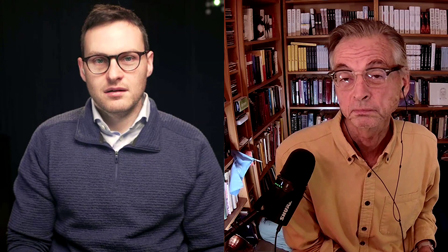
The Iron Core of News
Recorded: October 15  Posted: October 15

Tara Davis wrote on 10/15/2009 at 07:40 PM
Re: The Iron Core of News (Matt Welch & Alex Jones)
I think Jones has it almost exactly backwards.
Papers aren't getting weaker at providing news because they are dying.
They are dying because they are getting weaker at providing news.
In my town, there are two papers: The Minneapolis Star Tribune, and the St. Paul Pioneer Press. The Press has always been a slightly better paper than the "Strib" (as we often call it), and has a few more Pulitzers on the office shelves, but NEITHER paper has been very good at reporting the "hard news", going back to my teen years.
The Press is now a Knight-Ridder franchise, while the Strib is owned by Gannet. Both papers use AP and UPI wire stories for the vast bulk of their reporting of nation/world stories (which one can get on the Internet anyway), and both treat local stories with the same lightweight, sensationalist touch that our local TV stations do.
This was a state of affairs that worked fine, when there was no other way to get the news.
The Internet didn't just undercut the price of newspapers. Internet sites made all the LAZY work that papers relied on redundant. Suddenly the only reason to buy a newspaper is
DenvilleSteve wrote on 10/15/2009 at 10:12 PM
Are any newspapers offering Matt Drudge a job?
Matt Drudge is an excellent judge of what is newsworthy. That is proven every day by the large number of visits to his site of people wanting to know what is happening in the world. Putting aside that he makes more than they can pay him, I doubt that any of the major papers in the US have even thought of asking Drudge to be their editor in chief. Yet, he would likely make any paper he was a part more interesting to read ( and profitable ).
Newspapers in the US are run by smug democrats. Nothing can get those people to change their ways.
NormD wrote on 10/15/2009 at 10:59 PM
Re: The Iron Core of News (Matt Welch & Alex Jones)
I have canceled several newspapers and magazines because they are obnoxiously BIASED. I refuse to pay money to be preached at. You want to know whats going on in Iraq or Afghanistan, follow Michael Yon or Tim Lynch or Wired. Technology news - who reads a paper? Breaking news - use Drudge and other blogs. The newspapers and news magazines are all a huge waste. Iron News? What a fantasy. Newspapers only investigate things that advance their agenda. They deserve to die.
AemJeff wrote on 10/15/2009 at 11:04 PM
Re: The Iron Core of News (Matt Welch & Alex Jones)
Quoting NormD: I have canceled several newspapers and magazines because they are obnoxiously BIASED. I refuse to pay money to be preached at. You want to know whats going on in Iraq or Afghanistan, follow Michael Yon or Tim Lynch or Wired. Technology news - who reads a paper? Breaking news - use Drudge and other blogs. The newspapers and news magazines are all a huge waste. Iron News? What a fantasy. Newspapers only investigate things that advance their agenda. They deserve to die. So you read Yon and Drudge for the lack of bias?
TwinSwords wrote on 10/15/2009 at 11:16 PM
Re: The Iron Core of News (Matt Welch & Alex Jones)
Quoting WZA: Oh, it's not that Alex Jones, phew. ROFL. That was my reaction, too.
PreppyMcPrepperson wrote on 10/15/2009 at 11:17 PM
Re: The Iron Core of News (Matt Welch & Alex Jones)
Jones referenced but did not link to the Pew reports on the state of journalism. These are totally nonpartisan and really very telling.
I've always felt that the demise of professional news has been something of a self-fulfilling prophecy. Faced with competition for the first time, newspapers thought "oh dear, this will kill us, we better throw the most expensive stuff overboard," and in so doing, they got rid of the only thing that made them worth paying for, so that as, Tara notes, they no longer deserve our eyeballs, which makes it impossible for them to get ad dollars, which further depletes their budgets, and the race to the bottom continues.
Here's the issue--what Jones calls the iron core, what people in the field call 'enterprise reporting,'--was NEVER profitable. It was subsidized by newspapers engaging in practices other than news delivery--like providing crosswords--that they can't do anymore. So the economics of enterprise reporting haven't change; it's just been revealed for what it was, an inherently nonprofit practice, that can't be made profitable. It can't be profitable because it depends on INEFFICIENCY for its quality--the MORE time you spend, the MORE sources you interview, the more fishing expeditions
harkin wrote on 10/16/2009 at 01:09 AM
Re: The Iron Core of News (Matt Welch & Alex Jones)
So you read Yon and Drudge for the lack of bias? Yon is a single columnist whose bias is open and straightforward.
Drudge does not write (often) but links to other news stories. His site is visited by liberals and conservatives.
The New York Times, on the other hand is a collection of a huge number of journalists and opinion writers and yet exhibits a very strong bias towards leftism and yet still purports to be even-handed. In just one example (the Van Jones case) the ombudsman had to apologize to the paper's readers, and yet this bias is never properly addressed. They just continue the charade.
I have supported (subscribed) to a few newspapers over the past thirty-five years.
Los Angeles Times
San Francisco Chronicle
Sacramento Bee
Idaho Statesman
San Jose Mercury News
The Wall Street Journal
These are consistant reads above and beyond the locals I buy when I'm on the road.
The only ones now I consistantly buy now are the WSJ and the Chronicle. The others are so politcally biased and/or incompetent that I can no longer give them my $$$.
Same with these magazines
Time
Newsweek
The New Yorker
Vanity Fair
It's amazing to me how
bjkeefe wrote on 10/16/2009 at 02:01 AM
A question for Alex, ...
... among many others that come to mind: At around 35 min, when you were talking about the small newspaper in the small town your family still runs, you spoke of the newspaper having a responsibility for being aware of what was important to the community, and exercising that responsibility through "story selection." You gave the topic of religion (important to that town in Tennessee) as an example. How do you draw a line between this and what you spent the previous half hour belittling as "advocacy journalism?"
With all due respect -- no, more than that, because I come from a family of newspaper people and I worry about the loss of good newspapers at least as much as you do -- I was left saddened by the arguments you presented during this diavlog (at least through the first 35 mins). You seem, for example, to have in mind a caricature of alternative news sources, and did not at all hear, for example, the point Matt was trying to make about how useful niche sites + Google News can be. While I'll be the first to admit that we have millions of blogs that do
bjkeefe wrote on 10/16/2009 at 03:23 AM
Re: The Iron Core of News (Matt Welch & Alex Jones)
Quoting Tara Davis: I think Jones has it almost exactly backwards.
Papers aren't getting weaker at providing news because they are dying.
They are dying because they are getting weaker at providing news. I agree with this in many cases, and the Los Angeles Times is one shining (?) example of this. Or, at least, it is the one with which I'm the most familiar.
The Internet didn't just undercut the price of newspapers. Internet sites made all the LAZY work that papers relied on redundant. Mostly agree, although probably not to the degree of "all."
who figure it out will survive as national news outlets, but the day of the "local fishwrap" coming to your door each morning is just about over, and a lot of us simply don't care. Here, I would like to register as not one of the "lot of us." I am not so worried about the loss of all newspapers -- I am sure that NYT, WSJ, and a few others will survive -- and evolve -- into something that does a decent job of watchdogging the national scene. However, I am very concerned what life might get to be like at the state and local levels without professionals doing
AemJeff wrote on 10/16/2009 at 09:35 AM
Re: The Iron Core of News (Matt Welch & Alex Jones)
Quoting harkin: Yon is a single columnist whose bias is open and straightforward.
Drudge does not write (often) but links to other news stories. His site is visited by liberals and conservatives.
The New York Times, on the other hand is a collection of a huge number of journalists and opinion writers and yet exhibits a very strong bias towards leftism and yet still purports to be even-handed. In just one example (the Van Jones case) the ombudsman had to apologize to the paper's readers, and yet this bias is never properly addressed. They just continue the charade.
I have supported (subscribed) to a few newspapers over the past thirty-five years.
Los Angeles Times
San Francisco Chronicle
Sacramento Bee
Idaho Statesman
San Jose Mercury News
The Wall Street Journal
These are consistant reads above and beyond the locals I buy when I'm on the road.
The only ones now I consistantly buy now are the WSJ and the Chronicle. The others are so politcally biased and/or incompetent that I can no longer give them my $$$.
Same with these magazines
Time
Newsweek
The New Yorker
Vanity Fair
It's amazing to me how so many publications have alientated half their readership and yet
nikkibong wrote on 10/16/2009 at 09:41 AM
Re: A question for Alex, ...
Good critique, Brendan. Which is to say, I tend to agree.
Far too often, press critics tend to confuse medium with content. By that I mean, the slow demise of news printed on *paper* does not mean that the "iron core" is inherently melting away. It's merely a question of delivery.
I enjoyed this diavlog; thanks to Matt and Alex.
PreppyMcPrepperson wrote on 10/16/2009 at 09:50 AM
Re: A question for Alex, ...
Quoting bjkeefe: ... Aye aye. I think Alex was at his best when he was explaining how the economic model of newspapers unraveled (what happens when you lose the ability to package investigative stuff in with the sports scores). Beyond that, I thought his argument on reporting left much to be desired, as you've outlined.

|