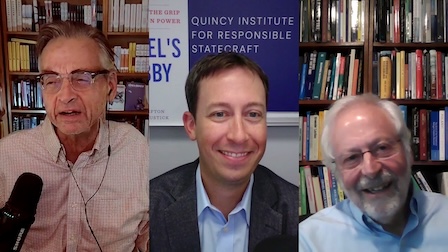
Worldwise: The Perils of Global Legalism
Recorded: October 15  Posted: October 19

bjkeefe wrote on 10/20/2009 at 04:22 PM
Re: Worldwise: The Perils of Global Legalism (Henry Farrell & Eric Posner)
This was an interesting discussion, and I can't really comment at the level it was held on, so mostly, I'll just say thanks. [Added: and how good it is to see Henry again.]
However, I am unable to resist the temptation to call Eric a Defeatocrat, and only half-kiddingly.
Yes, his analysis of the current state of international affairs hangs together, better than I would be able to rebut in a serious manner. I do of course agree that many times, "international law" is an excuse used by people who really want to say " you should do things the way my moral values tell me to behave." I also agree that international law is weak, often lacks enforcement mechanisms, is often obeyed best when it already says to do what some nation wants to do anyway, is often so vague as to be comical ("we will interpret these human rights laws so that they remain in strict compliance with (our notion of) Sharia law" was a good example), and all the rest.
However, there gets to be a point where embracing realism can go too far, where it starts to sound an awful lot like arguing for one's limitations. Whenever I hear someone like Eric putting this much effort
AemJeff wrote on 10/20/2009 at 04:26 PM
Re: Worldwise: The Perils of Global Legalism (Henry Farrell & Eric Posner)
You just had to bring it up, didn't you?
bjkeefe wrote on 10/20/2009 at 04:38 PM
Re: Worldwise: The Perils of Global Legalism (Henry Farrell & Eric Posner)
Quoting AemJeff: You just had to bring it up, didn't you? Yeah. Karl Rove taught me well.
;^)
Wonderment wrote on 10/20/2009 at 04:59 PM
Re: Worldwise: The Perils of Global Legalism (Henry Farrell & Eric Posner)
I thought this was a salutary conversation, examining the weaknesses, constraints on and impediments to international law.
Everyone knows that international law is a fact on the ground (and in the air, sea and outer space) of globalized society. The debate is about how to improve it.
Henry would probably (like me) favor robust international institutions, while Eric is skeptical.
It seems to me that the development of international compliance and enforcement of human rights law depends to a great extent on development in general (i.e, poverty eradication). We will not see Sharia law in an advanced democracy, just as we don't see medieval Christian law in Italy or Torah Law in Israel.
The huge problem that has been revealed over the past decade is that way too many nations practice exceptionalism -- i.e., rationalizing their political agendas to evade international law. They worry about international law, but try to game it.
For example, the Bushies up and decided torture wasn't a violation as long as American Good Guys were performing it. China may decide its standards for carbon emissions or political prisoners are entitled to a pass in accord with their
Lyle wrote on 10/20/2009 at 09:37 PM
Re: Worldwise: The Perils of Global Legalism (Henry Farrell & Eric Posner)
You don't give John Bolton enough credit Wonderment. I'd argue he's helping to make international law stronger, by continually pointing out what fails to work and/or what won't work. International law and international government, like American law and American government, benefits greatly from serious criticism.
Francoamerican wrote on 10/21/2009 at 04:52 AM
Re: Worldwise: The Perils of Global Legalism (Henry Farrell & Eric Posner)
An interesting discussion, though too ahistorical and too "anglo-saxon" for my taste.
International law (jus gentium) has a very long history and, at least as it is discussed on the European continent, is generally viewed as normative by jurists, even by those who reject the idea of "natural law." Perhaps this conception of international law, or "global legalism" in the words of Posner, is the heritage of modern "natural law" theories (jus naturale), but it is difficult for me to see how "rational" choice theory can replace it. If you divorce positive law from natural law (or morality, the modern translation of jus naturale--see Hobbes and Rousseau), you end up with a conception of the law as the will of the sovereign state, i.e. total value relativism. Even worse, you undercut the only possible grounds for cooperation between states, namely that they share certain values--for example principles of "fairness" or non-violence. Why should any state cooperate with any other state if the only grounds for cooperation are self-interest and security? They may of course want to cooperate, but then again they may not. History abounds in examples of non-cooperation between states precisely because they were obsessed with
bjkeefe wrote on 10/21/2009 at 11:35 AM
Re: Worldwise: The Perils of Global Legalism (Henry Farrell & Eric Posner)
Quoting Francoamerican: Why should any state cooperate with any other state if the only grounds for cooperation are self-interest and security? They may of course want to cooperate, but then again they may not. History abounds in examples of non-cooperation between states precisely because they were obsessed with their security and their self-interest to the exclusion of common concerns. Why, for example, should any state accept the principle of nuclear disarmament if its only concern is with its own security? Not to pretend your example is the sum of your argument, but because this is a pet peeve of mine ...
Have you ever read Freeman Dyson's Weapons and Hope? It's a bit dated, since it was written several decades ago, and hence, deals with nuclear weapons in the context of the Cold War, but there is still a lot of worthwhile thinking therein. Regarding what I quoted from your post, he makes a powerful argument that a state acquiring a few nuclear weapons increases its risk of being attacked, not its security.
His argument, of course, was more in line with the major worry then -- all-out global thermonuclear war -- but it still
Ocean wrote on 10/21/2009 at 12:05 PM
Re: Worldwise: The Perils of Global Legalism (Henry Farrell & Eric Posner)
Good points. I think that Francoamerican's comment has to do with the value of keeping natural law or moral principles as the main guide for international law. Principles of fairness or non-violence should inspire the agreements between nations instead of each sovereign state trying to put its own self interest and security first. Or something like that...
bjkeefe wrote on 10/21/2009 at 01:21 PM
Re: Worldwise: The Perils of Global Legalism (Henry Farrell & Eric Posner)
Quoting Ocean: Good points. I think that Francoamerican's comment has to do with the value of keeping natural law or moral principles as the main guide for international law. Principles of fairness or non-violence should inspire the agreements between nations instead of each sovereign state trying to put its own self interest and security first. Or something like that... Yes. Maybe I should have made it more clear than I did with my opening sentence, but I wasn't so much disputing FA as I was going off on a bit of a tangent, inspired by one part of what he had to say. I do find a lot to agree with in his main thesis.
PreppyMcPrepperson wrote on 10/21/2009 at 02:26 PM
Re: Worldwise: The Perils of Global Legalism (Henry Farrell & Eric Posner)
I agree. This was good. More legalese DVs, please Bob&Co?
Franco, I see your point, but I also see a problem. Not all states share those values. And what international law systems need often is to get compliance from the states that don't share the values that would lead them to comply. Therefore you have to be able to make rational arguments and implement policies that MAKE it in their interest. For example, a nonproliferation treaty with both military and economic consequences for violators.
Moreover, rational choice theorists pay attention to what states do, not what they say. They would argue that even when states agree on some treaty and announce it as reflective of their shared values, they are ultimately acting in their self-interest and would not have negotiated the treaty otherwise. Moral arguments still matter. They can impose a reputational cost on nations that don't sign up, tipping the question of national interest in the direction of the international policy. But the ultimate driver of behavior is the the state's sense of where its interests lie.
Wonderment wrote on 10/21/2009 at 02:58 PM
Re: Worldwise: The Perils of Global Legalism (Henry Farrell & Eric Posner)
For example, a nonproliferation treaty with both military and economic consequences for violators. That doesn't really address the problem of nations like India, Pakistan and Israel who refuse to sign the NPT, or North Korea who drops out of it when it feels insulted, or Iran who can (even more likely with future technology) push the envelope of compliance right up the moment of launching a bomb; or a rogue American regime, like Bush's, that will change the rules of nuclear engagement to revive "first strike" and preventative war actions against non-nuclear states (incentivizing them to clandestinely acquire nukes, as was the case with NK).
What "military consequences" do you have in mind for Iran if they violate the NPT? Does punishing one state in violation of NPT (by killing a lot of its citizens, presumably) make moral sense in the context of threats by nuclear neighbors who are not bound by the NPT because as bad international citizens they refuse to sign it? Isn't a punitive preventative war by definition "disproportionate" and in violation of international law?
Let's even concede for the sake of argument that a military retaliation against
PreppyMcPrepperson wrote on 10/21/2009 at 03:09 PM
Re: Worldwise: The Perils of Global Legalism (Henry Farrell & Eric Posner)
All fair points, and I'm not suggesting these are particularly effective ways to structure treaties. Simply to say that any international treaty I'm aware of is built on some kind of 'or else,' that makes nations sign up on national interest grounds. It is unclear to me that there's an example of a set of nations who have struck up an international legal agreement on a moral basis.
bjkeefe wrote on 10/21/2009 at 03:10 PM
Re: Worldwise: The Perils of Global Legalism (Henry Farrell & Eric Posner)
Quoting PreppyMcPrepperson: It is unclear to me that there's an example of a set of nations who have struck up an international legal agreement on a moral basis. What about the Geneva Conventions? Or human rights accords?
Francoamerican wrote on 10/21/2009 at 03:42 PM
Re: Worldwise: The Perils of Global Legalism (Henry Farrell & Eric Posner)
Quoting bjkeefe: Yes. Maybe I should have made it more clear than I did with my opening sentence, but I wasn't so much disputing FA as I was going off on a bit of a tangent, inspired by one part of what he had to say. I do find a lot to agree with in his main thesis. An interesting tangent. I haven't read the Dyson book. I agree with what you say. In fact I think it indirectly supports my main point.
Francoamerican wrote on 10/21/2009 at 03:44 PM
Re: Worldwise: The Perils of Global Legalism (Henry Farrell & Eric Posner)
Quoting Ocean: Good points. I think that Francoamerican's comment has to do with the value of keeping natural law or moral principles as the main guide for international law. Principles of fairness or non-violence should inspire the agreements between nations instead of each sovereign state trying to put its own self interest and security first. Or something like that... Precisely, Ocean. Your piercing intellect saw straight through me.
Francoamerican wrote on 10/21/2009 at 03:47 PM
Re: Worldwise: The Perils of Global Legalism (Henry Farrell & Eric Posner)
Quoting PreppyMcPrepperson: I agree. This was good. More legalese DVs, please Bob&Co?
Franco, I see your point, but I also see a problem. Not all states share those values. And what international law systems need often is to get compliance from the states that don't share the values that would lead them to comply. Therefore you have to be able to make rational arguments and implement policies that MAKE it in their interest. For example, a nonproliferation treaty with both military and economic consequences for violators.
Moreover, rational choice theorists pay attention to what states do, not what they say. They would argue that even when states agree on some treaty and announce it as reflective of their shared values, they are ultimately acting in their self-interest and would not have negotiated the treaty otherwise. Moral arguments still matter. They can impose a reputational cost on nations that don't sign up, tipping the question of national interest in the direction of the international policy. But the ultimate driver of behavior is the the state's sense of where its interests lie. Rational choice theory is just another name for Hobbes' bellum omnium contra omnes (war of all against all). No
Ocean wrote on 10/21/2009 at 04:02 PM
Re: Worldwise: The Perils of Global Legalism (Henry Farrell & Eric Posner)
Quoting PreppyMcPrepperson: It is unclear to me that there's an example of a set of nations who have struck up an international legal agreement on a moral basis. Climate change? Disaster relief? At least these appear to be efforts towards a common good.
danielschut wrote on 10/21/2009 at 04:56 PM
Re: Worldwise: The Perils of Global Legalism (Henry Farrell & Eric Posner)
I'm really sorry to say but I seriously feel that both authors do not have a full grasp of the relevant political science literature on this subject.
Posner for instance, sets up a huge straw man by attacking a very weak version of what the most political-science-informed international law scholars actually have to say. Professors like Slaughter actually DO try to account for power relations and state interests - just claiming that they don't isn't enough. Moreover, Posner keeps on asking "what the mechanism is by which international law might work". Well, , contrary to what Posner claims, several mechanisms have been provided and they all provide very interesting insights - and many of these proposed mechanisms even incorporate rational choice theories.
Farrell just seems very happy with letting that all happen, even asking Posner "what would be the strongest case" against his claims in stead of digging them up himself, even admitting he didn't read all the relevant material.
Next time, I'd be interested in hearing an author involved in one of thee books, for example: International Institutions (an International Organization Reader edited by Lisa Martin and Beth Simmons), Legalization and
PreppyMcPrepperson wrote on 10/21/2009 at 06:14 PM
Re: Worldwise: The Perils of Global Legalism (Henry Farrell & Eric Posner)
Quoting bjkeefe: What about the Geneva Conventions? Or human rights accords? There are, on a philosophical basis, moral arguments that can and should be made for these. And were at the time the Conventions were signed.
But a rational choice theorist would argue that the ACTUAL reason states signed them was not what they said (ie the moral rhetoric) but because having human rights accords was seen as a way to prevent future oppressive regimes from having their way with the world and providing a mechanism/justification for other powers to check them and hold them accountable. This was, in the period after WWII, when states were hyper-sensitive to the costs of facing up to crimes like genocide, in their perceived interest.
PreppyMcPrepperson wrote on 10/21/2009 at 06:17 PM
Re: Worldwise: The Perils of Global Legalism (Henry Farrell & Eric Posner)
Quoting Ocean: At least these appear to be efforts towards a common good. No one is disputing that international agreements sometimes achieve universal goods. Simply that (no matter what states SAY) the actual reason that they enter the agreement is because they perceive it to be in their interest to do so. It is in our interest to protect the climate because it will destroy us and our economies not to--if we get a real agreement out of COP15, that will be the rational choice explanation for why it happened.
bjkeefe wrote on 10/21/2009 at 06:38 PM
Re: Worldwise: The Perils of Global Legalism (Henry Farrell & Eric Posner)
Quoting PreppyMcPrepperson: There are, on a philosophical basis, moral arguments that can and should be made for these. And were at the time the Conventions were signed.
But a rational choice theorist would argue that the ACTUAL reason states signed them was not what they said (ie the moral rhetoric) but because having human rights accords was seen as a way to prevent future oppressive regimes from having their way with the world and providing a mechanism/justification for other powers to check them and hold them accountable. This was, in the period after WWII, when states were hyper-sensitive to the costs of facing up to crimes like genocide, in their perceived interest. Okay. Granted: almost no nation (or person, for that matter) does anything purely without regard to self-interest.
And also ("... a rational choice theorist would argue ..."), you can almost always cast anything in terms of another theory. I remember, for example, the way I could explain EVERYTHING in terms of individuals maximizing personal utility based on what I'd learned in Microecon 101, right after I'd taken Microecon 101.
But still, you'll never convince me that there wasn't also a whole lot of genuine moral basis underlying
PreppyMcPrepperson wrote on 10/21/2009 at 06:45 PM
Re: Worldwise: The Perils of Global Legalism (Henry Farrell & Eric Posner)
Quoting bjkeefe: But still, you'll never convince me that there wasn't also a whole lot of genuine moral basis underlying the formulation and adoption of the Geneva Conventions and other humanitarian accords. Fair enough. You'll never convince me that there was a whole lot of it. We'll agree to differ.
claymisher wrote on 10/21/2009 at 07:17 PM
Re: Worldwise: The Perils of Global Legalism (Henry Farrell & Eric Posner)
Quoting PreppyMcPrepperson: No one is disputing that international agreements sometimes achieve universal goods. Simply that (no matter what states SAY) the actual reason that they enter the agreement is because they perceive it to be in their interest to do so. It is in our interest to protect the climate because it will destroy us and our economies not to--if we get a real agreement out of COP15, that will be the rational choice explanation for why it happened. A rationalist choice theorist would also tell you that I'd murder you for $10 if I thought I could get away with it.
Ocean wrote on 10/21/2009 at 07:21 PM
Re: Worldwise: The Perils of Global Legalism (Henry Farrell & Eric Posner)
Quoting claymisher: A rationalist choice theorist would also tell you that I'd murder you for $10 if I thought I could get away with it. Would you? Clay!
Wonderment wrote on 10/21/2009 at 07:28 PM
Re: Worldwise: The Perils of Global Legalism (Henry Farrell & Eric Posner)
But still, you'll never convince me that there wasn't also a whole lot of genuine moral basis underlying the formulation and adoption of the Geneva Conventions and other humanitarian accords. Yes, definitely not an either/or. Preppy seems to be giving too much weight to what "they" (States) end up doing, as opposed to what "we" (people) are inspired by. Change comes from people who have passionate altruistic concerns about issues. The issues may be marketed as being beneficial from a rational self-interest point of view, but more often than not the moral principle is the prime mover.
If you read Samantha Power's book on the history of genocide ("A Problem from Hell") and international law, you will see that the changemakers are often ordinary people with strong moral convictions like Raphael Lemkin.
Usually, when things get enacted (laws are past, institutions are built), there's a mix of self-interest and altruism (just like in real life).
claymisher wrote on 10/21/2009 at 07:40 PM
Re: Worldwise: The Perils of Global Legalism (Henry Farrell & Eric Posner)
Quoting Ocean: Would you? Clay!  No!
The only people who act like the people in rational choice/public choice models are schizophrenics and economists (with some overlap).
Wonderment wrote on 10/21/2009 at 07:59 PM
Re: Worldwise: The Perils of Global Legalism (Henry Farrell & Eric Posner)
The only people who act like the people in rational choice/public choice models are schizophrenics and economists (with some overlap). Excuse me????..., what about us?
Unit wrote on 10/21/2009 at 08:04 PM
Re: Worldwise: The Perils of Global Legalism (Henry Farrell & Eric Posner)
Quoting claymisher: No!
The only people who act like the people in rational choice/public choice models are schizophrenics and economists (with some overlap). Clay doesn't know what "public choice" means. That or he's got his very own definition.
claymisher wrote on 10/21/2009 at 08:13 PM
Re: Worldwise: The Perils of Global Legalism (Henry Farrell & Eric Posner)
Quoting Unit: Clay doesn't know what "public choice" means. That or he's got his very own definition. Enlighten us. What's yers?
Ocean wrote on 10/21/2009 at 08:27 PM
Re: Worldwise: The Perils of Global Legalism (Henry Farrell & Eric Posner)
Quoting claymisher: No! Yeah... I didn't think you would do it for $10.
claymisher wrote on 10/21/2009 at 08:46 PM
Re: Worldwise: The Perils of Global Legalism (Henry Farrell & Eric Posner)
Quoting Ocean: Yeah... I didn't think you would do it for $10. Sometimes I play a little game where I ask myself "how much would you have to pay me" (can you tell I majored in econ?). The answers often surprise me. How much would you have to pay me to go to my high school reunion? $10,000. That's right, if it was $9,999 I'd turn it down. No, you keep that $9,999, I'm not going.
Ocean wrote on 10/21/2009 at 08:54 PM
Re: Worldwise: The Perils of Global Legalism (Henry Farrell & Eric Posner)
Quoting claymisher: Sometimes I play a little game where I ask myself "how much would you have to pay me" (can you tell I majored in econ?). The answers often surprise me. How much would you have to pay me to go to my high school reunion? $10,000. That's right, if it was $9,999 I'd turn it down. No, you keep that $9,999, I'm not going. OK.
Unit wrote on 10/21/2009 at 09:23 PM
Re: Worldwise: The Perils of Global Legalism (Henry Farrell & Eric Posner)
Quoting claymisher: Enlighten us. What's yers? Well, for instance, this year's Nobel in Econ, Lin Ostrom, is a public-choice theorist that does field studies and tries to model how people act in real contexts.
Baltimoron wrote on 10/21/2009 at 10:57 PM
Re: Worldwise: The Perils of Global Legalism (Henry Farrell & Eric Posner)
This is one of the few diavlogs I would listen to twice, and for which I wished I had a written transcript.
Thanks!
PreppyMcPrepperson wrote on 10/21/2009 at 11:31 PM
Re: Worldwise: The Perils of Global Legalism (Henry Farrell & Eric Posner)
Quoting claymisher: A rationalist choice theorist would also tell you that I'd murder you for $10 if I thought I could get away with it. This is an unfair, and incorrect, caricature of rational choice theory. Firstly, it does not say that the only form of self-interest to which we react is monetary. Secondly, it does not say that all individuals can be persuaded to do all things.
Instead, it says that what any individual or state does can ultimately explained by the fact that, at some basic level, they perceive or believe their actions to be good for them.
That notion of 'good,' the positive benefit that an individual or state is weighing against a potential cost, can be economic, political, physical, social, or even emotional.
[For example: a rational choice theorist might say about the exchange further down this thread, "Claymisher will not attend his HS reunion because he deems the emotional cost of being back with those people/in that place greater than the emotional benefit of potentially running into some old friends."]
In the case of states, those categories of benefit analysis still apply. There are economic costs/benefits (sanctions, say), political ones (meaning that actions can increase or diminish your power), physical ones (menaing that actions have military consequences), social ones (meaning that actions can change your relationships to other states), and emotional ones (meaning that when some rogue world leader says something inflammatory or does something reckless, they have decided that the emotional benefit or showing national
claymisher wrote on 10/22/2009 at 12:24 AM
Re: Worldwise: The Perils of Global Legalism (Henry Farrell & Eric Posner)
Quoting PreppyMcPrepperson: it says that what any individual or state does can ultimately explained by the fact that, at some basic level, they perceive or believe their actions to be good for them. People are motivated by motives. Got it.
It's an interesting exercise to assume everybody is maximally cynical, but that's all it is. Just because you start with that assumption doesn't make it true.
bjkeefe wrote on 10/22/2009 at 12:39 AM
Re: Worldwise: The Perils of Global Legalism (Henry Farrell & Eric Posner)
Quoting claymisher: People are motivated by motives. Got it.
It's an interesting exercise to assume everybody is maximally cynical, but that's all it is. Just because you start with that assumption doesn't make it true. Not to pile on gratuitously, but a major shoutout to clay for saying more succinctly what I was trying to say earlier.
PreppyMcPrepperson wrote on 10/22/2009 at 12:52 AM
Re: Worldwise: The Perils of Global Legalism (Henry Farrell & Eric Posner)
The funny thing about theories is that they can't be proved true, they can only be falsified. So while I can't prove that people make rational choices, I can listen to and respond to any attempts you might make to show that they don't. So far, I've been able to identify a rational choice explanation for even moralistic-seeming behavior (see exchange with Wonderment about climate change), but as bj points out you can probably conjecture some other explanation for that same behavior. Unless one of us is sitting on a large chunk of scenarios where the other's posited theory doesn't hold water, this is a stalemated exchange.
claymisher wrote on 10/22/2009 at 01:04 AM
Homo reciprocans
Quoting Unit: Well, for instance, this year's Nobel in Econ, Lin Ostrom, is a public-choice theorist that does field studies and tries to model how people act in real contexts. You got me. I give public choice a hard time because nine times out of ten it's invoked as an all-purpose bludgeon (e.g., Megan McArdle). You know, "I'm against universal health care because [hand-wavy motion] ... public choice!!!!" A lot of the PCers are straight up libertarian propagandists on the Koch payroll. But there are broad-minded thinkers in the public choice school and its general vicinity (Mancur Olson, Ostrom, even my faves Bowles and Gintis). But you're probably only interested in the public choice stuff that's really just formalized libertarian politics.
Here's a funny quote from Brad DeLong:
I remember Mancur Olson begging me to come write in Public Choice, saying: “It doesn’t have to be just right-wing wackos. It can have two healthy wings. All I need is a few to join me…” Anyone, if you're interested in a more realistic, more interesting, and actually empirical approach, check out Cosma Shalizi's article about Homo reciprocans
Partly because they lend themselves to precise, mathematical expression, individualist theories have proven theoretically insightful, practically useful, and surprisingly powerful. They are also basically
claymisher wrote on 10/22/2009 at 01:11 AM
Re: Worldwise: The Perils of Global Legalism (Henry Farrell & Eric Posner)
Quoting PreppyMcPrepperson: The funny thing about theories is that they can't be proved true, they can only be falsified. (You know, you don't have to drink the Popperian kool-aid.)
So while I can't prove that people make rational choices, I can listen to and respond to any attempts you might make to show that they don't. So far, I've been able to identify a rational choice explanation for even moralistic-seeming behavior (see exchange with Wonderment about climate change), but as bj points out you can probably conjecture some other explanation for that same behavior. Unless one of us is sitting on a large chunk of scenarios where the other's posited theory doesn't hold water, this is a stalemated exchange. Hell no. I win. I'm not saying people aren't self-interested. I'm just saying 100% of people aren't 100% self-interested.
PreppyMcPrepperson wrote on 10/22/2009 at 01:22 AM
Re: Worldwise: The Perils of Global Legalism (Henry Farrell & Eric Posner)
And I'm saying they are.
piscivorous wrote on 10/22/2009 at 01:50 AM
Re: Worldwise: The Perils of Global Legalism (Henry Farrell & Eric Posner)
Try Mother Teresa
bjkeefe wrote on 10/22/2009 at 01:56 AM
Re: Homo reciprocans
Quoting claymisher: You got me. I give public choice a hard time because nine times out of ten it's invoked as an all-purpose bludgeon (e.g., Megan McArdle). You know, "I'm against universal health care because [hand-wavy motion] ... public choice!!!!" A lot of the PCers are straight up libertarian propagandists on the Koch payroll. But there are broad-minded thinkers in the public choice school and its general vicinity (Mancur Olson, Ostrom, even my faves Bowles and Gintis). But you're probably only interested in the public choice stuff that's really just formalized libertarian politics.
Here's a funny quote from Brad DeLong: And, oh lord, the comment from Sebastian a few below that one is FTW:
I’d add to this that the survival of wacko pubic choice is critical as one of the most beloved strawmen of political scientists… Quoting claymisher: Anyone, if you're interested in a more realistic, more interesting, and actually empirical approach, check out Cosma Shalizi's article about Homo reciprocans Dammit, why have we not had Cosmo on to do a diavlog at least four hundred times already?
Continued shoutout to you, clay, for continuing to remind us all of this most valuable voice on the Web.
claymisher wrote on 10/22/2009 at 02:03 AM
Re: Homo reciprocans
Heh, I just keep linking to the same article.
Here's Gintis on the unification of the behavioral sciences. I think it's both sensible and completely mind-blowing (and it even includes a limited defense of the rational actor model):
http://videolectures.net/cvss08_gintis_fpubs/
But here's my favorite econ video. And it's only 5 minutes!
http://www.youtube.com/watch?v=VVp8UGjECt4
bjkeefe wrote on 10/22/2009 at 02:22 AM
Re: Homo reciprocans
[Added] This aside from Cosmo could (should, I would like to imagine) make one spend all day in contemplation:
(In experimental Prisoner's Dilemma games, subjects tend to cooperate if the game is called "Community" and defect if it's "Wall Street.")
bjkeefe wrote on 10/22/2009 at 02:26 AM
Re: Homo reciprocans
Quoting claymisher: Heh, I just keep linking to the same article.
Here's Gintis on the unification of the behavioral sciences. I think it's both sensible and completely mind-blowing (and it even includes a limited defense of the rational actor model):
http://videolectures.net/cvss08_gintis_fpubs/
But here's my favorite econ video. And it's only 5 minutes!
http://www.youtube.com/watch?v=VVp8UGjECt4 LOL!
That Yoram clip is great, and worth watching again.
I'll have to postpone watching the Gintis vid until I have more strength -- please remind me if I haven't commented within a couple of days.
Thanks.
bjkeefe wrote on 10/22/2009 at 02:36 AM
Re: Worldwise: The Perils of Global Legalism (Henry Farrell & Eric Posner)
Quoting piscivorous: Try Mother Teresa While I wouldn't necessarily place much stock in this one example, the image of MT at least stands, and more to the point, I think clay's larger statement in his last sentence holds. There is something intrinsic but not so easily described in (some? many? most?) humans where any sort of "rational actor" description fails.
For lack of a better term, we often let our better angels rule. That is the key to why our otherwise appallingly violent and selfish species has survived, and (with apologies to FA) flourished.
Sorry, PMP, but that you can explain everything you encounter by saying people are always 100% self-interested may work for purposes of debate, or even a pleasing model, but I don't think it's true, I think it ignores too many contradictory exceptions, and I don't think it will survive if you really try to build upon your model. People do "the right thing" for many reasons that we have not yet begun to understand.
PreppyMcPrepperson wrote on 10/22/2009 at 04:01 AM
Re: Worldwise: The Perils of Global Legalism (Henry Farrell & Eric Posner)
Quoting bjkeefe: People do "the right thing" for many reasons that we have not yet begun to understand. Right. And I'm positing--not seeking to prove, or to have you agree to, actually--that we will find that they believe or perceive on some level that what they do will be good for them too. That may be a real-world physical/tangible/economic sense or in an evolutionary sense, but I don't think people do things for others without any reference to how it affects them.
MT, for example, derived something in the way of status by starting MoC that she would not have derived by plugging and chugging away at a mid-level in the order she originally signed up to. Am I saying that when she started out on her own she had a conscious awareness of this? No. I am saying that at a subconscious level, this is what would make her choice rational.
bjkeefe wrote on 10/22/2009 at 05:18 AM
Re: Worldwise: The Perils of Global Legalism (Henry Farrell & Eric Posner)
Quoting PreppyMcPrepperson: Right. And I'm positing--not seeking to prove, or to have you agree to, actually--that we will find that they believe or perceive on some level that what they do will be good for them too. That may be a real-world physical/tangible/economic sense or in an evolutionary sense, but I don't think people do things for others without any reference to how it affects them.
MT, for example, derived something in the way of status by starting MoC that she would not have derived by plugging and chugging away at a mid-level in the order she originally signed up to. Am I saying that when she started out on her own she had a conscious awareness of this? No. I am saying that at a subconscious level, this is what would make her choice rational. You can see, I expect, why I said (to pisc) earlier that I didn't want to accept MT as a good example of the point of view I am trying to put forth. Sure, I believe that a lot of what drove her, specifically, was personal interest. (I thought that long before I ever heard of Hitchens, btw -- I was raised Catholic.)
Now, where you say "on some level" and "rational," I am unsure how to
Unit wrote on 10/22/2009 at 08:52 AM
Re: Worldwise: The Perils of Global Legalism (Henry Farrell & Eric Posner)
Quoting bjkeefe: You can see, I expect, why I said (to pisc) earlier that I didn't want to accept MT as a good example of the point of view I am trying to put forth. Sure, I believe that a lot of what drove her, specifically, was personal interest. (I thought that long before I ever heard of Hitchens, btw -- I was raised Catholic.)
Now, where you say "on some level" and "rational," I am unsure how to think. I can imagine that we'll someday discover something at some deep ("subconcious") level that shows humans have an impetus -- perhaps even one amenable to mathematical description -- that causes us to act in a way that you and I would at this moment call altruistic, that turns out to be fairly well self-interested, even calculated, in some sense. (I think it more likely, as I said before, that what will really happen is that we will be able to formulate a succession of ever more complete-sounding theories where all altruistic behaviors can be explained solely in terms of self-interest, however non-conscious they may be.) But really, I can only imagine that in a logical sense. I wouldn't bet on it -- I don't think our species will be (correctly) that trivially described for a long time. [Edited to delete how long a "long time" might be. But I think it will be a long time. Uh ... a very long time? Longer than it will take us to accomplish most other things we now think we'll be able to do "eventually" -- let's just leave it at that.]
I guess I just will
PreppyMcPrepperson wrote on 10/22/2009 at 03:24 PM
Re: Worldwise: The Perils of Global Legalism (Henry Farrell & Eric Posner)
Quoting bjkeefe: I am not expecting you to accept this just because I say it, but I hope you will weight my longer life experience and continuing education at least enough so that you do not calcify your mind by continuing to insist something like, "Really, human behavior is pretty much understood." Because it really isn't. We are not nearly so neatly pigeonholed, even by ourselves. I take your life experience very seriously, bj, do not worry.
And I'm not saying human behavior is pretty much understood; I'm saying what we understand so far leads me to think that rational choice/perceptions of self-interest will ultimately be able to explain it. That's not something I'm trying to prove or expecting you to disprove; it's a prediction and by definition speculative. We won't know if I'm right or not unless we explain enough human behavior to find something to which rational choice absolutely cannot apply.
bjkeefe wrote on 10/22/2009 at 03:55 PM
Re: Worldwise: The Perils of Global Legalism (Henry Farrell & Eric Posner)
Quoting PreppyMcPrepperson: I take your life experience very seriously, bj, do not worry.
And I'm not saying human behavior is pretty much understood; I'm saying what we understand so far leads me to think that rational choice/perceptions of self-interest will ultimately be able to explain it. That's not something I'm trying to prove or expecting you to disprove; it's a prediction and by definition speculative. We won't know if I'm right or not unless we explain enough human behavior to find something to which rational choice absolutely cannot apply. Fair enough. I am not trying to berate you for having that view/making that prediction by saying "I used to think that, too." I am just tossing what I've come to learn out there in the hope that you will not have to spend as long as I did breaking free of that expectation. In retrospect, I think that I suffered in this regard from "I believe this is true because I want it to be true."
But who knows. Maybe all I've done is learn the wrong things. (And I don't say that sarcastically -- I am sincerely unsure about almost anything one could name, if I think about it for long
Unit wrote on 10/22/2009 at 09:40 PM
Re: Homo reciprocans
Quoting claymisher: You got me. I give public choice a hard time because nine times out of ten it's invoked as an all-purpose bludgeon (e.g., Megan McArdle). You know, "I'm against universal health care because [hand-wavy motion] ... public choice!!!!" A lot of the PCers are straight up libertarian propagandists on the Koch payroll. But there are broad-minded thinkers in the public choice school and its general vicinity (Mancur Olson, Ostrom, even my faves Bowles and Gintis). But you're probably only interested in the public choice stuff that's really just formalized libertarian politics.
Here's a funny quote from Brad DeLong:
Anyone, if you're interested in a more realistic, more interesting, and actually empirical approach, check out Cosma Shalizi's article about Homo reciprocans From the very start Cosma's got Adam Smith all wrong. I stopped right there. But if she then goes on to criticizes mathematical models, then I'm all in agreement. This is the weird part about your stances Clay: correct me if I'm wrong but weren't you all too ready to accept the dubious rationales for the Obama stimulus (multipliers, aggregate demand etc...) that were based on super-dubious macroeconometric models?
PreppyMcPrepperson wrote on 10/22/2009 at 09:46 PM
Re: Worldwise: The Perils of Global Legalism (Henry Farrell & Eric Posner)
Thanks for the advice bj. If I have any epiphanies of humility, I'll let ya know!
piscivorous wrote on 10/26/2009 at 09:20 PM
Re: Worldwise: The Perils of Global Legalism (Henry Farrell & Eric Posner)
Mr Posner has add some further thought to this discussion with Mr Farrell.

|