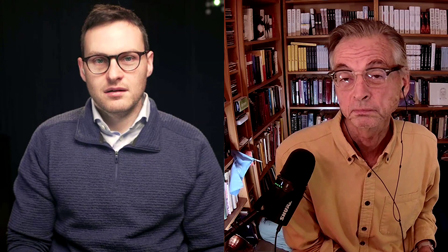
March 15, 2010


more diavlogs


View Thread Post Comment
nikkibong wrote on 10/29/2009  at  04:59 PM
Re: The Perniciousness of Positive Thinking (Hanna Rosin & Barbara Ehrenreich)
Yay! Barbara Ehreinreich!
Apologies for the positive thinking - I'm a big Ehrenreich fan - and she's got a great Alma Mater, to boot.
View Thread Post Comment
TwinSwords wrote on 10/29/2009  at  06:00 PM
Re: The Perniciousness of Positive Thinking (Hanna Rosin & Barbara Ehrenreich)
Wow! Barbara Ehrenreich! Welcome to BhTV! It's great to have you here!
View Thread Post Comment
TwinSwords wrote on 10/29/2009  at  06:03 PM
Re: The Perniciousness of Positive Thinking (Hanna Rosin & Barbara Ehrenreich)
Quoting nikkibong: Yay! Barbara Ehreinreich!
Apologies for the positive thinking - I'm a big Ehrenreich fan - and she's got a great Alma Mater, to boot.
And a great Blogginghead for a daughter (as you know), too!
View Thread Post Comment
claymisher wrote on 10/29/2009  at  06:15 PM
Re: The Perniciousness of Positive Thinking (Hanna Rosin & Barbara Ehrenreich)
The power of positive thinking has creeped me out since I was a little kid. What a terrific subject for a book! Can't wait to hear this one.
View Thread Post Comment
Winspur wrote on 10/29/2009  at  08:40 PM
Re: The Perniciousness of Positive Thinking (Hanna Rosin & Barbara Ehrenreich)
Thank you for a great diavlog. Barbara's explication of Calvinism, Christian Science, and the prosperity gospel was really interesting (my grandmother was an ardent Christian Scientist). How creepy that the megachurches have stripped all Christian symbols from their interiors--the better to worship Mammon, I guess.
View Thread Post Comment
Ocean wrote on 10/29/2009  at  09:13 PM
Re: The Perniciousness of Positive Thinking (Hanna Rosin & Barbara Ehrenreich)
Interesting daivlog. I haven't read the book, but I saw Barbara when Jon Stewart interviewed her a couple of weeks ago. At the time I was rather disappointed in what she said. I'm glad I had the opportunity to hear about her book in this diavlog, as her argument seems more reasonable now. Barbara seems to emphasize --and reject-- in her book, the more extreme forms of "positive thinking", from its religious origins to its business derivatives. She didn't seem to be very balanced in her appreciation of "positive thinking" and health, or in the context of self help groups of cancer patients. She apparently encountered people that represented the more radical positions. Patients that deal with cancer go through the regular Kübler Ross stages of grief. Anger is certainly a legitimate phase and suppressing it isn't conducive to wellbeing. By the same token, getting stuck in that phase, feeling sorry for oneself, or feeling overwhelmed by pessimistic possibilities isn't going to help. When I think about positive thinking when it refers to cancer or other serious illnesses, I don't think about some magical cure but rather about a coping skill, a strategy to overcome, from a psychological perspective, a
read more . . .
View Thread Post Comment
Simon Willard wrote on 10/29/2009  at  11:37 PM
Re: The Perniciousness of Positive Thinking (Hanna Rosin & Barbara Ehrenreich)
Humbug. This is like a Hanna/Barbera cartoon. Who pays attention to these silly theories, anyway? Positive thinking, negative thinking... it was always nonsense, and there's no need for these two to analyze the nonsense.
View Thread Post Comment
Starwatcher162536 wrote on 10/29/2009  at  11:41 PM
Re: The Perniciousness of Positive Thinking (Hanna Rosin & Barbara Ehrenreich)
Don't diss my Chi, dawg. I komaaya kommaya your ass.
View Thread Post Comment
Baltimoron wrote on 10/29/2009  at  11:52 PM
Blame It on William James
Firstly, props for booking Barbara Ehrenreich. It dates me, but I had the privilege to attend some student conferences in New York hosted by Democratic Socialists of America when I was a college student in the 80s. I listened to Ehrenreich and Michael Harrington when I should have taken more notes for posterity
But, I was surprised Ehrenreich didn't mention the influence of William James in her capsule history. "The Will to Believe" is seminal - and available online. As a matter of fact, although I do chirp to Ehrenreich's critique of alternative American cults, I associate positive thinking with the most fertile of periods of American academic work, the pragmatic movement. I think a critique of James, as much as he refined the "logic" of positive thinking, begins with Charles S. Peirce and other pragmaticists. But, Ehrenreich's and Rosin's emphasis on popular, middlebrow authors is a treasure trove of woo-smiting spleen.
Finally, I'm struck by the connection between positive thinking and 12-step programs.
View Thread Post Comment
Markos wrote on 10/30/2009  at  01:50 AM
Re: The Perniciousness of Positive Thinking (Hanna Rosin & Barbara Ehrenreich)
I enjoyed this discussion very much. But I wish I could have participated in it.
I think the Millionaire Mind seminars make the leader(s) of the seminars extremely wealthy while the followers who make them wealthy pay a lot of money upfront for "courses" of dubious value. And there are lots more Reverend Ike-ish churches and get-rich infomercial come-os that deserve these women's scorn.
On the other hand, I wish I could have participated in this discussion because I don't Barbara and Hanna might have thrown the baby out with the bath water.I would have liked to question Barbara especially about what keeps her going in life. Charles Barkley, Michael Jordan, J.K. Rowling and Albert Einstein (to name a few) all employed visualization and "mental discipline" to achieve what they did.
I think Barbara sounds like she paints a too-extreme picture of he target of her critique. I would have really enjoyed asking her some questions and discussing some things with her that Hanna didn't cover.
View Thread Post Comment
Baltimoron wrote on 10/30/2009  at  02:24 AM
Re: The Perniciousness of Positive Thinking (Hanna Rosin & Barbara Ehrenreich)
Barbara and Hanna might have thrown the baby out with the bath water.I would have liked to question Barbara especially about what keeps her going in life. Charles Barkley, Michael Jordan, J.K. Rowling and Albert Einstein (to name a few) all employed visualization and "mental discipline" to achieve what they did.
I think you implicitly accept tenets of positive thinking. Ehrenreich ends - and I agree it's all too short - on a note about realism. James and religious nuts share the belief, that reason is inadequate. The "discovery" was, that will is the under-appreciated third wheel of the human soul, after the Romantics had destroyed feeling or sentiment forever as an alternative. Ehrenreich also mentions how her previous experience as a scientist helped her to understand cancer without accepting the crackpot notion, that immunology had any bearing on cancer cells. Debunking religious crackpots, new age woo, and championing evidence-based medicine is a coherent world view. I wish Ehrenreich had emphasized that.
View Thread Post Comment
JonIrenicus wrote on 10/30/2009  at  06:09 AM
Re: The Perniciousness of Positive Thinking (Hanna Rosin & Barbara Ehrenreich)
I am not going to defend a bunch of nonsense about positive thinking curing disease, but it seems lopsided to me.

Take this critique of her book.
http://www.amazon.com/review/R1XNYF0...R1XNYF0HJJYNP3

Take that or leave it.
Also how does this relate to the placebo effect? No effect in specific cases of immune function against cancer (why would it, the point is that cancerous cells are typically seen as the bodies own cells and not targeted), but what about the general case where two groups are given a drug sample with one group given the placebo and still doing better than being given nothing. There must be something there beyond the absence of a negative like severe stress. Or is that all it is?
View Thread Post Comment
Baltimoron wrote on 10/30/2009  at  08:35 AM
Re: The Perniciousness of Positive Thinking (Hanna Rosin & Barbara Ehrenreich)
Also how does this relate to the placebo effect?...
Just a quick googling brought this up: secondary symptoms are alleviated, but the actual tumors are unaffected.
View Thread Post Comment
Francoamerican wrote on 10/30/2009  at  10:17 AM
Re: Blame It on William James
Quoting Baltimoron: But, I was surprised Ehrenreich didn't mention the influence of William James in her capsule history.
Most unfair to Wm James, who was a cheerful pessimist, a bit like Nietzsche. But it would take too long to argue the point. I agree that this was a excellent discussion of the transformation of the dreadful Calvinism of early America into the dreadful cheerfulness of positive thinking in contemporary America.
The following account of Wm James of his visit to the "ideal" suburban utopia of Chautauqua might interest you:
A few summers ago I spent a happy week at the famous Assembly Grounds on the borders of Chautauqua Lake. The moment one treads that sacred enclosure, one feels oneself in an atmosphere of success. Sobriety and industry, intelligence and goodness, orderliness and ideality, prosperity and cheerfulness pervade the air. It is a serious and studious picnic on a gigantic scale. Here you have a town of many thousands of inhabitants, beautifully laid out in the forest and drained and equipped with the means of satisfying all the necessary lower and most of the superfluous higher wants of man. You have a first-class college in full
read more . . .
View Thread Post Comment
Me&theboys wrote on 10/30/2009  at  10:44 AM
Re: The Perniciousness of Positive Thinking (Hanna Rosin & Barbara Ehrenreich)
Excellent diavlog, but way too short and too many topics covered too briefly. Bring Ehrenreich back for a diavlog to address one (or each) of the topics in more detail. A Rosin/Ehrenreich discussion of these churches they describe would be fascinating. Also, the topic of positive psychology as perpetuated in popular media by well known academics deserved far more discussion. Maybe Ehrenreich and Jon Haidt would be a good match for that discussion. I read The Happiness Hypothesis by Jon Haidt, which was great and thoughtful and intelligent, followed by Authentic Happiness by Seligman, which I subsequently threw in the trash it was so horrible (the only book I've ever thrown away in disgust, other than The Bridges of Madison County - blech). Seligman's book wasn't horrible because of the writing but because of the concept and how it is sold in the book. Short term, it's-all-about-me-thinking, dumbed down, feel good pablum that is inexcusable for someone of Seligman's training, IMO. Here's a good link to a criticism of positive psychology.
View Thread Post Comment
claymisher wrote on 10/30/2009  at  12:31 PM
Re: Blame It on William James
Quoting Francoamerican: Most unfair to Wm James, who was a cheerful pessimist, a bit like Nietzsche. But it would take too long to argue the point. I agree that this was a excellent discussion of the transformation of the dreadful Calvinism of early America into the dreadful cheerfulness of positive thinking in contemporary America.
The following account of Wm James of his visit to the "ideal" suburban utopia of Chautauqua might interest you:
A few summers ago I spent a happy week at the famous Assembly Grounds on the borders of Chautauqua Lake. The moment one treads that sacred enclosure, one feels oneself in an atmosphere of success. Sobriety and industry, intelligence and goodness, orderliness and ideality, prosperity and cheerfulness pervade the air. It is a serious and studious picnic on a gigantic scale. Here you have a town of many thousands of inhabitants, beautifully laid out in the forest and drained and equipped with the means of satisfying all the necessary lower and most of the superfluous higher wants of man. You have a first-class college in full blast. You have magnificent music—a chorus of 700 voices, with possibly the most perfect open-air auditorium
read more . . .
View Thread Post Comment
bjkeefe wrote on 10/30/2009  at  02:22 PM
Re: Blame It on William James
Quoting claymisher: I love James (and his pals Dewey and Peirce), but that's nonsense. Only a high-status white man at the top of the social hierarchy would say that. I'm pretty sure the poor, the weak, and the hated would settle for the atrocious harmlessness in all things. There's enough drama in the unavoidable -- illness, loss, death, etc -- to keep me on my toes.
I take your point about James having had the luxury of his position to be able to make those complaints, and I certainly agree it's correct when one adopts the point of view of those less well off than he was.
Still, I don't think his grumbles are entirely unjustified. It is legitimate, to my mind, to be dissatisfied with an observed situation, no matter that it is not the worst of all possible worlds, and it does not suffice merely to point out someone worse off to completely delegitimize the dissatisfaction. (Being told "think of all the poor starving children in Biafra" is not a good way to get Junior to clean his plate.) There is no reason why everyone should have to use the same set of standards, given our different lots
read more . . .
View Thread Post Comment
Francoamerican wrote on 10/30/2009  at  02:30 PM
Re: Blame It on William James
Quoting claymisher: I love James (and his pals Dewey and Peirce), but that's nonsense. Only a high-status white man at the top of the social hierarchy would say that. I'm pretty sure the poor, the weak, and the hated would settle for the atrocious harmlessness in all things. There's enough drama in the unavoidable -- illness, loss, death, etc -- to keep me on my toes.
No doubt, but is it nonsense? I think you are forgetting that for some people the satisfaction of basic needs induces nothing but boredom, ennui and thoughts of suicide. Romantic balderdash? Maybe, but without the dissatisfaction James describes humanity would probably still be roaming the savannahs in seach of the next meal.
View Thread Post Comment
Wonderment wrote on 10/30/2009  at  03:16 PM
Re: Blame It on William James
I love James (and his pals Dewey and Peirce), but that's nonsense. Only a high-status white man at the top of the social hierarchy would say that. I'm pretty sure the poor, the weak, and the hated would settle for the atrocious harmlessness in all things. There's enough drama in the unavoidable -- illness, loss, death, etc -- to keep me on my toes.
I'm also a big fan of James and the pragmatists, not to mention Henry James, Willie's brother, who is on anyone's short list for the top 10 novelists in US history.
I would never defend the quackery of curing cancer with positive thoughts. California, where I live, is overrun with people who have absorbed all sorts of crazy nonsense about medicine, especially regarding vaccines and homeopathy.
That said, I am reluctant to throw out the baby with the bath water in too polemical a critique of self-help and pop psychology. People get enormous psychological benefit from the broad range of religion, self-help and alternative medicine. It's only dangerous (in my view) when it substitutes for science or when the beliefs conflict with science (as in the anti-
vaccine movement).
Also, worth mentioning is that people usually turn to alternative modes because
read more . . .
View Thread Post Comment
PreppyMcPrepperson wrote on 10/30/2009  at  03:33 PM
Random James aside
Quoting Wonderment: I'm also a big fan of James and the pragmatists, not to mention Henry James, Willie's brother, who is on anyone's short list for the top 10 novelists in US history.
I grew up (and currently reside) in New York and have lived some chunk of that time within five minutes of Henry James' part of town. He's a favorite novelist of mine and I've always thought of him as a New York writer.
But when I lived in the UK, I met tons of people who has read his books in school British Lit classes sandwiched between Dickens and Hardy, and who were absolutely convinced that he's a British novelist because it's where he emigrated to and where he died.
Thoughts?
View Thread Post Comment
Wonderment wrote on 10/30/2009  at  03:46 PM
Re: Random James aside
Well, he was an expat who was obsessed with the theme of America/Europe, and he spent 40 years of his life in Europe, so the Euros have a case for claiming him (sort of like T.S. Eliot).
I also wanted to mention in the previous post that William's "The Varieties of Religious Experience" is a seminal text in 20th century theology (published in 1902) and certainly influenced the likes of writers like Bob Wright.
View Thread Post Comment
claymisher wrote on 10/30/2009  at  04:59 PM
Re: Blame It on William James
Quoting bjkeefe: I take your point about James having had the luxury of his position to be able to make those complaints, and I certainly agree it's correct when one adopts the point of view of those less well off than he was.
Still, I don't think his grumbles are entirely unjustified. It is legitimate, to my mind, to be dissatisfied with an observed situation, no matter that it is not the worst of all possible worlds, and it does not suffice merely to point out someone worse off to completely delegitimize the dissatisfaction. (Being told "think of all the poor starving children in Biafra" is not a good way to get Junior to clean his plate.) There is no reason why everyone should have to use the same set of standards, given our different lots in life and taking as axiomatic that life itself is unfair.
Perhaps it is the nature of how we're wired up that once we get to a point where one set of complaints is addressed, another set always presents itself for attention. (It also seems true that solved problems look easy in retrospect, and current
read more . . .
View Thread Post Comment
bjkeefe wrote on 10/30/2009  at  04:59 PM
Life imitating art, once again
Just as Heinlein predicted, almost half a century ago.
This is the Church of the New Revelation, to a tee.
The really worrisome thing? Recall that Jubal at one point fretted that before he died, membership would become compulsory. And so far, I'm not seeing any Valentine Michael Smiths that'll prevent that from happening.
Ah, well. Guess we'll have to take care of that ourselves. And to that end, hats off to Hannah and especially Barbara.
View Thread Post Comment
Lyle wrote on 10/30/2009  at  05:10 PM
Re: Random James aside
Is Christopher Hitchens American?
View Thread Post Comment
bjkeefe wrote on 10/30/2009  at  05:35 PM
Separated at birth?
Mostly listened to this one, happened to look at the screen toward the end and ... whoa, is that a chair back?
View Thread Post Comment
graz wrote on 10/30/2009  at  06:00 PM
Re: Blame It on William James
Quoting claymisher: I'm surprised nobody mentioned William James's "The Moral Equivalent of War." It holds up really well. (Give it a read, it's only as long as a long blog post.) However, in the 100 years since it was written I think we've found the outlet for innate warlike tendencies: professional sports. Okay, just kidding. BTW, anybody see "Big Fan"?
Yes. The genius of Patton Oswalt, the NY football Giants (backdrop) and the screenwriter for The Wrestler who was a fanatical sports radio listener as a kid... to say nothing of the plug from the best show and Sharpling.
P.S. Welcome to the Mike show
Jesse Thorn from The Sound of Young America podcast (available free on iTunes) does a good interview with the writer, Robert Siegel.
View Thread Post Comment
claymisher wrote on 10/30/2009  at  07:54 PM
Re: Blame It on William James
Quoting graz: Yes. The genius of Patton Oswalt, the NY football Giants (backdrop) and the screenwriter for The Wrestler who was a fanatical sports radio listener as a kid... to say nothing of the plug from the best show and Sharpling.
P.S. Welcome to the Mike show
Jesse Thorn from The Sound of Young America podcast (available free on iTunes) does a good interview with the writer, Robert Siegel.
VELLCOME to ZEE MIKE show!
graz, when you were watching Big Fan did you keep thinking Spike would call in? I did.
View Thread Post Comment
ginger baker wrote on 10/30/2009  at  09:12 PM
Re: The Perniciousness of Positive Thinking (Hanna Rosin & Barbara Ehrenreich)
its great to hear ehrenreich on bhtv. she is also very easy on the eyes...
View Thread Post Comment
Baltimoron wrote on 10/30/2009  at  10:31 PM
Re: Blame It on William James
I'm also a big fan of James and the pragmatists, not to mention Henry James, Willie's brother, who is on anyone's short list for the top 10 novelists in US history.
I was fortunate to attend a seminar on religion and William James as an undergrad. I recall some quip, that William was the better writer of the brothers. Throughout the course, though, I developed a wariness about James. I've never read a writer whose prose was both so lucid and yet so deceptive. I don't have access to my notes now, or else I could cite examples. But, as far as I recall, compression played a large part in how James presented his interpretation of other philosophers' arguments. Reading James is a case study in how a master rhetorician works to persuade.
I also agree "Varieties" is a brilliant, thoroughly entertaining book, perhaps one of the best American non-fiction books ever written. I often rely on the healthy-/sick-minded and once-/twice-born distinctions when I listen to or read some person talk about their religious beliefs or perspective in general. The book allows for far more objectivity about what people really believe than thinking about official dogma or institutional history. After I read that book, though, I became much less
read more . . .
View Thread Post Comment
Baltimoron wrote on 10/30/2009  at  10:46 PM
Re: Blame It on William James
I view this as an illustration of James' sick-minded perspective that led him to apply his psychological and philosophical insights to religion in the first place.
View Thread Post Comment
Baltimoron wrote on 10/30/2009  at  11:39 PM
Re: Separated at birth?
Great flashback of Lily Tomlin at her best! I just thought of a way to mask diavloggers, because whatever technology is used now is just hurting my eyes: run vintage videos, perhaps with some patchy lip sync'ing. without sound! Tea-baggers can choose their favorite Glenn Beck tirade! Comedans can run the Three Stooges! It could be film-educating and informative!
View Thread Post Comment
Baltimoron wrote on 10/31/2009  at  12:03 AM
Re: Random James aside
Considering how much Henry James, Sr. invested in his kids' education, including schooling and travel, it's hard to conceive of the James family as "New Yorkers". Both Henry and William were unusually cosmopolitan and Euro-savvy compared to the average American of their time. Then again, upstate New York throughout the 19th Century was chock of unusual Americans: abolitionists, suffragists, evangelists, reformers of any conceivable stripe. Maybe we can call the James brood ordinary New Yorkers for a very unique region.
View Thread Post Comment
Baltimoron wrote on 10/31/2009  at  12:04 AM
Re: Random James aside
...William's "The Varieties of Religious Experience" is a seminal text in 20th century theology (published in 1902) and certainly influenced the likes of writers like Bob Wright.
That gives me cause for concern. Can we call Wright a "radical empiricist"?
View Thread Post Comment
AemJeff wrote on 10/31/2009  at  12:31 AM
Re: Random James aside
Quoting Baltimoron: That gives me cause for concern. Can we call Wright a "radical empiricist"?
Not after The Evolution of God.
View Thread Post Comment
bjkeefe wrote on 10/31/2009  at  01:18 AM
Re: Blame It on William James
Quoting claymisher: Hey, back up there! I wasn't defending the status quo.
I didn't mean to suggest you were. Sorry if I created that impression -- I did get off on a little bit of a tangent, perhaps. But I did want to argue for the legitimacy of someone who seems like "he has it all" to be discontented.
I just think "it'd be more interesting around here if somebody got raped" is bonkers.
I didn't notice that line anywhere. Of course I agree, though -- that's nuts.
I get anomie and Durkheim. What'd Haidt say, nobody is more satisfied and happier than a nation fighting for independence? On an individual level you gotta have some stress to stay fit (Sapolsky talks about this in "Why Zebras Don't Get Ulcers." Old folks in retirement homes keep it together longer when they have chores to do vs. being pampered). Heck, you might even need some germs to keep your immune system from wigging out.
So no stress (Hotel California) and the war of all against all are unhappy extremes. How much and what kinds of stress and hardship are optimal for people to thrive?
I haven't read what you've listed, but I do share that view, that there is an in-between place; i.e., that
read more . . .
View Thread Post Comment
PreppyMcPrepperson wrote on 10/31/2009  at  01:37 AM
Re: Random James aside
The above comments are interesting, and yes, Baltimoron, NY in the late c19 was something of a distinctive place.
But I'm not sure the thing that confuses me about James has grown any clearer. I'm interested in whether Henry James' writing is more accurately placed in the American or British literary tradition. That may or may not be related to the question most of you answered--of whether Henry James, the man, should be properly thought of as a famous American or a famous Briton or a famous citizen-of-the-world.
Any insight from fellow James fans or literary geeks about how to classify his work would be eminently useful.
View Thread Post Comment
Baltimoron wrote on 10/31/2009  at  01:54 AM
Re: Random James aside
I'm no Henry James fan or expert, or even a lit-geek. A moronic question, maybe: why, aside from geography, do lit-geeks distinguish American from British lit? Didn't early 19th Century Americans like Cooper and Irving try to create a distinct American literature? Was there something to this other than geography? Maybe James just didn't fit into this project.
View Thread Post Comment
Baltimoron wrote on 10/31/2009  at  02:29 AM
Shorter Ehrenreich
I found this Ehrenreich interview, which offers a shorter, handier version of the diavlog (no snub of dinglelinks intended). This response seemed to summarize the entire thesis of the discussion entirely:
EW: When does this idea of positive thinking change into being what you're saying it is now?
BE: It had ceased to be seen as a healing method, although that comes back. By the time I encounter it, breast cancer has come back into the health area. But in the early 20th century there was, for the first time, scientific medicine and the beginnings of some sorts of effective treatments. That kind of closed a door for the positive-thinking movement, which then increasingly in the 20th century addressed itself to prosperity and wealth and success.
Firstly, are the healing and success variants, as Ehrenreich has it, actually related?
Secondly, if science killed the first version of positive thinking, is there a way to kill the second that is analogous?
EW: You write that the alternative to positive thinking isn't despair. What do you see as the alternative?
BE: How about a little realism? How about not seeing the world so totally colored by our own wishes and emotions? For the
read more . . .
View Thread Post Comment
Francoamerican wrote on 10/31/2009  at  06:10 AM
Re: Blame It on William James
Quoting Baltimoron: I view this as an illustration of James' sick-minded perspective that led him to apply his psychological and philosophical insights to religion in the first place.
How so? Unless you are a believer in the positive thinking excoriated by Ehrenreich, I don't see how you can dispute what James is saying in the passage I quoted. The American vision of the good life in suburbia is both infantile and boring. Nothing much has changed in that regard.
Anyone who has read Jame's Principles of Psychology or A Pluralistic Universe or Pragmatism knows that James had a scientific mind and, after youthful phase of fashionable, romantic Weltschmertz, regarded religious beliefs as either pathological or as "ways of coping" with a harsh reality peculiar to certain types of mind. In his own vocabulary he was "tough-minded" rather than "tender-minded." See First Lecture of Pragmatism: The Present Dilemma of Philosophy.
The Will to Believe offended many 20th-century scientific positivists, and I agree that James makes some dubious arguments but he rightly saw that natural science leaves too much out of the picture to be satisfying to an adult mind.
View Thread Post Comment
Markos wrote on 10/31/2009  at  02:03 PM
Re: The Perniciousness of Positive Thinking (Hanna Rosin & Barbara Ehrenreich)
I would like to ask Ehrenreich what she thinks about the notion of the "power of the mind" and whether she really doubts that a person can train his/her mind to focus on a visualized goal and that that can become a very powerful tool in achieving the goal. Even religious people often say "God helps those who help themselves." While I am annoyed to a large degree by certain aspects of "positive thinking", it seems to me that Ehrenreich treats just about all contemporary notions of positive thinking as magical thinking.
For one thing, I think she herself has employed the power of the mind to have the very successful career she's had.
I think she dismisses too much.
At the same time, I must confess that I think there is more to what is called "mystical" ( because science has not yet been able to identify the mechanics of so much of The Unknown ) than probably most of the other commenters under this diavlog who would probably unfairly consider me an airhead or a space cadet.
View Thread Post Comment
Wonderment wrote on 10/31/2009  at  02:56 PM
Re: Blame It on William James
Anyone who has read Jame's Principles of Psychology or A Pluralistic Universe or Pragmatism knows that James had a scientific mind and, after youthful phase of fashionable, romantic Weltschmertz, regarded religious beliefs as either pathological or as "ways of coping" with a harsh reality peculiar to certain types of mind.
He published "Varieties of Religious Experience" when he was 60.
He did have a scientific mind, but in the way that Aldous Huxley did (and he used the same "mind-expanding" drugs).
View Thread Post Comment
JonIrenicus wrote on 10/31/2009  at  03:12 PM
Re: The Perniciousness of Positive Thinking (Hanna Rosin & Barbara Ehrenreich)
Quoting Markos: I would like to ask Ehrenreich what she thinks about the notion of the "power of the mind" and whether she really doubts that a person can train his/her mind to focus on a visualized goal and that that can become a very powerful tool in achieving the goal. Even religious people often say "God helps those who help themselves." While I am annoyed to a large degree by certain aspects of "positive thinking", it seems to me that Ehrenreich treats just about all contemporary notions of positive thinking as magical thinking.
For one thing, I think she herself has employed the power of the mind to have the very successful career she's had.
I think she dismisses too much.
At the same time, I must confess that I think there is more to what is called "mystical" ( because science has not yet been able to identify the mechanics of so much of The Unknown ) than probably most of the other commenters under this diavlog who would probably unfairly consider me an airhead or a space cadet.
I think the area that is too damped in her arguments
read more . . .
View Thread Post Comment
skfinkel wrote on 10/31/2009  at  04:09 PM
Re: The Perniciousness of Positive Thinking (Hanna Rosin & Barbara Ehrenreich)
I was stuck by the tragic letter to an editor years ago by a man who had been diagnosed with cancer, and was berating himself for eating sausages--as if he had direct control over getting the cancer. Instead of being able to simply live his last months, he was mired in guilt as if he had done this to himself.
When my husband was dying of cancer, there were a few people who I felt were somehow blaming him for getting the cancer in the first place. The absurdity was palpable, but it was in the air from some. Infuriating. I am so glad to hear that you have brought to light this unfortunate mystical belief that state of mind can affect whether or not you get cancer. It's almost like a new kind of religion--that somehow what we do (smile a lot, pray, do a rain dance, etc.) can affect what happens to us or the world.
View Thread Post Comment
Ocean wrote on 10/31/2009  at  05:39 PM
Re: The Perniciousness of Positive Thinking (Hanna Rosin & Barbara Ehrenreich)
It's interesting how different commenters look at this topic from so many different perspectives, some of them so colored by unpleasant experiences that they've had.
I find the idea of positive thinking, in its psychological application closely related to the concept of locus of control. We may not be able to control external events in the sense of defying the laws of nature, but we can exert significant influence on our own states of mind, our goals, actions, etc. People who have a predominant internal locus of control think that they have a significant amount of control over their own lives, while those with an external locus of control will feel like victims of their circumstances. Positive thinking is more consistent with internal locus of control. It has more to do with assertiveness and being proactive. Again, I'm referring to the concept of positive thinking that is used in psychology/psychiatry as a therapeutic tool, and has nothing to do with any effect on cancer or other biological parameters.
I keep reading comments in this thread and feel compelled to rescue the aspects that I think are legitimate for this otherwise rather polemic concept.
View Thread Post Comment
Francoamerican wrote on 10/31/2009  at  07:37 PM
Re: Blame It on William James
Quoting Wonderment: He published "Varieties of Religious Experience" when he was 60.
He did have a scientific mind, but in the way that Aldous Huxley did (and he used the same "mind-expanding" drugs).
Except that James was probably more sympathetic to polytheism. Cum grano salis.
View Thread Post Comment
JonIrenicus wrote on 11/01/2009  at  01:07 AM
Re: The Perniciousness of Positive Thinking (Hanna Rosin & Barbara Ehrenreich)
Quoting Ocean: It's interesting how different commenters look at this topic from so many different perspectives, some of them so colored by unpleasant experiences that they've had.
I find the idea of positive thinking, in its psychological application closely related to the concept of locus of control. We may not be able to control external events in the sense of defying the laws of nature, but we can exert significant influence on our own states of mind, our goals, actions, etc. People who have a predominant internal locus of control think that they have a significant amount of control over their own lives, while those with an external locus of control will feel like victims of their circumstances. Positive thinking is more consistent with internal locus of control. It has more to do with assertiveness and being proactive. Again, I'm referring to the concept of positive thinking that is used in psychology/psychiatry as a therapeutic tool, and has nothing to do with any effect on cancer or other biological parameters.
I keep reading comments in this thread and feel compelled to rescue the aspects that I think are legitimate for this
read more . . .
View Thread Post Comment
Baltimoron wrote on 11/01/2009  at  01:12 AM
Re: Blame It on William James
And yet what was my own astonishment, on emerging into the dark and wicked world again, to catch myself quite unexpectedly and involuntarily saying: “Ouf, what a relief! Now for something primordial and savage, even though it were the Armenian massacre, to set the balance straight again. This order is too tame, this culture too second-rate, this goodness to uninspiring. This human drama without a villain or a pang; this community so refined that ice-cream soda is the utmost offering it can make to the brute animal in man; this city simmering in the tepid lakeside sun; this atrocious harmlessness in all things---I cannot abide them. Let me take my chances again in the bid outside worldly wilderness with all its sins and sufferings.
That entire passage might support Ehrenreich's thesis, IF there's a connection between positive thinking and the prosperity gospel. But, I was analyzing the last paragraph using James' distinction in the Varieties. As one might gather from other passages, I don't like James' or Dewey's version of pragmatism.I prefer Peirce, whose entire oeuvre is fascinating. James is too solipsistic and commits epistemological errors.
View Thread Post Comment
ledocs wrote on 11/01/2009  at  03:01 AM
Re: The Perniciousness of Positive Thinking (Hanna Rosin & Barbara Ehrenreich)
Ocean said:
Just as an aside, although in its origin and for some of its defenders, cognitive behavioral therapy can be viewed as "a reaction to" psychoanalytic therapies, in fact it is not. These are two different treatment modalities
.
If I am reading this correctly, you concede that cognitive behavioral therapy can be seen historically as a reaction against psychoanalysis. But then you go on to say that this is irrelevant to its clinical applicability. The therapist has a toolkit, examines the patient, and applies the appropriate tool. I have a problem with what you seem to be saying about the history of the underlying psychological theory. That is, I don't see how that history can be irrelevant, and, when the therapist chooses what tool to use, she must be making an implicit theoretical judgment about what is going on in the patient's head. The other possibility would be that the therapist accepts the Freudian theoretical framework but thinks that cognitive behavorial therapy is a good way to treat certain manifestations of the Freudian machinery, a better way than psychoanalytic talking therapies. This other possibility is a coherent way of thinking, but I'm guessing that
read more . . .
View Thread Post Comment
Francoamerican wrote on 11/01/2009  at  07:17 AM
Re: Blame It on William James
Quoting Baltimoron: That entire passage might support Ehrenreich's thesis, IF there's a connection between positive thinking and the prosperity gospel. But, I was analyzing the last paragraph using James' distinction in the Varieties. As one might gather from other passages, I don't like James' or Dewey's version of pragmatism.I prefer Peirce, whose entire oeuvre is fascinating. James is too solipsistic and commits epistemological errors.
Solipsist would be the last word that would come to my mind in describing James. Few philosophers come even close to James in his attention to the variety and diversity of "experience"---admittedly a slippery, very 19th-century category that few philosophers today would want to use. James spent much of his intellectual energy and career arguing against German and British "idealists" as well as every kind of philosophical monism, every attempt to equate thought and reality.
But I guess this is a question of taste. Peirce was certainly an accute logician, but his range imo was rather narrow.
View Thread Post Comment
Francoamerican wrote on 11/01/2009  at  07:48 AM
Re: Random James aside
Quoting PreppyMcPrepperson: The above comments are interesting, and yes, Baltimoron, NY in the late c19 was something of a distinctive place.
But I'm not sure the thing that confuses me about James has grown any clearer. I'm interested in whether Henry James' writing is more accurately placed in the American or British literary tradition. That may or may not be related to the question most of you answered--of whether Henry James, the man, should be properly thought of as a famous American or a famous Briton or a famous citizen-of-the-world.
Any insight from fellow James fans or literary geeks about how to classify his work would be eminently useful.
F R Leavis includes James in his once famous book, The Great Tradition, which includes Dickens, George Eliot, Conrad and Lawrence. Expropriation of American goods or homage to a great master of the English language?
I don't think H James ever thought of himself as English, but he famously thought that American society was too "thin" and uncomplicated for the kinds of novels he wanted to write. England, and to a lesser extent France and Italy, were the solution to this problem: By placing rich and improbably subtle Americans in a thicker
read more . . .
View Thread Post Comment
Ocean wrote on 11/01/2009  at  10:05 AM
Re: The Perniciousness of Positive Thinking (Hanna Rosin & Barbara Ehrenreich)
Bonjour Ledocs,
You did a pretty good job of squeezing some meaning out of my two sentences. Thank you for that.

Quoting ledocs: .
If I am reading this correctly, you concede that cognitive behavioral therapy can be seen historically as a reaction against psychoanalysis. But then you go on to say that this is irrelevant to its clinical applicability. The therapist has a toolkit, examines the patient, and applies the appropriate tool.
Yes, I said that.
I have a problem with what you seem to be saying about the history of the underlying psychological theory. That is, I don't see how that history can be irrelevant, and, when the therapist chooses what tool to use, she must be making an implicit theoretical judgment about what is going on in the patient's head.
The therapist has to make an assessment about what the problem to be addressed in treatment (disorder, symptoms, etc,), practical considerations about length of treatment, resources, and the personality structure (or character traits if you like) of the patient are. Based on those he/she would choose which therapeutic approach may be more effective, and this would involve choosing a theoretical framework that best matches the clinical situation as described
read more . . .
View Thread Post Comment
Ocean wrote on 11/01/2009  at  10:33 AM
Re: The Perniciousness of Positive Thinking (Hanna Rosin & Barbara Ehrenreich)
Quoting JonIrenicus: Here is an example of excessive over the top external locus of control, Dyson talking about Cosby's comments years ago on Mahers show.

http://www.vimeo.com/7371029

The voice of reason and sense is Mary Frances Berry with her retort about "most of what happens to you is because of what YOU do, not because of what somebody else does..."
Beautiful, wonderful, life givingly refreshing perspective
But Dyson is not swayed, not when it comes to anything about black people, bad outcomes are virtually all circumstance, willows blowing in the wind, no rudders, powerless, slaves to the dictates of what society flecks their way so they can do better...
/vomits in disgust at the attitude

Words cannot describe the abject revulsion I have towards such ideas and those who are true believers in such drek.
You shouldn't feel so revolted.
I agree that Mary Frances Berry expressed a balanced opinion. However, what you criticize -- and react to-- in Dyson is a very common phenomenon. When you look at an issue there's the balanced view, on the one hand this, on the other hand that. Then someone, due most likely to some important life experience, ends up finding more meaning on one hand -- so
read more . . .
View Thread Post Comment
graz wrote on 11/01/2009  at  10:44 AM
Re: The Perniciousness of Positive Thinking (Hanna Rosin & Barbara Ehrenreich)
Quoting Ocean: You shouldn't feel so revolted.
I agree that Mary Frances Berry expressed a balanced opinion. However, what you criticize -- and react to-- in Dyson is a very common phenomenon. When you look at an issue there's the balanced view, on the one hand this, on the other hand that. Then someone, due most likely to some important life experience, ends up finding more meaning on one hand -- so to speak -- than the other and says so. For example, Cosby talked about and emphasized personal responsibility (to tie it to the original topic, internal locus of control, empowerment). Then someone else, hears it and thinks "what about the other hand?", and goes public emphasizing the other perspective. This is Dyson's position. He says, of course there is personal responsibility, but that's not all there is to it, there are reasons why black people can't always exercise as much personal responsibility as one would like them to, because there are structural, societal obstacles to it. He is emphasizing the external locus of control, to counterbalance the other position.
In my opinion, you have to hold both views in order to understand their dynamic play. You also have to understand that there is
read more . . .
View Thread Post Comment
Ocean wrote on 11/01/2009  at  11:17 AM
Re: The Perniciousness of Positive Thinking (Hanna Rosin & Barbara Ehrenreich)
Quoting graz: That's a beautiful statement. Maybe as a prescriptive for John, but also for me as a way to reconcile my thoughts and feelings about certain subjects that I can't seem to tackle objectively. Is that an example of a synthesis of Freud and cognitive science? Thanks.
Thank you for the compliment.
View Thread Post Comment
Francoamerican wrote on 11/01/2009  at  11:28 AM
Re: The Perniciousness of Positive Thinking (Hanna Rosin & Barbara Ehrenreich)
[quote=Ocean;135677] For clarification, I want to add that we have only been addressing the psychological aspects of clinical work, without any reference or implications for the biological/neurotransmitter aspects of treatment, which are more or less parallel in most instances. [quote]
Sorry to butt in, but this statement shocked me. What do you mean when you say that the biological/neurotransmitter aspects of treatment are more or less "parallel?" If you mean the administration of psychotropic drugs, if that is the correct term, what possible connection could there be to a "talking cure" ŕ la Freud or even to some kind of behavioral therapy?
View Thread Post Comment
Ocean wrote on 11/01/2009  at  11:51 AM
Re: The Perniciousness of Positive Thinking (Hanna Rosin & Barbara Ehrenreich)
Quoting Francoamerican:
Quoting Ocean: For clarification, I want to add that we have only been addressing the psychological aspects of clinical work, without any reference or implications for the biological/neurotransmitter aspects of treatment, which are more or less parallel in most instances.
Sorry to butt in, but this statement shocked me. What do you mean when you say that the biological/neurotransmitter aspects of treatment are more or less "parallel?" If you mean the administration of psychotropic drugs, if that is the correct term, what possible connection could there be to a "talking cure" ŕ la Freud or even to some kind of behavioral therapy?
What I meant is that there is no direct connection. The patient's symptoms may be such that medications could be beneficial. However, that doesn't change any of the above considerations in terms of talk therapy. They are parallel processes, for the most part they don't interfere with each other, like lines that don't cross.
View Thread Post Comment
JonIrenicus wrote on 11/01/2009  at  12:19 PM
Re: The Perniciousness of Positive Thinking (Hanna Rosin & Barbara Ehrenreich)
Quoting Ocean: You shouldn't feel so revolted.
I agree that Mary Frances Berry expressed a balanced opinion. However, what you criticize -- and react to-- in Dyson is a very common phenomenon. When you look at an issue there's the balanced view, on the one hand this, on the other hand that. Then someone, due most likely to some important life experience, ends up finding more meaning on one hand -- so to speak -- than the other and says so. For example, Cosby talked about and emphasized personal responsibility (to tie it to the original topic, internal locus of control, empowerment). Then someone else, hears it and thinks "what about the other hand?", and goes public emphasizing the other perspective. This is Dyson's position. He says, of course there is personal responsibility, but that's not all there is to it, there are reasons why black people can't always exercise as much personal responsibility as one would like them to, because there are structural, societal obstacles to it. He is emphasizing the external locus of control, to counterbalance the other position.
Dyson concedes personal responsibility on a perfunctory level at the start, everything after that is a riff on external factors. That is 99% of his
read more . . .
View Thread Post Comment
Francoamerican wrote on 11/01/2009  at  12:21 PM
Re: The Perniciousness of Positive Thinking (Hanna Rosin & Barbara Ehrenreich)
Quoting Ocean: What I meant is that there is no direct connection. The patient's symptoms may be such that medications could be beneficial. However, that doesn't change any of the above considerations in terms of talk therapy. They are parallel processes, for the most part they don't interfere with each other, like lines that don't cross.
I see. Concurrent, but non-interfering. That would still surprise me, but what do I know..... I am a reader of psychologists and psychiatrists. I have never had to deal with patients. But it seems to me, as a student of philosophy, that a treatment that aims to suppress the symptoms of a psychic disorder is rather different from a treatment, such as psychoanalysis, that seeks to make the patient conscious of what causes the symptoms?
View Thread Post Comment
Ocean wrote on 11/01/2009  at  12:57 PM
Re: The Perniciousness of Positive Thinking (Hanna Rosin & Barbara Ehrenreich)
Quoting Francoamerican: I see. Concurrent, but non-interfering. That would still surprise me, but what do I know..... I am a reader of psychologists and psychiatrists. I have never had to deal with patients. But it seems to me, as a student of philosophy, that a treatment that aims to suppress the symptoms of a psychic disorder is rather different from a treatment, such as psychoanalysis, that seeks to make the patient conscious of what causes the symptoms?
In order to be clear about this we would have to address specific disorders, but I'll give it a try.
Many disorders that are treated in psychiatric practice have what I will call a biological/ neurotransmitter defect. This defect is the final common path by which many different problems can manifest clinically, the symptoms being anxiety, depression, psychosis, etc. Whether this defect is originated in a genetic disposition, the effect of an external agent (drugs, other diseases), the effect of an external 'traumatic' event or a combination of all those factors is independent of the benefit that medications may provide. Medications don't make that distinction (as to the cause or causes of the problem). Medication will act on the respective neurotransmitters to alleviate the symptoms.
Some of the
read more . . .
View Thread Post Comment
Wonderment wrote on 11/01/2009  at  01:52 PM
Re: The Perniciousness of Positive Thinking (Hanna Rosin & Barbara Ehrenreich)
Some of the psychiatric disorders are predominantly "biological". That means that the most important defect is neurochemical, and the use of medications is necessary to treat them. The typical example is psychosis.
Other psychiatric disorders may have a biological component but also be heavily influenced by psychosocial factors, such as stress, trauma, losses, etc. In those cases there may be role for both medications and psychotherapy, in order to address the multiple factors. A typical example may be depression.
In other cases the psychological issues are primary and central to the problem. There may or may not be a role for medications, but psychotherapy is essential to addressing the main problem. Here you have a wider spectrum, from hypochondria, to phobias, to personality disorders, to addictions and many more.
I hope that made it clearer...
That is clear and consistent with what I know (as a layperson) about current practices. I would stress that although professionals may be out there who feel meds are sufficient unto themselves, I never heard of anyone who doesn't also recommend talk therapy as a component in a treatment program, even for a psychosis that responds well to meds. The pros seem to have the numbers
read more . . .
View Thread Post Comment
Francoamerican wrote on 11/01/2009  at  01:58 PM
Re: The Perniciousness of Positive Thinking (Hanna Rosin & Barbara Ehrenreich)
Quoting Wonderment: That is clear and consistent with what I know (as a layperson) about current practices. I would stress that although professionals may be out there who feel meds are sufficient unto themselves, I never heard of anyone who doesn't also recommend talk therapy as a component in a treatment program, even for a psychosis that responds well to meds. The pros seem to have the numbers to back talk+pills as leading to the most effective outcomes.
I also think Franco is over-emphasizing the role of psychoanalysis. From my understanding, analysis plays little to zero role in most modern therapies (who can afford it, for one thing?). I wouldn't be surprised at all, for example, if most Marriage and Family therapists nowadays had never read Freud, Jung et al or barely remember them from a college course they once took.
Freud's influence, of course, is immeasurable, even among people who never read him, but the model of a patient on a couch talking about his oedipal complex is obsolete.
In France, there are still psychoanalysts and still people who take them seriously. As I am sure you can imagine, I couldn't care less about what passes for the truth in
read more . . .
View Thread Post Comment
Wonderment wrote on 11/01/2009  at  02:11 PM
Re: The Perniciousness of Positive Thinking (Hanna Rosin & Barbara Ehrenreich)
In France, there are still psychoanalysts and still people who take it seriously. As I am sure you can imagine, I couldn't care less about what passes for the truth in the US.
Really? Is it covered by national health insurance? If so, you shouldn't pass up an opportunity like that to get your head screwed on right. Bon chance!
View Thread Post Comment
Francoamerican wrote on 11/01/2009  at  02:17 PM
Re: The Perniciousness of Positive Thinking (Hanna Rosin & Barbara Ehrenreich)
Quoting Wonderment: Really? Is it covered by national health insurance? If so, you shouldn't pass up an opportunity like that to get your head screwed on right. Bon chance!
The correct spelling is bonne chance. Same to you, you silly old goose.
View Thread Post Comment
Francoamerican wrote on 11/01/2009  at  02:44 PM
Re: The Perniciousness of Positive Thinking (Hanna Rosin & Barbara Ehrenreich)
Quoting Ocean: In order to be clear about this we would have to address specific disorders, but I'll give it a try.
Many disorders that are treated in psychiatric practice have what I will call a biological/ neurotransmitter defect. This defect is the final common path by which many different problems can manifest clinically, the symptoms being anxiety, depression, psychosis, etc. Whether this defect is originated in a genetic disposition, the effect of an external agent (drugs, other diseases), the effect of an external 'traumatic' event or a combination of all those factors is independent of the benefit that medications may provide. Medications don't make that distinction (as to the cause or causes of the problem). Medication will act on the respective neurotransmitters to alleviate the symptoms.
Some of the psychiatric disorders are predominantly "biological". That means that the most important defect is neurochemical, and the use of medications is necessary to treat them. The typical example is psychosis.
Other psychiatric disorders may have a biological component but also be heavily influenced by psychosocial factors, such as stress, trauma, losses, etc. In those cases there may be role for both medications and psychotherapy, in order to address the multiple
read more . . .
View Thread Post Comment
AemJeff wrote on 11/01/2009  at  02:47 PM
Re: The Perniciousness of Positive Thinking (Hanna Rosin & Barbara Ehrenreich)
Quoting Francoamerican: Somewhat, but I have heard it all before. Your distinctions between psychological, psychosocial and biological causes of psychic disorder are so vague as to border on the meaningless. As if human beings could be compartmentalized in that way---the body, the soul, society.... In the absence of a scientific, i.e. strictly deterministic account of the mind, you might as well be talking about phlogiston. Since there is no science of the soul or mind (=psychology) these distinctions mean very little.
That said, I have nothing against drugging people into oblivion.
In light of her specific disclaimer:
Quoting Ocean: In order to be clear about this we would have to address specific disorders, but I'll give it a try.
...
is this really a fair criticism?
View Thread Post Comment
Francoamerican wrote on 11/01/2009  at  03:04 PM
Re: The Perniciousness of Positive Thinking (Hanna Rosin & Barbara Ehrenreich)
Quoting AemJeff: In light of her specific disclaimer:
is this really a fair criticism?
A valid point.
I think, though, in the light of this particular dialogue, which emphasized the role of history and culture ("positive thinking") in determining how some Americans think and feel about themselves, there are very strong reasons to doubt biological determinism.
View Thread Post Comment
Ocean wrote on 11/01/2009  at  03:09 PM
Re: The Perniciousness of Positive Thinking (Hanna Rosin & Barbara Ehrenreich)
Quoting Francoamerican: Somewhat, but I have heard it all before. Your distinctions between psychological, psychosocial and biological causes of psychic disorder are so vague as to border on the meaningless. As if human beings could be compartmentalized in that way---the body, the soul, society.... In the absence of a scientific, i.e. strictly deterministic account of the mind, you might as well be talking about phlogiston. Since there is no science of the soul or mind (=psychology) these distinctions mean very little.
That said, I have nothing against drugging people into oblivion.
Meaningless to you, Franco.
But, I admit that I'm used to explain these topics to people who accept the assumptions on which the theories of the mind are based.
I agree with you that people can't be compartmentalized. However, in order to understand the multiple factors that influence the final product of our psychological function, it is helpful to describe them separately. Do you doubt that our biological make up affects how our mind works? How about our environment, does that have any impact? How about our personal experiences, how we relate to others?
What's so difficult to understand? Please explain, or accept what I say without the arrogant stance.
By the way, it's always a pleasure to
read more . . .
View Thread Post Comment
Ocean wrote on 11/01/2009  at  03:10 PM
Re: The Perniciousness of Positive Thinking (Hanna Rosin & Barbara Ehrenreich)
Quoting Francoamerican: A valid point.
I think, though, in the light of this particular dialogue, which emphasized the role of history and culture ("positive thinking") in determining how some Americans think and feel about themselves, there are very strong reasons to doubt biological determinism.
Read my response to your other comment.
View Thread Post Comment
Francoamerican wrote on 11/01/2009  at  03:22 PM
Re: The Perniciousness of Positive Thinking (Hanna Rosin & Barbara Ehrenreich)
Quoting Ocean: Meaningless to you, Franco.
But, I admit that I'm used to explain these topics to people who accept the assumptions on which the theories of the mind are based.
I agree with you that people can't be compartmentalized. However, in order to understand the multiple factors that influence the final product of our psychological function, it is helpful to describe them separately. Do you doubt that our biological make up affects how our mind works? How about our environment, does that have any impact? How about our personal experiences, how we relate to others?
What's so difficult to understand? Please explain, or accept what I say without the arrogant stance.
By the way, it's always a pleasure to argue with you.
See my reply to aemjeff.
There is no arrogance in my stance. There is, however, much arrogance in the stance of psychologists who confuse the suppression of a psychic disorder with the understanding of it.
View Thread Post Comment
Ocean wrote on 11/01/2009  at  03:27 PM
Re: The Perniciousness of Positive Thinking (Hanna Rosin & Barbara Ehrenreich)
Quoting Wonderment: That is clear and consistent with what I know (as a layperson) about current practices. I would stress that although professionals may be out there who feel meds are sufficient unto themselves, I never heard of anyone who doesn't also recommend talk therapy as a component in a treatment program, even for a psychosis that responds well to meds. The pros seem to have the numbers to back talk+pills as leading to the most effective outcomes.
Yes, that's correct for the most part. But when you think about this remember that the vast majority of people who receive medications for a psychiatric problem receive them from their primary care physician and they are not necessarily referred for therapy.
I also think Franco is over-emphasizing the role of psychoanalysis. From my understanding, analysis plays little to zero role in most modern therapies (who can afford it, for one thing?).
Psychoanalysis has always been for those who can afford it. Still it has become less popular in the last decade or so. When I mentioned psychodynamic therapies, I didn't refer to psychoanalysis only, but rather to the entire group of therapies that are based on
read more . . .
View Thread Post Comment
Ocean wrote on 11/01/2009  at  03:33 PM
Re: The Perniciousness of Positive Thinking (Hanna Rosin & Barbara Ehrenreich)
Quoting Francoamerican: See my reply to aemjeff.
There is no arrogance in my stance.
Your answers often come across as arrogant even if you don't intend them to be. I would blame it on the French style of discourse...
There is, however, much arrogance in the stance of psychologists who confuse the suppression of a psychic disorder with the understanding of it.
I'll obviate the arrogance part of your sentence, and I'll get to the only part that seems interesting to me which is the second one. You say that (some) psychologists confuse the suppression of a psychic disorder with the understanding of it. I guess that is possible, but who/ what are you talking about? Who is confusing those two?
View Thread Post Comment
Wonderment wrote on 11/01/2009  at  03:49 PM
Re: The Perniciousness of Positive Thinking (Hanna Rosin & Barbara Ehrenreich)
Yes, that's correct for the most part. But when you think about this remember that the vast majority of people who receive medications for a psychiatric problem receive them from their primary care physician and they are not necessarily referred for therapy.
Here in California, I think there may be a requirement for MDs to refer a patient to a psychiatrist if the meds are more than a short-term deal. Not entirely sure about that, but in every case of a family member of mine being treated for depression, there was a) the unequivocal recommendation of counseling and b) a referral to the shrink for med management.
The huge scandal, of course, is that mental health treatments other than pills are often denied by the insurers. If you're lucky, your plan may give you a few therapy sessions per year; our "Cadilac plan" offers none.
View Thread Post Comment
Ocean wrote on 11/01/2009  at  04:12 PM
Re: The Perniciousness of Positive Thinking (Hanna Rosin & Barbara Ehrenreich)
Quoting Wonderment: Here in California, I think there may be a requirement for MDs to refer a patient to a psychiatrist if the meds are more than a short-term deal. Not entirely sure about that, but in every case of a family member of mine being treated for depression, there was a) the unequivocal recommendation of counseling and b) a referral to the shrink for med management.
There's a huge variation from place to place. I saw a big difference between East and West coast. Just think of what it's like outside the large urban areas, where there's a shortage of specialists. I don't think we can generalize in the least.
The huge scandal, of course, is that mental health treatments other than pills are often denied by the insurers. If you're lucky, your plan may give you a few therapy sessions per year; our "Cadilac plan" offers none.
I haven't heard of therapy as not being covered at all. The most common scenario is that there are limited mental health benefits or limited number of sessions per year.
View Thread Post Comment
Francoamerican wrote on 11/01/2009  at  04:15 PM
Re: The Perniciousness of Positive Thinking (Hanna Rosin & Barbara Ehrenreich)
Quoting Ocean: Your answers often come across as arrogant even if you don't intend them to be. I would blame it on the French style of discourse... ?
Maybe. The French style of discourse is brief and to the point, sans périphrase inutile. The assumption is that the reader is intelligent. You may find it arrogant. I find the verbosity of many Americans even more insulting besides being boring.
Quoting Ocean: I'll obviate the arrogance part of your sentence, and I'll get to the only part that seems interesting to me which is the second one. You say that (some) psychologists confuse the suppression of a psychic disorder with the understanding of it. I guess that is possible, but who/ what are you talking about? Who is confusing those two?
I was referring to the treatment of mental illness by drugs, which suppress or alleviate symptoms without helping patients understand what ails them---why they are depressed, or why they are angry, or why they engage in self-destructive behavior, or why they suffer from addictions etc. etc.. How many "disorders" now have been catalogued by the American Association of Mental Health Care Providers? 500? The assumption that the cause of every mental disorder is biological
read more . . .
View Thread Post Comment
Ocean wrote on 11/01/2009  at  05:23 PM
Re: The Perniciousness of Positive Thinking (Hanna Rosin & Barbara Ehrenreich)
Quoting Francoamerican: I was referring to the treatment of mental illness by drugs, which suppress or alleviate symptoms without helping patients understand what ails them---why they are depressed, or why they are angry, or why they engage in self-destructive behavior, or why they suffer from addictions etc. etc..
Some of your examples are typical cases for which the best treatment would have to include psychotherapy. The main reason for understanding what ails the patients is that they can do something to change those conditions. In the old classification of psychiatric disorders they used to talk about 'endogenous' vs. 'exogenous' depression. Endogenous meant that it was caused by some internal obscure defect, while exogenous meant there was an external stressor that at least triggered the depression. The former was believed to be more amenable to pharmacological treatment, more biological in origin. The second one was considered to be more "psychological" in nature. However, both forms respond to medications. Once the severity of depression is such that it becomes a clinical syndrome, the neurochemical changes in the brain are probably very similar if not the same. For endogenous depression, knowing the cause, for example a genetic predisposition wouldn't help. On
read more . . .
View Thread Post Comment
Unit wrote on 11/01/2009  at  07:30 PM
Re: The Perniciousness of Positive Thinking (Hanna Rosin & Barbara Ehrenreich)
Of course the type of positive thinking that is most dangerous is the one that politicians exercise constantly: the idea that good intentions and upbeat messages about great ideals is all that it takes to make real changes happen.
View Thread Post Comment
claymisher wrote on 11/01/2009  at  11:48 PM
positive psychology, etc
I kinda think everybody's talking past each other here, or has a lot more to say than they can fit in a post. I do. So in that spirit, my points:
- positive thinking approaches that make supernatural claims ("The Secret", Norman Vincent Peale, "I visualized a Ferrari and the universe provided," etc) are dangerous and often cruel because when it doesn't work it's blamed on a lack of positivity. That's awful.
- A lot of people get hung up on the word happiness. I get it. I'm suspicious of people who are happy all the time too. But I think when people are talking about happiness that's just shorthand for "not being dragged down by depression, chronic stress, anxiety, panic attacks, etc." You know, just being normal. It's not like walking on sunshine all the time. But "how to be normal" ain't as appealing as "how to be happy."
- I don't want to vouch for everything that calls itself positive psychology, but I like the basic idea that mental health isn't completely about eliminating bad things, but also about increasing good things (you don't maximize profits by minimizing costs. Revenue counts too). I think this is really important in relationships. You're always going to have some problems but that's
read more . . .
View Thread Post Comment
Ocean wrote on 11/02/2009  at  07:28 AM
Re: positive psychology, etc
Quoting claymisher: I kinda think everybody's talking past each other here, ..
Not really, but we did go out on a tangent.
or has a lot more to say than they can fit in a post.
That's certainly the case.
I do. So in that spirit, my points:
- positive thinking approaches that make supernatural claims ("The Secret", Norman Vincent Peale, "I visualized a Ferrari and the universe provided," etc) are dangerous and often cruel because when it doesn't work it's blamed on a lack of positivity. That's awful.
Yes, that's exactly what Barbara talks about here and in her book.
- A lot of people get hung up on the word happiness. I get it. I'm suspicious of people who are happy all the time too. But I think when people are talking about happiness that's just shorthand for "not being dragged down by depression, chronic stress, anxiety, panic attacks, etc." You know, just being normal. It's not like walking on sunshine all the time. But "how to be normal" ain't as appealing as "how to be happy."
Ahhh, the definition of happiness! I think that ultimately you have to come up with your own definition of 'normal' and 'happiness'. But it's probably more a state of mind than an absence or presence of
read more . . .
View Thread Post Comment
PreppyMcPrepperson wrote on 11/02/2009  at  10:43 AM
Re: Random James aside
Quoting Baltimoron: I'm no Henry James fan or expert, or even a lit-geek. A moronic question, maybe: why, aside from geography, do lit-geeks distinguish American from British lit? Didn't early 19th Century Americans like Cooper and Irving try to create a distinct American literature? Was there something to this other than geography? Maybe James just didn't fit into this project.
See Franco's comments below. I think he's largely right. James took on the subject of American life, but he did so in a more or less European realist style. Whereas those of his contemporaries who were engaged, as you mention, in trying to craft an independent American tradition were producing work that was manifestly anti-realist, a kind of romanticism. [Yes, there was a robust Romantic tradition in Europe, but it was a. in poetry, largely, not fiction and b. not as dark in tone as the American stuff].
At the same time, what I find lacking in James that the European realists share is the direct responses to the European canon, the way Hardy novels 'borrow' chunks of text directly from Paradise Lost, say, and assume readers will recognize the reference.
So I still think he's an enigma on some level. Which just means I have to spend more time reading him, and I can't complain about that.
View Thread Post Comment
PreppyMcPrepperson wrote on 11/02/2009  at  10:44 AM
Re: Random James aside
Thanks for the book references.
View Thread Post Comment
Francoamerican wrote on 11/02/2009  at  10:53 AM
Re: The Perniciousness of Positive Thinking (Hanna Rosin & Barbara Ehrenreich)
Ocean writes....
Thank you for your thoughtful reply. Perhaps claymisher is right and we are talking past one another. My comment was inspired by an article I read some time ago in the NYR of Books on the history of the Diagnostic and Statistical Manual of Mental Disorders (DSM). Between the 1952 edition and the 2000 edition the number of "mental disorders" increased from 106 to 297, and the number of pages from 130 to 886). Now this might look like progress, but according to the Wikipedia article on the DSM:

"By design, the DSM is primarily concerned with the symptoms of mental disorders, it does not attempt to analyze or explain the conditions it lists or even to discuss possible patterns or relationships between and among them. As such, it has been compared to a naturalist’s field guide to birds, with similar advantages and disadvantages. The lack of causative or explanatory material, however, is not specific to the DSM, but rather reflects a general lack of pathophysiological understanding of psychiatric disorders. As DSM-III chief architect Robert Spitzer and DSM-IV editor Michael First outlined in 2005, "little progress has been made toward understanding the pathophysiological processes and etiology of
read more . . .
View Thread Post Comment
bjkeefe wrote on 11/02/2009  at  04:31 PM
Re: The Perniciousness of Positive Thinking (Hanna Rosin & Barbara Ehrenreich)
Quoting Francoamerican: ... but according to the Wikipedia article on the DSM:
"... As such, it has been compared to a naturalist’s field guide to birds, with similar advantages and disadvantages. The lack of causative or explanatory material, however, is not specific to the DSM, but rather reflects a general lack of pathophysiological understanding of psychiatric disorders. [...]"
Seems to me that most, if not all, fields of science have gotten started this way -- people record observations, gather them up, try to create taxonomies, try to discern patterns, try to fit as many of the observations into a larger theoretical structure as is possible, and so forth. There doesn't seem to be any other obvious way of going about it.
Maybe we will never get to the point where we can reduce understanding of human minds to the proverbial set of equations that will fit on a T-shirt, but that's no reason not to continue to try to improve our understanding, and if all we can do now is, in effect, add pages to the field guide, well, so be it. Better than nothing.
View Thread Post Comment
Ocean wrote on 11/02/2009  at  06:19 PM
Re: The Perniciousness of Positive Thinking (Hanna Rosin & Barbara Ehrenreich)
Yes, the DSM is only a system of classification of mental disorders. Basically, it spells out the criteria that needs to be met in order to give a diagnosis. One of the most important contributions of this manual is that it allows making diagnosis more homogeneous, with the obvious benefits for clinical work and research. Like Brendan mentions in his comment, the first step is to identify the clinical syndromes so that they can be studied, including their etiology and pathophysiology.
View Thread Post Comment
JonIrenicus wrote on 11/02/2009  at  08:41 PM
Re: The Perniciousness of Positive Thinking (Hanna Rosin & Barbara Ehrenreich)
Quoting Unit: Of course the type of positive thinking that is most dangerous is the one that politicians exercise constantly: the idea that good intentions and upbeat messages about great ideals is all that it takes to make real changes happen.
People tend to respond better to a candidate that gives hints of a brighter tomorrow as opposed to wallowing in the muck of today and emoting all the ills of the world.
Lesson: Don't be a Genine.
http://www.youtube.com/watch?v=iA-yr9uJ72M#t=5m57s
View Thread Post Comment
Ocean wrote on 11/02/2009  at  09:13 PM
Re: The Perniciousness of Positive Thinking (Hanna Rosin & Barbara Ehrenreich)
I didn't see your response yesterday.
Quoting JonIrenicus: The revulsion is towards the ideas and the people that propagate them who slow the process down of shifting to a more balanced locus model.
So you are responding to something that you identify as an obstacle for black people to be empowered, yes?

The real societal pressures that retarded the well being of people has gone down over the years, not up.
Slavery, gone, jim crow, gone, racist attitudes against blacks, shriveling and dying on the vine.
Yes, I agree. The pressures haven't disappeared but they have decreased.
And in the face of the retreat of REAL external forces that degraded peoples chances in life, people like Dyson double down on their influence !!!!!
Why is this not maddening to people? How can anyone with the tiniest bit of sense stand for this?
Although black people are no longer under the same restrictive conditions as they used to be, and the trend is such of improvement, it doesn't mean that they have the same opportunities and chances as white people. Using your deck of cards comparison, I would say that their deck of cards is still of a lesser quality. Poverty
read more . . .
View Thread Post Comment
Unit wrote on 11/03/2009  at  12:08 AM
Re: The Perniciousness of Positive Thinking (Hanna Rosin & Barbara Ehrenreich)
Quoting JonIrenicus: People tend to respond better to a candidate that gives hints of a brighter tomorrow as opposed to wallowing in the muck of today and emoting all the ills of the world.
Lesson: Don't be a Genine.
http://www.youtube.com/watch?v=iA-yr9uJ72M#t=5m57s
What I was trying to say is that 'hubris' doesn't bother me so much when individuals indulge in it and suffer the consequences (or CEO's for that matter), but I much more concerned when elected officials or corporate leaders on the govt payroll do it. Unfortunately, as you say, voters only pay attention to what politicians say, not so much to what they do, or what results from their actions.
View Thread Post Comment
Wonderment wrote on 11/03/2009  at  01:08 AM
Prayer treatments in healthcare bill
Bipartisan positive thinking and praying. No co-pay.
View Thread Post Comment
piscivorous wrote on 11/03/2009  at  01:37 AM
Re: Prayer treatments in healthcare bill
Who would have thought such an idea could come out of MA.
The provision was inserted by Sen. Orrin G. Hatch (R- Utah) with the support of Democratic Sens. John F. Kerry and the late Edward M. Kennedy -- both of Massachusetts, home to the headquarters of the Church of Christ, Scientist.
View Thread Post Comment
bjkeefe wrote on 11/03/2009  at  02:33 AM
Re: Prayer treatments in healthcare bill
Quoting Wonderment: Bipartisan positive thinking and praying. No co-pay.
Ugh. Just ugh. Shame on Hatch, and especially shame on Kerry and Kennedy.
View Thread Post Comment
Francoamerican wrote on 11/03/2009  at  03:31 AM
Re: The Perniciousness of Positive Thinking (Hanna Rosin & Barbara Ehrenreich)
Quoting Ocean: Yes, the DSM is only a system of classification of mental disorders. Basically, it spells out the criteria that needs to be met in order to give a diagnosis. One of the most important contributions of this manual is that it allows making diagnosis more homogeneous, with the obvious benefits for clinical work and research. Like Brendan mentions in his comment, the first step is to identify the clinical syndromes so that they can be studied, including their etiology and pathophysiology.
Yes, you're just repeating what the article and every other competent psychologist has been saying for the past 150 years or so:
....."little progress has been made toward understanding the pathophysiological processes and etiology of mental disorders."
View Thread Post Comment
Francoamerican wrote on 11/03/2009  at  03:33 AM
Re: The Perniciousness of Positive Thinking (Hanna Rosin & Barbara Ehrenreich)
Quoting bjkeefe: Seems to me that most, if not all, fields of science have gotten started this way -- people record observations, gather them up, try to create taxonomies, try to discern patterns, try to fit as many of the observations into a larger theoretical structure as is possible, and so forth. There doesn't seem to be any other obvious way of going about it.
Maybe we will never get to the point where we can reduce understanding of human minds to the proverbial set of equations that will fit on a T-shirt, but that's no reason not to continue to try to improve our understanding, and if all we can do now is, in effect, add pages to the field guide, well, so be it. Better than nothing.
Not necessarily. Wrong classifications can be deadends and impediments to understanding. Besides, science as currently understood is either deterministic or it is nothing.
View Thread Post Comment
bjkeefe wrote on 11/03/2009  at  05:12 AM
Re: The Perniciousness of Positive Thinking (Hanna Rosin & Barbara Ehrenreich)
Quoting Francoamerican: Not necessarily. Wrong classifications can be deadends and impediments to understanding.
Sure. We don't always get things right the first time around. But we have yet to find a better approach to getting started. Or, put another way, we've had most of our successes in science starting this way.
Besides, science as currently understood is either deterministic or it is nothing.
No reason to think that we might not get there someday in understanding how brains work, and there do already seem to be at least some deterministic aspects that have been uncovered in this field.
View Thread Post Comment
SkepticDoc wrote on 11/03/2009  at  06:28 AM
Re: Prayer treatments in healthcare bill
Quoting Wonderment: Bipartisan positive thinking and praying. No co-pay.
This is one of the most frightful posts ever...
Only the light of reason can guide us:
http://www.amazon.com/Blind-Faith-Al...7247538&sr=1-3
View Thread Post Comment
Ocean wrote on 11/03/2009  at  07:30 AM
Re: The Perniciousness of Positive Thinking (Hanna Rosin & Barbara Ehrenreich)
Quoting Francoamerican: Yes, you're just repeating what the article and every other competent psychologist has been saying for the past 150 years or so:
....."little progress has been made toward understanding the pathophysiological processes and etiology of mental disorders."
I would say not as much progress as many would like.
View Thread Post Comment
Ocean wrote on 11/03/2009  at  07:35 AM
Re: Prayer treatments in healthcare bill
Quoting Wonderment: Bipartisan positive thinking and praying. No co-pay.
So much for evidence-based medicine...
View Thread Post Comment
Francoamerican wrote on 11/03/2009  at  12:28 PM
Re: The Perniciousness of Positive Thinking (Hanna Rosin & Barbara Ehrenreich)
Quoting bjkeefe: Sure. We don't always get things right the first time around. But we have yet to find a better approach to getting started. Or, put another way, we've had most of our successes in science starting this way.
No reason to think that we might not get there someday in understanding how brains work, and there do already seem to be at least some deterministic aspects that have been uncovered in this field.
We? Who? Psychologists or neuroscientists? Starting with Wm James there is a long line of psychologists and philosophers (of mind) who would dispute the very idea that the mind (or consciousness) and the brain are the same thing, hence the possibility of a naturalistic or materialistic account of the former, which is what determinism would require. You would have to assume that materialism is true in the first place, but that, as James pointed out, is not science: "To explain our phenomenally given thoughts as products of deeper-lying entities is metaphysics."
View Thread Post Comment
Me&theboys wrote on 11/03/2009  at  12:43 PM
Re: positive psychology, etc
Quoting claymisher: (........).... I really enjoyed Timothy Wilson's book "Strangers to Ourselves." The gist is that people are more or less incapable of understanding themselves accurately, that people are most introspective at the worst possible time (when they're depressed), and that introspection usually just makes you feel worse. There's a lot more to it than that, but I'm trying to keep it short here. David Rakoff wrote about it here.
Some great points, Clay. The book above looks interesting. I just finished reading Robert Burton's On Being Certain (which is really about how ludicrous it is to think we can be certain, given how little we know of how our minds form opinions and process information and react to the world). Similar basic concept taken along a different path of thought, it seems.
View Thread Post Comment
Francoamerican wrote on 11/03/2009  at  12:50 PM
Re: The Perniciousness of Positive Thinking (Hanna Rosin & Barbara Ehrenreich)
Quoting Ocean: I would say not as much progress as many would like.
I would say none at all, if you exclude traumatic injury and genetic disorders. See my reply to bjkeefe.
View Thread Post Comment
claymisher wrote on 11/03/2009  at  01:08 PM
Re: The Perniciousness of Positive Thinking (Hanna Rosin & Barbara Ehrenreich)
Quoting Francoamerican: Not necessarily. Wrong classifications can be deadends and impediments to understanding. Besides, science as currently understood is either deterministic or it is nothing.
I'm not sure what determinism has to do with this.
The field guide stage of science is pretty cool. If you look up just about any disease on wikipedia (starting with A) you see lots of diseases that where named and diagnosed long before any treatments were available. That's just how it goes. I used to wonder why it took so long for the theory of natural selection to develop, but now I know it couldn't have happened without first an incredible amount of data gathering (I like to read about favorite plants in old books via google books). You just need piles and piles of data before you can know what you're dealing with it. There were a 150 years between Linnaeus and Darwin. I have a hunch that 150 years from now they'll laugh at us for having called a hundred different diseases "depression" the way we laugh at Galen's diagnoses.
View Thread Post Comment
Francoamerican wrote on 11/03/2009  at  01:19 PM
Re: The Perniciousness of Positive Thinking (Hanna Rosin & Barbara Ehrenreich)
Quoting claymisher: I'm not sure what determinism has to do with this.
The field guide stage of science is pretty cool. If you look up just about any disease on wikipedia (starting with A) you see lots of diseases that where named and diagnosed long before any treatments were available. That's just how it goes. I used to wonder why it took so long for the theory of natural selection to develop, but now I know it couldn't have happened without first an incredible amount of data gathering (I like to read about favorite plants in old books via google books). You just need piles and piles of data before you can know what you're dealing with it. There were a 150 years between Linnaeus and Darwin. I have a hunch that 150 years from now they'll laugh at us for having called a hundred different diseases "depression" the way we laugh at Galen's diagnoses.
If your model of a good scientific explanation is Darwinian "natural selection," then I fear we probably would never agree on what constitutes good science. A good scientific explanation of anything means determinism. The mind and its disorders may---eventually---be
read more . . .
View Thread Post Comment
claymisher wrote on 11/03/2009  at  01:54 PM
Re: The Perniciousness of Positive Thinking (Hanna Rosin & Barbara Ehrenreich)
Quoting Francoamerican: If your model of a good scientific explanation is Darwinian "natural selection," then I fear we probably would never agree on what constitutes good science. A good scientific explanation of anything means determinism. The mind and its disorders may---eventually---be explainable by mechanical causality, but until someone comes along who can do it, I remain a sceptic. See my reply to bjkeefe.
I think your issue is with the definition of the word "science." I know a woman who had terrible anxiety -- she had daily panic attacks, afraid to go outside because she was convinced she'd cut people up and eat them -- and eventually had the good fortune to see a CBT doc. He had her record her fears into a tape recorder, then listen to the tape every night. After a couple of months the panic attacks were gone. She'd been afraid of going out into the world from age 10 to 35. She'd had one major depression after another, probably due to the panic attacks causing her isolation. Now she's a lot healthier. Did her doc have a theory of the mind? Did he solve the mind-body problem? Does any of that matter for helping
read more . . .
View Thread Post Comment
bjkeefe wrote on 11/03/2009  at  02:14 PM
Re: The Perniciousness of Positive Thinking (Hanna Rosin & Barbara Ehrenreich)
Quoting Francoamerican: We? Who?
By "we" I meant "people of a scientific bent."
As for what philosophers from past centuries have said about the mind, the brain, or the mind/brain, well ... I expect you already know how much stock I place in those, as far as making scientific progress goes. Maybe we'll never understand human behavior as well as we understand physics, maybe it'll even turn out that we can never get a handle on it, but until we've hammered at the problem for a good while longer, I will retain my assumption that it's a field amenable to the scientific process.
View Thread Post Comment
Francoamerican wrote on 11/03/2009  at  02:37 PM
Re: The Perniciousness of Positive Thinking (Hanna Rosin & Barbara Ehrenreich)
Quoting bjkeefe: By "we" I meant "people of a scientific bent."
As for what philosophers from past centuries have said about the mind, the brain, or the mind/brain, well ... I expect you already know how much stock I place in those, as far as making scientific progress goes. Maybe we'll never understand human behavior as well as we understand physics, maybe it'll even turn out that we can never get a handle on it, but until we've hammered at the problem for a good while longer, I will retain my assumption that it's a field amenable to the scientific process.
As I said, quoting James, your position isn't scientific. It is metaphysical, indeed it is superstitious because you assume that the only valid explanation is in terms of matter (=the brain). There is an enormous literature on the mind/body problem that extends right up to the present.
View Thread Post Comment
bjkeefe wrote on 11/03/2009  at  02:52 PM
Re: The Perniciousness of Positive Thinking (Hanna Rosin & Barbara Ehrenreich)
Quoting Francoamerican: As I said, quoting James, your position isn't scientific. It is metaphysical, indeed it is superstitious because you assume that the only valid explanation is in terms of matter (=the brain).
Incorrect. I do not believe this. What I do believe is that it seems plausible to think that we might one day be able to understand human behavior, at least better than we do now, in scientific terms.
This is also the approach I am most interested in, as we have spent all of recorded history talking about this topic in other terms ...
Quoting Francoamerican: There is an enormous literature on the mind/body problem that extends right up to the present.
... and while some of it is appealing, it is ultimately unsatisfying to me.
I must say that attempting to belittle my preference for a different approach as a "superstition" carries about as much water as someone insisting my atheist attitude is a "faith," which is to say, about as much as a fork.
View Thread Post Comment
Francoamerican wrote on 11/03/2009  at  03:05 PM
Re: The Perniciousness of Positive Thinking (Hanna Rosin & Barbara Ehrenreich)
Quoting claymisher: I think your issue is with the definition of the word "science." I know a woman who had terrible anxiety -- she had daily panic attacks, afraid to go outside because she was convinced she'd cut people up and eat them -- and eventually had the good fortune to see a CBT doc. He had her record her fears into a tape recorder, then listen to the tape every night. After a couple of months the panic attacks were gone. She'd been afraid of going out into the world from age 10 to 35. She'd had one major depression after another, probably due to the panic attacks causing her isolation. Now she's a lot healthier. Did her doc have a theory of the mind? Did he solve the mind-body problem? Does any of that matter for helping the sick? No. So maybe it's not "science." But if it's not then not much else is either.
Interesting. A case like this tends to support the idea of the self-conscious mind acting on itself by suggestion. Wm James was very interested in cases like this. So was Freud. So is any psychologist not dogmatically wedded to neurology and neuroscience.
View Thread Post Comment
Francoamerican wrote on 11/03/2009  at  03:09 PM
Re: The Perniciousness of Positive Thinking (Hanna Rosin & Barbara Ehrenreich)
Quoting bjkeefe: Incorrect. I do not believe this. What I do believe is that it seems plausible to think that we might one day be able to understand human behavior, at least better than we do now, in scientific terms.
This is also the approach I am most interested in, as we have spent all of recorded history talking about this topic in other terms ...

... and while some of it is appealing, it is ultimately unsatisfying to me.
I must say that attempting to belittle my preference for a different approach as a "superstition" carries about as much water as someone insisting my atheist attitude is a "faith," which is to say, about as much as a fork.
I have no idea of what you mean by "scientific terms." In most circles that means determinism. Since there is no deterministic theory of the mind, you might as well be talking about nothing. And you are.
View Thread Post Comment
bjkeefe wrote on 11/03/2009  at  03:21 PM
Re: The Perniciousness of Positive Thinking (Hanna Rosin & Barbara Ehrenreich)
Quoting Francoamerican: I have no idea of what you mean by "scientific terms." In most circles that means determinism. Since there is no deterministic theory of the mind, you might as well be talking about nothing. And you are.
Or so it seems to you. I think part of the problem is you may be trying to force my sense of what science is into your insistence on what it must be.
At any rate, I'm sorry I am unable to make clear to you what I mean.
View Thread Post Comment
claymisher wrote on 11/03/2009  at  03:49 PM
Re: The Perniciousness of Positive Thinking (Hanna Rosin & Barbara Ehrenreich)
Quoting Francoamerican: I have no idea of what you mean by "scientific terms." In most circles that means determinism. Since there is no deterministic theory of the mind, you might as well be talking about nothing. And you are.
Franco, I love ya, but you're in contrarian obscurantist gadfly mode here. What is it exactly that you have a problem with? That the DSM is too long? That medical practitioners aren't yet omniscient? Is there a specific scientific methodology you disapprove of? Help us out here.
View Thread Post Comment
ledocs wrote on 11/03/2009  at  03:59 PM
Re: The Perniciousness of Positive Thinking (Hanna Rosin & Barbara Ehrenreich)
I have edited a prior post to reflect the fact that I had misidentified Ocean as another user with a similar username.
Many thanks to bjkeefe for telling me how to promote my blog in the signature of my posts.
So, as long as I'm here, I was going to drop this, but....Getting back to your therapeutic toolkit, Ocean. Suppose you've got a patient who presents with many Woody Allen-like characteristics. That is, the patient seems to be a good candidate for traditional psychoanalysis with a very large Freudian component underlying the therapy. Let us further suppose that you, the therapist, have been trained in Freudian or neo-Freudian psychoanalysis, but that you have also been trained in other therapies, including cognitive behavioral therapy. And let's stipulate, further, that you, the therapist, are not *really* doctrinaire about anything. That is, your basic attitude is that no theoretical framework is complete or true and your approach to therapy is therefore quite pragmatic. So, in this case, your Woody Allen-like patient has no money and no insurance. So while you in fact think that the therapy from which he would most profit is traditional psychoanalysis, you decide to try cognitive behavioral therapy, because no
read more . . .
View Thread Post Comment
Francoamerican wrote on 11/03/2009  at  04:01 PM
Re: The Perniciousness of Positive Thinking (Hanna Rosin & Barbara Ehrenreich)
Quoting claymisher: Franco, I love ya, but you're in contrarian obscurantist gadfly mode here. What is it exactly that you have a problem with? That the DSM is too long? That medical practitioners aren't yet omniscient? Is there a specific scientific methodology you disapprove of? Help us out here.
I will quote Wm James again: "To explain our phenomenally given thoughts as products of deeper-lying entities is metaphysics." i.e. not science.
What is so difficult to understand? The mind is self-conscious. The mind acts on itself. The mind is free. The mind invents language and everything that follows from that: history, civilization, culture. There is no explanation of all these things in terms of underlying neural activity. Period.
View Thread Post Comment
popcorn_karate wrote on 11/03/2009  at  04:40 PM
Re: The Perniciousness of Positive Thinking (Hanna Rosin & Barbara Ehrenreich)
are you saying that the essentially problem of science is that, at root, there is no foundation that doesn't end up with either determinism or mind/body duality? so you have to either abandon the idea of free will or abandon the idea that science explains everything?
sorry if i'm way off-base on paraphrasing what i think you might be saying.
View Thread Post Comment
Francoamerican wrote on 11/03/2009  at  04:53 PM
Re: The Perniciousness of Positive Thinking (Hanna Rosin & Barbara Ehrenreich)
Quoting popcorn_karate: are you saying that the essentially problem of science is that, at root, there is no foundation that doesn't end up with either determinism or mind/body duality? so you have to either abandon the idea of free will or abandon the idea that science explains everything?
sorry if i'm way off-base on paraphrasing what i think you might be saying.
I think your paraphrase is exact.
View Thread Post Comment
ledocs wrote on 11/03/2009  at  05:02 PM
Re: The Perniciousness of Positive Thinking (Hanna Rosin & Barbara Ehrenreich)
There is a lengthy discussion of just this point in my blog. Click on my signature to read it. I take francoamerican's point of view.
View Thread Post Comment
claymisher wrote on 11/03/2009  at  05:32 PM
Re: The Perniciousness of Positive Thinking (Hanna Rosin & Barbara Ehrenreich)
Quoting Francoamerican: I think your paraphrase is exact.
Are you really taking the position that because we can't prove this all isn't a dream then scientists are wasting their time?
View Thread Post Comment
popcorn_karate wrote on 11/03/2009  at  05:54 PM
Re: The Perniciousness of Positive Thinking (Hanna Rosin & Barbara Ehrenreich)
i think he is saying that if you believe in free will and science you have to admit that Science is a useful tool, but perhaps not TRUTH!
I do find some folks on this site a bit overly triumphalist about science and the unlikelihood that something unexplained/unexplainable by science could exist.
i guess my view is that science is a big, bright spotlight in a really big darkness, but it does not reveal everything that is important to me, it is the brightest but not the only light, and it does not shed light on why i'm sitting here with this big fucking flashlight...
but i'm rambling - i do find FA to be on to something with his critique.
View Thread Post Comment
Ocean wrote on 11/03/2009  at  07:29 PM
Re: The Perniciousness of Positive Thinking (Hanna Rosin & Barbara Ehrenreich)
I think I have to divide your comment in at least a couple of sections in order to respond to it.
Quoting ledocs: Getting back to your therapeutic toolkit, Ocean. Suppose you've got a patient who presents with many Woody Allen-like characteristics. That is, the patient seems to be a good candidate for traditional psychoanalysis with a very large Freudian component underlying the therapy. Let us further suppose that you, the therapist, have been trained in Freudian or neo-Freudian psychoanalysis, but that you have also been trained in other therapies, including cognitive behavioral therapy. And let's stipulate, further, that you, the therapist, are not *really* doctrinaire about anything. That is, your basic attitude is that no theoretical framework is complete or true and your approach to therapy is therefore quite pragmatic. So, in this case, your Woody Allen-like patient has no money and no insurance. So while you in fact think that the therapy from which he would most profit is traditional psychoanalysis, you decide to try cognitive behavioral therapy, because no one involved has the time or inclination, financial constraints included, for traditional psychoanalysis. My question is, is this something that could really happen? Can psychoanalysis and cognitive behavioral therapy coexist in
read more . . .
View Thread Post Comment
ledocs wrote on 11/04/2009  at  05:25 AM
Re: The Perniciousness of Positive Thinking (Hanna Rosin & Barbara Ehrenreich)
The point of the toolkit metaphor is that a therapist with a toolkit is a therapist who is eclectic, pragmatic, and willing to try different therapies, perhaps even on the same patient. She's not wedded to any theoretical framework. The point of my anecdote was that I actually had a therapist who seemed to have studied a lot of different frameworks and therapies (he told me this) and who used a very pragmatic approach in the therapy. At times, he seemed to be going in a Freudian direction, at other times an existential one, and at times no theoretical underpinnings of what was going were apparent to me (at least, that's how I remember it). We only had eight sessions. They were paid for by the company I wanted to leave at the time. I regarded this as a pretty successful therapy. It wasn't my only experience with psychotherapy.
I don't know why you would caution me against generalizing from this personal anecdote. The anecdote was cited as evidence that might contradict my own inclination, which is to think that a therapist who is drawn to Freudianism would not also have CBT in his
read more . . .
View Thread Post Comment
Ocean wrote on 11/04/2009  at  07:24 AM
Re: The Perniciousness of Positive Thinking (Hanna Rosin & Barbara Ehrenreich)
Quoting ledocs: The point of the toolkit metaphor is that a therapist with a toolkit is a therapist who is eclectic, pragmatic, and willing to try different therapies, perhaps even on the same patient. She's not wedded to any theoretical framework. The point of my anecdote was that I actually had a therapist who seemed to have studied a lot of different frameworks and therapies (he told me this) and who used a very pragmatic approach in the therapy. At times, he seemed to be going in a Freudian direction, at other times an existential one, and at times no theoretical underpinnings of what was going were apparent to me (at least, that's how I remember it). We only had eight sessions. They were paid for by the company I wanted to leave at the time. I regarded this as a pretty successful therapy. It wasn't my only experience with psychotherapy.
I don't know why you would caution me against generalizing from this personal anecdote. The anecdote was cited as evidence that might contradict my own inclination, which is to think that a therapist who is drawn to Freudianism would not also have CBT in his
read more . . .
View Thread Post Comment
SkepticDoc wrote on 11/04/2009  at  07:36 AM
Re: Prayer treatments in healthcare bill
prayer will not influence fertility
View Thread Post Comment
Ocean wrote on 11/04/2009  at  07:41 AM
Re: Prayer treatments in healthcare bill
Quoting SkepticDoc: prayer will not influence fertility
Yeah, I figure there are more effective ways...
View Thread Post Comment
bjkeefe wrote on 11/04/2009  at  02:33 PM
Re: Prayer treatments in healthcare bill
Quoting SkepticDoc: prayer will not influence fertility
Had to laugh at Shermer's dry observation that none of these charlatans claimed claims prayer works in the opposite direction -- to reduce unwanted fertility -- despite the many trials that have been conducted throughout history.
Also had to laugh at “John Wayne Truelove.”
Anyway, thanks for passing along this bit of good news.
View Thread Post Comment
uncle ebeneezer wrote on 11/04/2009  at  03:11 PM
Re: Prayer treatments in healthcare bill
Yeah, a friend of mine just found out that his wife is pregnant (they were not trying/ready.) When I asked how that happened he told me that they had been using the ovulation method as suggested by their church (Catholic.)
My response was: fingers-at-temples, head-shaking...
View Thread Post Comment
popcorn_karate wrote on 11/04/2009  at  03:39 PM
Re: Prayer treatments in healthcare bill
Quoting uncle ebeneezer: Yeah, a friend of mine just found out that his wife is pregnant (they were not trying/ready.) When I asked how that happened he told me that they had been using the ovulation method as suggested by their church (Catholic.)
My response was: fingers-at-temples, head-shaking...
hey give em a break. that worked for me for 5 years!
now excuse me - i have to go pick up one of my kids at soccer and the other from a piano lesson...
View Thread Post Comment
uncle ebeneezer wrote on 11/04/2009  at  03:53 PM
Re: Prayer treatments in healthcare bill
Well it only worked for them for roughly two months (they just got married.)
I'm just saying that of all the methods of birth-control, that's not one that I would put much "faith" into. My buddy is not ready and not excited about it (I can just tell.) He did all the church stuff before their wedding only so that she would get off his case, but he was never into it. They are her beliefs not his. This just illustrates why I have issues with religion, and marriage, and kids etc...
PS I am a fan of soccer and piano so good on you for that!
View Thread Post Comment
popcorn_karate wrote on 11/04/2009  at  04:09 PM
Re: Prayer treatments in healthcare bill
pretend there was a smiley face in that post and see if it strikes you differently...
i used that method>>excuse me i gotta pick up my kids...
yeah, looks like nobody is gonna pay me for my comedic genius. oh well.
but seriously, wow! I'm surprised they went for using that method if they were serious about birth control. I used it because i kinda wanted kids and kinda didn't and figured i'd just roll the dice...
View Thread Post Comment
uncle ebeneezer wrote on 11/04/2009  at  05:38 PM
Re: Prayer treatments in healthcare bill
I knew you were joking, PK. And thought your post was funny, as well.
Yeah, that's the exact point I was making. If someone wants to roll the dice, fine...but they didn't believe they were rolling dice and that is the tragedy because this is a life-changing event that I think people should only do when they are really ready. I've seen many a relationship where a couple moved too fast, whether it was getting married or having kids etc., when both people weren't really ready, which led to feelings of resentment and ultimately messed up the relationship/family. My buddy is usually very level-headed about big decisions so I was pretty surprised that he didn't realize that when it comes to taking birth control advice from clergy, "god doesn't play dice." ;-)
View Thread Post Comment
popcorn_karate wrote on 11/04/2009  at  06:00 PM
Re: Prayer treatments in healthcare bill
Quoting uncle ebeneezer: I was pretty surprised that he didn't realize that when it comes to taking birth control advice from clergy, "god doesn't play dice." ;-)
very nice
View Thread Post Comment
JonIrenicus wrote on 11/04/2009  at  07:22 PM
Re: The Perniciousness of Positive Thinking (Hanna Rosin & Barbara Ehrenreich)
Quoting Ocean: So you are responding to something that you identify as an obstacle for black people to be empowered, yes?
Precisely. He is a retardation towards that goal in my view, and all those who vomit out similar ideas.

Yes, I agree. The pressures haven't disappeared but they have decreased.
Devil's in the degree to how much people think they have decreased. Guys like Dyson seem to view the decrease as superficial. Overt types diminished so he switches full steam to legacy and societal pressures, on top of arguments like white privilege and hidden racism as a force en masse holding black people and other minorities back.
Although black people are no longer under the same restrictive conditions as they used to be, and the trend is such of improvement, it doesn't mean that they have the same opportunities and chances as white people. Using your deck of cards comparison, I would say that their deck of cards is still of a lesser quality. Poverty and discrimination are still great obstacles. And by the way, when I refer to poverty, that applies to any race/ethnicity not exclusively to black people.
Agreed on the bolded, disagree on
read more . . .
View Thread Post Comment
stephanie wrote on 11/05/2009  at  12:40 PM
Re: The Perniciousness of Positive Thinking (Hanna Rosin & Barbara Ehrenreich)
Quoting JonIrenicus: But saying to people that the reason it is harder to get from A to B, today, is because of hidden racism, is a lie.
To be clear, are you claiming that racism no longer plays any factor?
Partly on listening to some of the arguments given for why there are differences in numbers and graduation rates and the like.
The main argument I reject is that there is some societal pressure working against minorities. White privilege has no bearing on the truancy rates at a school, why did my high school have so many kids who were late getting to school? Because of white people? Sorry, that is on the kids/parents allowing their kids to be late.
Part of the problem in talking about this is that the nature of the influences that matter are mixed. For example, setting the race bit aside for a minute, there are lots of reasons why some kids are more focused on education than others, and it seems obvious that social messages will play some role in that. Are you disagreeing with this? Are you angered by the idea somehow? Or is it that you
read more . . .
View Thread Post Comment
JonIrenicus wrote on 11/05/2009  at  05:58 PM
Re: The Perniciousness of Positive Thinking (Hanna Rosin & Barbara Ehrenreich)
Quoting stephanie: To be clear, are you claiming that racism no longer plays any factor?
Yes. At least not in the way it was classically seen to. There is virtually no one being prevented from going to a certain school because of their race, or getting a job. And when the cases of man bites dog appear in modern society, they are shunned.
The types of "legacy" effects can be claimed till the end of time, and will be until every group on this earth has absolutely equal results. The question is whether the legacy explanation is truly the cause of the discrepancies. My thesis is simple. Irrational obsession with legacy over all else type explanations blinds people from a clearer view of the causes of the different outcomes.
I do believe there are legacy effects, I just think the bulk of them relate to behavior and wealth accumulation as opposed to racially specific themes.
Part of the problem in talking about this is that the nature of the influences that matter are mixed. For example, setting the race bit aside for a minute, there are lots of reasons why some kids are
read more . . .


bjkeefe: Hear, hear! 

uncle ebeneezer: What does it really mean? 

uncle ebeneezer: Is Tom purposely trying to steer interest away from his profession? 

themightypuck: Bob the Baptist comes out. 

uncle ebeneezer: Will formulates a scenario where the terrorists, literally, win! 

sapeye: Hmmm, is Bob guilty of serious stereotyping? 

Stapler Malone: No, Bob. It’s not. Nothing ever is.  

d7greene: Lawrence Lessig knows a juice-boxer when he sees one. 

Toryentalist: Matt is great, Matt is great—listen and repeat. 

thouartgob: Joel’s elegant refutation of Bob’s point. 

uncle ebeneezer: George Johnson, hopeless romantic! 

themightypuck: Robert Wright, Asteroid Cowboy. 

bjkeefe: Spelling is fun-damental! 

nikkibong: The joy of taking stuff out of context. 

bjkeefe: Who stole Matthew’s tie? 

uncle ebeneezer: The Art of Subtlety. 

bjkeefe: Heather slaps the entire BhTV community. 

bjkeefe: Can anyone find a case where this is not ultimately Mickey's advice to Dems? 

Ken Davis: The racial blind taste test. 

Stapler Malone: Go forward, not backward; upward not forward; and always twirling, twirling, twirling towards freedom.... 

Simon Willard: Bob steps outside himself here. 

JonIrenicus: Puzzle spelled out. 

uncle ebeneezer: George's response here was absolutely priceless. 

graz: Bob takes Tom Jones down a peg. 

bjkeefe: Entry for a video dictionary: "unflappable." 

podcasts

audio (iTunes)
audio (other feed)
video (iTunes)
video (other feed)

follow us

RSS
Facebook
Twitter

store


Buy Bloggingheads T-shirts and mugs at CafePress

mailing list

Get a notification when a new diavlog is posted

contact

Send your questions or comments to