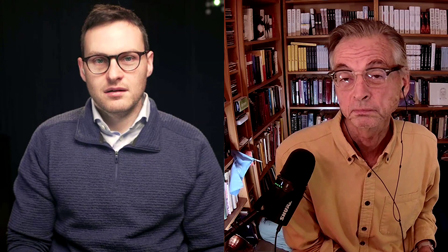
A New Kind of Science Saturday
Recorded: February 8  Posted: February 23
singlepixelcamera wrote on 02/23/2008 at 05:33 AM
Re: A New Kind of Science Saturday
OK I haven't watched it yet, but before I do I want to record and advertise the fact that I think Wolfram is kind of a jerk. You know, in case I'm hypnotized or won over or whatever. Recommended:
http://www.slate.com/id/2067547/
singlepixelcamera
JIM3CH wrote on 02/23/2008 at 05:39 AM
Where is D. Hofstadter when you need him?
No offence intended to Dr. Wolfram; Is there no hope of luring Douglas Hofstadter into the Blogginghead fold?
jwdeming wrote on 02/23/2008 at 05:48 AM
Re: A New Kind of Science Saturday
Far and away the best diavlog to date. SW is simply a singularly multi-faceted genius who's surprisingly personable. Not the reclusive nerd some had led me to believe he was. The man is not only a fascinating thinker but a leader. I understand why he's such a successful entrepreneur. He's relaxed, intense, articulate, and worldly wise. No one else on the planet is quite like this guy.
There was not one moment I did not find interesting. The last minutes where he mentions Plan C and something new and big to come soon from NKS were intriguing. SW knows how to leave you with a cliffhanger.
Johnson too does a nice job of staying out of SW's way. Which couldn't be hard because Wolfram likes to talk. For once, I didn't mind listening.
JIM3CH wrote on 02/23/2008 at 06:03 AM
Re: Where is D. Hofstadter when you need him?
Have a look at the demos link. Cool!
Nate wrote on 02/23/2008 at 06:26 AM
Universal Turing Machine
Universal Turing Machine, in case anyone was wondering:
http://en.wikipedia.org/wiki/Universal_Turing_machine
Christopher M wrote on 02/23/2008 at 10:40 AM
Re: Game of Life
Cosma Shalizi's review of Wolfram's book A New Kind of Science is here. Shalizi, who knows something about these kind of things, argues that "there is much here that is new and true, but what is true is not new, and what is new is not true." I'm certainly not competent to arbitrate the dispute, though it seems to me that Shalizi backs up his opinion.
Bloggin' Noggin wrote on 02/23/2008 at 12:19 PM
Re: A New Kind of Science Saturday
Very interesting diavlog -- one of the best of the Sci Sats.
Can I just say that Wolfram's talk about "computational irreducibility" -- if I understood it properly -- rang a bell with my own thought about the free will problem.
Determinism initially seems to threaten free will because you imagine that someone could predict what you will do before you do it.
Actually, the problem is not just that we are predictable -- most of us are quite able to predict each others actions most of the time, yet that doesn't threaten free will.
Why doesn't this worry us? Because the way we do it is to put ourselves in the other person's position and deliberate for them, trying to substitute our their desires and beliefs (and blind spots) for our own.
The real worry is that someone could bypass this intentional mirroring approach and still predict what we will do.
Sometimes we can do this with other people even without being Laplace's demon: maybe Fred thinks he chose to date Angela because of her ineffable personal qualities, but Fred's friends all predicted the attraction based on her blond
JIM3CH wrote on 02/23/2008 at 01:26 PM
Re: A New Kind of Science Saturday
Quoting Bloggin' Noggin: If we imagine Laplace's demon with the laws of the universe and a complete description of the universe at a time This assumption seems unrealistic to me. Nuclear decay is only predicable in terms of average tendencies (e.g., half-life). For example, the time of emission, energy level, and direction of a beta particle from a specific atom is completely unpredictable is it not? The universe is chalk full of such unpredictable events. This would seem to put a limit on how precise one could possibly be in specifying future states of the universe based upon any known state at time T. The universe is inherently random and chaotic.
Teed Rockwell wrote on 02/23/2008 at 01:51 PM
Re: A New Kind of Science Saturday
It is not surprising that a computer genius like Wolfram would be intrigued by the idea of a single line of Code controlling the entire universe. I've often considered that possibility when looking at Fractal patterns generated by such simple codes. But as seductive as that idea is, I believe it contains a fundamental confusion. A line of code by itself is incapable of generating anything. If Wolfram wrote such a code on a blackboard it wouldn't generate anything. That "simple" line only works within the context of vast complicated network of electronic circuitry called a computer. We design that network to be as stable as possible so we can create changes in it by writing only a single line of code. But a totally accurate description of the causal powers of that line would have to fully describe the entire workings of the computer.
It is very easy for us to think of a single object, whether a stick of dynamite or a line of computer code, as having "intrinsic causal powers". In fact, however, that is a pragmatic myth that enables us to create things
bjkeefe wrote on 02/23/2008 at 01:52 PM
Re: Game of Life
Christopher_M:
Whether or not one feels compelled to pick a winner between Wolfram and Shalizi, that was a really fun read. Thanks for the link.
Bloggin' Noggin wrote on 02/23/2008 at 02:01 PM
Re: A New Kind of Science Saturday
Even Laplace wouldn't have thought his demon was "realistic." And it's certainly true that the universe isn't actually deterministic -- at least not at every level. (Also relativity would deny any objective reality to the notion of "the universe at a time.")
To my question, it doesn't matter how "realistic" determinism is -- the issue is simply "what follows from determinism"? You may wonder why someone would worry about that, given that the universe isn't deterministic. I can think of two reasons: a) it seems quite possible that at the level of brain processes, the indeterminism of the quantum world averages out so that the chances of making an unpredictable decision are almost as low as my being able"jump" through the wall and
b) indeterminism doesn't seem to make free will any more intelligible (why should mere randomness make my decision any more free?)
Of course when you cite chaos, we are both to some degree talking about the same thing (chaotic systems are deterministic, but they evolve in this "history dependent" way.
My point is primarily that the worry about free will is connected to the thought, not that someone might
bjkeefe wrote on 02/23/2008 at 02:26 PM
Alternate link for George's review
The link on the video page does not work for me -- it just returns a blank page.
However, clicking the first link returned by this Google search does appear to return the desired result.
HTH.
Bobby G wrote on 02/23/2008 at 03:00 PM
Re: A New Kind of Science Saturday
I don't understand why, in such a deterministic world, we would still have free will. Okay, a being that knew all facts, such as Laplace's demon, wouldn't be able to predict our behavior without putting himself in our shoes first. Fine. (From what I can tell, this is just another way of putting Donald Davidson's anomalous monism--the theory that, while it is true that brain states are mental states, it is not the case that we can reduce our talk of mental states to our talk of brain states; in slogan form: ontological identity is not the same thing as explanatory identity.)
But I don't see how this renders determinism any less of a threat to free will. After all, it's still the case that your wanting to do something was caused by a mental event over which you had no control. If you think this isn't threatening to free will, let me ask you the question: imagine everything you did, you did because you wanted. But imagine that you--or that your friends, or whoever--learned that the only reason you wanted to do these things is that a scientist caused you to want to do
AemJeff wrote on 02/23/2008 at 03:15 PM
Re: A New Kind of Science Saturday
Quoting Teed Rockwell: It is not surprising that a computer genius like Wolfram would be intrigued by the idea of a single line of Code controlling the entire universe. I've often considered that possibility when looking at Fractal patterns generated by such simple codes. But as seductive as that idea is, I believe it contains a fundamental confusion. A line of code by itself is incapable of generating anything. If Wolfram wrote such a code on a blackboard it wouldn't generate anything. That "simple" line only works within the context of vast complicated network of electronic circuitry called a computer. We design that network to be as stable as possible so we can create changes in it by writing only a single line of code. But a totally accurate description of the causal powers of that line would have to fully describe the entire workings of the computer.
It is very easy for us to think of a single object, whether a stick of dynamite or a line of computer code, as having "intrinsic causal powers". In fact, however, that is a pragmatic myth that enables us to create things
Allan wrote on 02/23/2008 at 03:20 PM
Jerks
Single Pixel Camera:
My definition of a jerk
is someone who hasn't listened to the dialogue
but starts off the comment section
by insulting the guest.
singlepixelcamera wrote on 02/23/2008 at 04:04 PM
Re: Jerks
My definition is a little more flexible. So if for instance you are very arrogant, or if you pass off other people's ideas as your own, then this anonymous blog commenter might just think, and say, that you're a jerk.
For repetition's sake, the Ellenberg piece and the less polite Shalizi piece pointed out by C. M. might convince you that Wolfram is the bigger jerk.
But OK I'm up to like 200 words of axe-grinding. I'll cut it out, sorry.
spc
frontier_sally wrote on 02/23/2008 at 04:42 PM
Re: A New Kind of Science Saturday
"Answering all the obvious questions took about 10 1/2 years..."
That man is brilliant! Fascinating interview!
Corvid wrote on 02/24/2008 at 02:39 AM
Re: A New Kind of Science Saturday
George was very loud, while Stephen was quite quiet. I had to bias the stereo balance on my computer heavily to the right.
JIM3CH wrote on 02/24/2008 at 05:27 AM
Re: A New Kind of Science Saturday
Like you I am convinced that we all have free will. Unlike some, I am also convinced that we are eventually held accountable. I have never been bothered by determinism. I guess it was my training in thermodynamics. What you refer to as “mere randomness” makes all the difference in the world. Because without that randomness, systems become closed and tend toward equilibrium. It is the random component of nature that allows the existence of open systems that are in continuous non-equilibrium. It is this non-equilibrium aspect of nature that allows processes like life to exist , seemingly contrary to the second law of thermodynamics (i.e., increasing entropy is a property of all closed systems). Perhaps (I don’t know for sure, of course) it is also responsible for the existence of conscience intelligence, and what we refer to as free will. That is my view anyway.
trond wrote on 02/28/2008 at 11:04 AM
Re: A New Kind of Science Saturday
Enjoyed the feud over whether 1D or 2D best served as an intuitive example for CA.

|