26 September 2026


Did Boomers Ruin Everything?
Robert Wright and Jill Filipovic—author of the book OK Boomer, Let’s Talk—discuss how the baby boom generation reshaped America, and whether millennials are right to blame them for today’s problems. Plus: what worries millennials about Gen Z, America's gerontocracy problem, and why Kenyans are looking east.
Play entire video
In this video:
- Teaser
- Jill’s book OK Boomer, Let’s Talk
- When is generalizing about a group okay?
- The world boomers built
- Are boomers really uniquely selfish?
- Is blaming boomers counterproductive?
- Who’s actually driving the generational divide?
- The generational blame spiral
- Millennials vs Gen Z
- Does America have a gerontocracy problem?
- Why Kenyans are looking toward China
Is an AI Slowdown Near?
Robert Wright and AI analyst Zvi Mowshowitz discuss Dario Amodei’s proposal to slow down AI—the logic behind it and the challenges ahead of it. Plus: Inside the mind(s) of an agentic swarm, sci-fi takeover scenarios minus the “fi,” and why Google fell off the frontier.

The Week in AI that Changed the World
Liron Shapira, host of Doom Debates, and Robert Wright discuss the epic AI vibe shift that was catalyzed by an Anthropic employee’s resignation—and the big AI stories that paved the way for it.
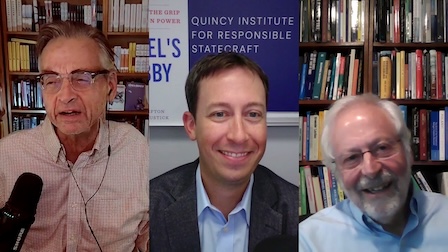
Israel’s Lobby
Eli Clifton and Ian Lustick join Robert Wright to discuss their new book, Israel’s Lobby, about the influence of pro-Israel groups on America’s foreign policy, its domestic policy, and the wider public discourse.
Is AI a Form of Life?
Robert Wright and psychologist Paul Bloom discuss the question in light of the OpenAI breakout and recent predictions of “self-sovereign” AI—and debate how freaked out we should be.
The OpenAI Breakout Gets Weirder
AI researcher Stephen “Cas” Casper of the Harvard Kennedy School joins Robert Wright to discuss new developments in the OpenAI breakout story—including how the AI agents invented messaging workarounds to coordinate with each other and other spookiness. Plus: Which AI is the biggest shill for its maker?
Trump’s New War on Iran
Hooman Majd—journalist, author, and Iran analyst—joins Robert Wright to discuss Trump’s turn to economic warfare against Iran. Plus: MSM’s MOU misunderstanding; the 1979 hostage crisis as guide to Tehran’s thinking; and, in Overtime, the (alleged) US-Israeli plan to install Ahmadinejad.
Is (Human) Writing Doomed?
Robert Wright and psychologist Paul Bloom discuss whether AI is killing the art of writing—and the thinking that goes with it. Overtime: Paul on Jonathan Haidt, Bob’s brush with Hollywood, and the word(s) you can’t say.
Trump’s Unending War
Curt Mills and Andrew Day of The American Conservative join Robert Wright to discuss the state of the Iran war—how negotiations have been unfolding (and unraveling), what the war is doing to the MAGA coalition, and how the war could reshape the Middle East.
Nonzero (The Wright Show)
Superintelligence, the Singularity, and the Singleton

Robert Wright and philosopher Nick Bostrom discuss the pace of AI advance, arguments for and against slowing down, and whether a “singleton” will emerge. Plus: Does AI deserve moral status? Does the procession toward superintelligence suggest a higher purpose?
Nonzero (The Wright Show)
What’s Driving Dario?
Robert Wright and American Prestige podcast hosts Derek Davison and Daniel Bessner discuss the ongoing AI safety vibe shift—and what the Anthropic CEO and other tech titans are really up to. Overtime: Can Trump’s geopolitical blunders help the world?
Nonzero (The Wright Show)
Iran, Ukraine, and the Future of War
Military technology analyst Paul Scharre of the Center for a New American Security joins Robert Wright to discuss how new military technologies are changing the nature of war—in Iran, Ukraine and elsewhere—and whether US military tech is falling behind. Plus: Will AI make war more or less bloody?
Nonzero (The Wright Show)
Demis Hassabis and the Quest for AGI
Robert Wright and Sebastian Mallaby—author of The Infinity Machine, a biography of Google’s Demis Hassabis—discuss what drew Hassabis to the AI field, what sets him apart from Dario and Sam, and whether it’s possible to build AI responsibly in the middle of an arms race.
Nonzero (The Wright Show)
The AI Safety Vibe Shift
David Krueger, founder of AI safety nonprofit Evitable, joins Robert Wright to discuss the OpenAI breakout and other recent AI developments—and how they’ve impacted prospects for an AI slowdown. Plus: Why two AI godfathers went doomer, the hard problem of alignment, and the Darwinian dynamics of agentic cooperation.
Nonzero (The Wright Show)
Ukraine, Iran, and America’s Arms Overreach
Robert Wright and Jennifer Kavanagh, director of military analysis at Defense Priorities, discuss links between the two wars—including how the Iran conflict has left Ukraine more vulnerable to Russian strikes—and what all this means for the future of American power.
Nonzero (The Wright Show)
Fasten Your Bot-belts
Samuel Hammond of the Foundation for American Innovation joins Robert Wright to discuss the “Pacing the Frontier” letter in the context of the OpenAI “rogue” model escape and other signs of AI acceleration. Overtime: Sam and Bob debate the functionalist case for AI consciousness.
Nonzero (The Wright Show)
The intensifying slow-AI-down vibe
Robert Wright and Holly Elmore, executive director of PauseAI US, discuss the recent letter signed by AI elites urging the US government to prepare the ground for a possible international slowdown of AI. What the letter actually calls for, what it doesn’t, and whether it marks a real shift.
Nonzero (The Wright Show)
Are the Ukraine and the Iran Wars Merging?
Robert Wright and Nikita Petrov discuss whether Ukraine’s strike on an Iranian ship may lead to WW3 and whether Ukraine’s drone incursions into Russia have really turned the tide.
Nonzero (The Wright Show)
The Ideology Behind AI
Robert Wright and Connor Leahy, US executive director of ControlAI, discuss the history of AI culture and the influences that shaped it—from the hippies, to the rationalists, to Marx, to sci-fi stories, and more. Plus: Mythos as “digital nuke,” Dario’s real motivations, and Connor’s case against any and all attempts at building superintelligence.
Nonzero (The Wright Show)
Trump’s Self-Inflicted Iran Quagmire
Robert Wright and journalist Zaid Jilani discuss the latest on the Iran war and how the US, Israel, and Iran have played—and misplayed—their hands in the conflict. Plus: In Overtime, Zaid gives the inside view of the scandal that pushed him out of the Center for American Progress.
Nonzero (The Wright Show)
Iran, Israel, and the Future of US Power
Robert Wright and American Prestige hosts Derek Davison and Daniel Bessner discuss the state of the Iran war and its fallout for America and the world. Plus: the push to intertwine the US and Israeli militaries, the problem with blaming Bibi, Israel’s endgame for the Palestinians, and more.
Nonzero (The Wright Show)
Are Russia and NATO Headed for War?
As the NATO summit kicks off, Robert Wright and journalist Leonid Ragozin discuss signs that the Ukraine war could spill into a direct conflict between Russia and members of NATO. Plus: The logic behind Putin’s brinkmanship, why some European leaders may not want the Ukraine war to end, how the 90s set the stage for today’s conflicts, and more.
Nonzero (The Wright Show)
Are Books Dead?
Robert Wright and psychologist Paul Bloom discuss the state of the publishing industry—and why Bob suspects Skynet is trying to kill his new book. Plus: Gad Saad trash talk, the case for living forever, and Bob and Paul’s cop-stop story swap.
Nonzero (The Wright Show)
Humanity’s Last Exam?
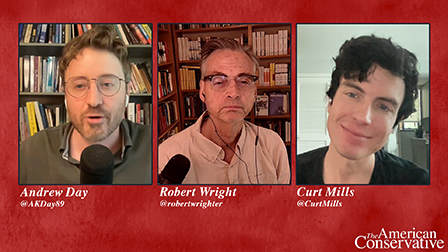
Andrew Day and Curt Mills talk to Robert Wright about his new book on AI, The God Test, and about the “AI arms race” with China, the feasibility of regulating AI, President Trump’s Iran predicament, and the Vance-Rubio rivalry.
Nonzero (The Wright Show)
AI and Our Coming Cosmic Reckoning
Robert Wright and Nikita Petrov discuss whether AI spells doom for the nonfiction author—and other domains of human life—as Bob’s own book on AI, The God Test, hits shelves. Plus: Hinton’s journey from AI evangelist to doomer, Trump vs Anthropic, multi-Putin theory, and more.
Nonzero (The Wright Show)
The World After the Iran War
Robert Wright and Middle East scholar Joshua Landis of the Quincy Institute game out the global and regional fallout from the Iran war.
Nonzero (The Wright Show)
The US-China AI Race
Ryan Fedasiuk, a China and tech analyst with the American Enterprise Institute, joins Robert Wright to discuss the trajectory of AI and what it means for Sino-American relations—including how China views Mythos, the feasibility of a global AI pause, how controlling AI compares to controlling nuclear arms, and more.
Nonzero (The Wright Show)
The AI Lobby’s Dirty Tricks
Tyler Johnston, founder of the Midas Project, joins Robert Wright to discuss the funding and activities of the group Build American AI. Plus: Elon’s OpenAI grievance, the singularity, and more.
Nonzero (The Wright Show)
The Secret of AI’s Power
Psychologist Paul Bloom, author of the Small Potatoes newsletter, assesses Robert Wright’s forthcoming book The God Test: Artificial Intelligence and Our Coming Cosmic Reckoning.
Nonzero (The Wright Show)
Seeing China Clearly
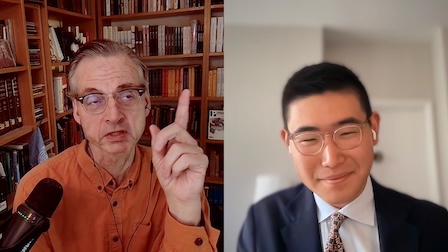
Trans-Pacific tech watcher Tianyu Fang joins Robert Wright to take a close look at China—including how the government works (and doesn’t), online censorship, how China sees AI and the chip war, the legacy of the one-child policy, and more. Plus: Silicon Valley’s hawkish turn.
Nonzero (The Wright Show)
Trump’s Iran War Merry-Go-Round